
Different Sex Drives in a Relationship: The Complete Guide to Desire Differences
Different Levels of Sexual Desire Are Normal
If you and your partner want sex at different times or with different frequency, you are not alone. Desire differences are one of the most common concerns couples experience. They can happen at the beginning of a relationship, after many years together, or during major life changes.
A desire difference happens when partners don’t want sexual connection at the same time, as often, or in the same way. One person may think about sex often, while the other rarely thinks about sex. One partner may feel desire suddenly, while the other needs time, relaxation, affection, or pleasurable touch before desire begins. Partners may also want different sexual activities or prefer different ways of initiating intimacy.
There is no correct amount of sex to want. Wanting sex more often doesn’t make someone demanding or overly sexual. Wanting sex less often doesn’t mean someone is broken, withholding affection, or failing their partner. A person also does not have to increase their desire simply because their partner wants more sex.
Desire differences usually become painful when couples get caught in a cycle of pressure and rejection. One partner may initiate sex because they want closeness or reassurance. The other may feel pressured and begin avoiding sex or physical affection. The first partner then feels rejected and may try even harder to create sexual connection. Over time, both people can feel lonely, misunderstood, or unwanted.
The goal is not to decide which partner has the “right” libido. It is also not to make the lower-desire partner want more sex or ask the higher-desire partner to pretend sex doesn’t matter. The goal is to understand both partners, reduce pressure, protect consent, and discover whether the couple can create a sexual relationship that feels safe and satisfying for both people.
Desire differences do not automatically mean that a relationship is unhealthy or sexually incompatible. With honest communication and the right support, many couples can build intimacy without relying on pressure, obligation, or a required amount of sex.
Table of Contents
What Are Desire Differences?
Is “Mismatched Libido” the Right Term?
How Common Are Different Sex Drives?
There Is No “Normal” Amount of Sex
Spontaneous Desire and Responsive Desire
Why Do Couples Develop Desire Differences?
When Low Desire Is Not a Problem
When a Change in Desire May Need Medical Attention
The Desire-Pressure Cycle
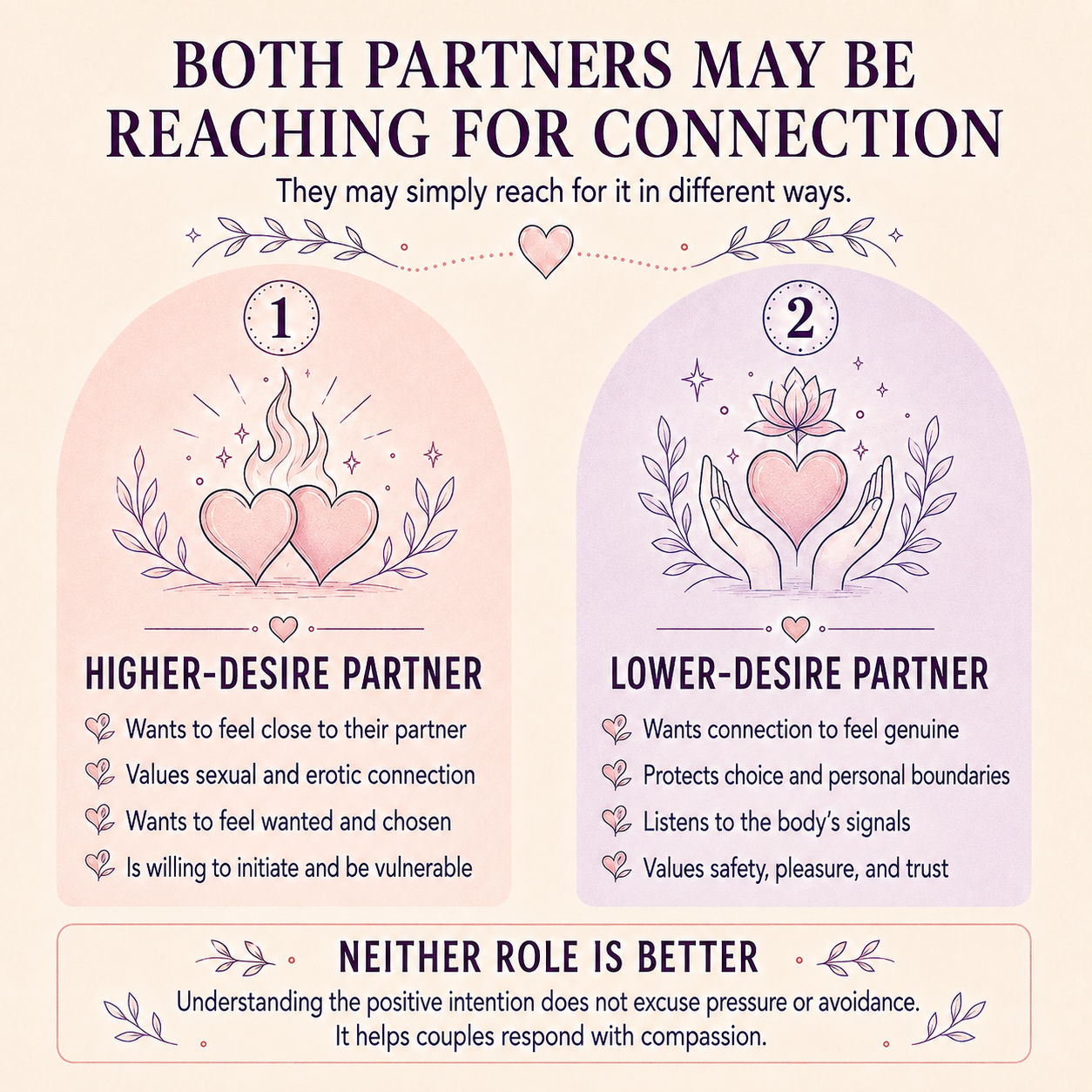
Understanding the Higher-Desire Partner
Understanding the Lower-Desire Partner
Why Scheduling Sex Does Not Always Work
Consent When Partners Have Different Levels of Desire
Duty Sex and the Cost of Pushing Through
How to Talk About Different Sex Drives
How Couples Can Navigate Desire Differences
What Healthy Compromise Should—and Should Not—Mean
Can a Relationship Work With Different Sex Drives?
When Are Desire Differences a Sign of Sexual Incompatibility?
Can Sex Therapy Help With Desire Differences?
When Individual Therapy May Be Helpful
When Couples Therapy May Not Be Enough
Frequently Asked Questions About Desire Differences
Getting Help for Desire Differences in Scottsdale, Arizona
What Are Desire Differences?
Desire differences happen when two partners don’t want sexual connection with the same frequency, at the same time, or in the same way. Also known as desire discrepancies or mismatched sex drives.
A desire difference doesn’t always mean that one person has high desire and the other has low desire. Two people may want sex equally often, but rarely want it at the same time. One partner may prefer sex in the morning, while the other feels more interested at night. One may want sexual connection after a stressful day, while the other needs to feel relaxed before becoming interested.
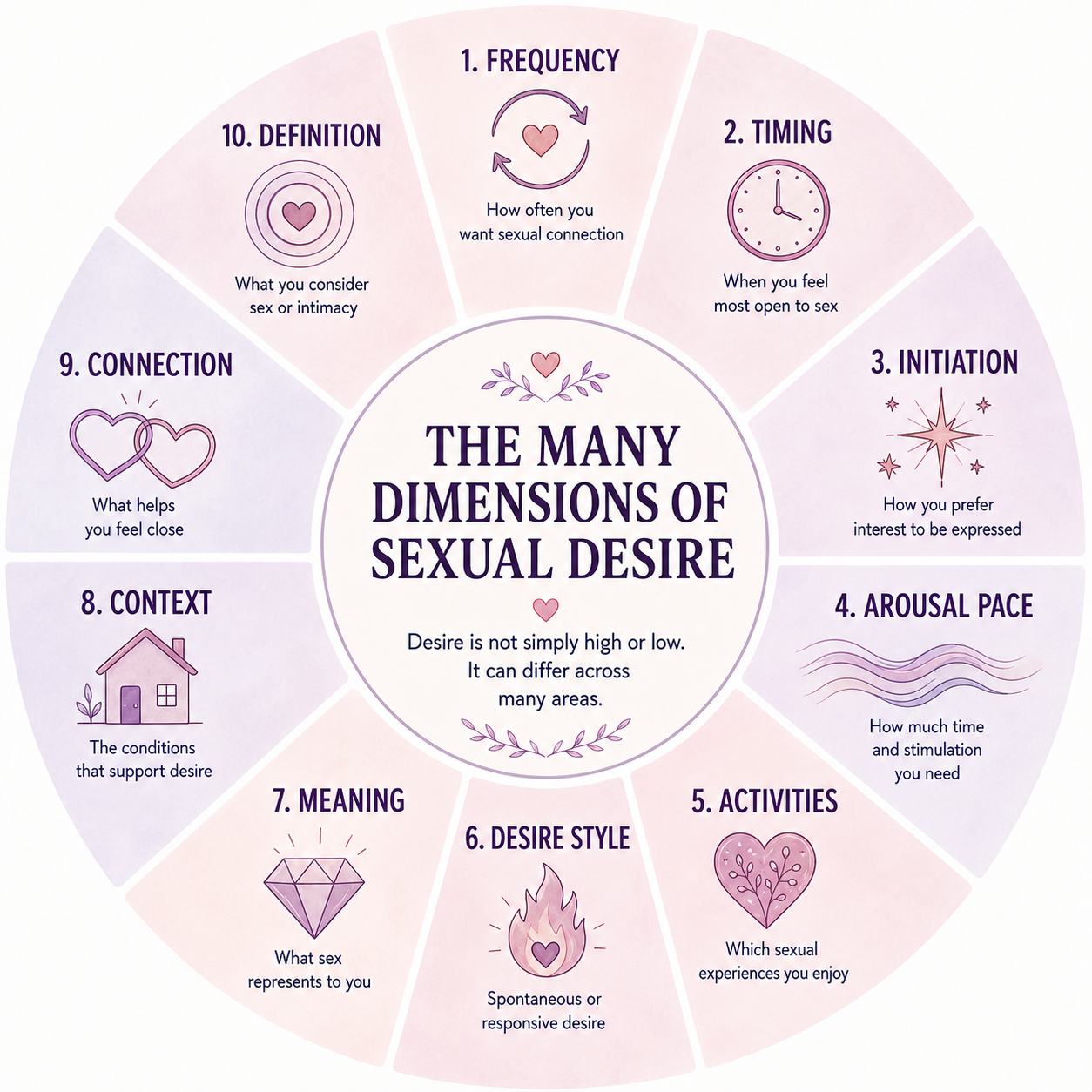
Partners can experience differences in:
How often they want sex
When they feel interested in sex
How they prefer sex to be initiated
How much time they need to become aroused
Which sexual activities they enjoy
How often they think about sex
Whether they experience spontaneous or responsive desire
How important sex feels in the relationship
What helps them feel emotionally and physically connected
How they define sex and intimacy
Desire can also change depending on the situation. Someone may have little interest in their current sexual routine but feel desire when thinking about a fantasy, using a vibrator, masturbating, or exploring something new. A person may experience desire when they feel rested and connected but have little interest when they feel stressed, pressured, resentful, or exhausted.
This is why it is not always helpful to label one person as the “low-desire partner.” The person may not have low desire in every situation. Their level of interest may be affected by the relationship, the type of sex being offered, physical discomfort, stress, medication, past experiences, or whether they feel free to say no.
The presence of a desire difference does not mean that either partner has a disorder. It becomes a relationship concern when the difference causes distress, conflict, pressure, avoidance, resentment, or loneliness. Understanding the pattern is often more useful than trying to decide which partner needs to change.
Is “Mismatched Libido” the Right Term?
People often use the phrase mismatched libidos to describe partners who want sex at different times or with different frequency. It is a common search term, but it can give couples the wrong idea about what is happening.
The word “mismatched” can make a couple sound broken or sexually incompatible. It can also suggest that two people should naturally want the same amount of sex. In reality, it is normal for partners to have different levels and styles of desire. These differences may change throughout the relationship.
The term desire difference is often more helpful because it does not label either partner as the problem. It simply describes the space between what each person wants.
Labels such as “the high-libido partner” and “the low-libido partner” can also be misleading. Desire is not always a fixed personality trait. A person who wants less sex in one relationship might want more in another. Someone’s desire may also change depending on stress, health, hormones, relationship safety, sexual satisfaction, or the kind of sex being offered.
For example, someone may have little interest in intercourse but enjoy making out, mutual masturbation, erotic touch, or using a vibrator. Another person may rarely experience spontaneous desire but become interested after affectionate or pleasurable touch begins. Neither person necessarily has a low libido. Their desire may work differently or respond to different conditions.
The phrase “lower-desire partner” can be useful when describing the person who currently wants sex less often within a specific relationship. However, it should not be treated as a diagnosis or permanent identity. The same is true for the “higher-desire partner.”
Throughout this guide, we will use the term desire differences because it is more accurate and less blaming. The question is not, “Which partner has the wrong libido?” A more helpful question is, “What affects desire for each of us, and how can we handle our differences with honesty, care, and respect?”
How Common Are Different Sex Drives?
Different sex drives are very common. In fact, desire differences are considered one of the most common sexual concerns couples experience and one of the main reasons couples seek sex therapy.
It is difficult to give one exact percentage because researchers define and measure desire differences in different ways. Some studies measure how often each partner wants sex. Others look at how much distress the difference causes. Nearly every couple will want sex at different times occasionally, but not every difference becomes a relationship problem.
Desire also changes throughout life. A couple may feel sexually in sync during one season and very different during another. Stress, parenting, sleep, health conditions, medications, hormonal changes, relationship conflict, and changes in sexual pleasure can all affect desire. The partner who wants more sex may also change over time.
Research describes sexual desire discrepancy as a common challenge that couples must navigate together—not proof that one partner has a sexual problem. The size of the difference may matter less than how the couple responds to it. Pressure, criticism, guilt, and avoidance can make the difference feel larger. Curiosity, communication, and respect for each person’s boundaries can make it easier to manage.
Having different sex drives does not mean your relationship is unhealthy or destined to fail. It means you and your partner are two different people whose sexual needs, bodies, and experiences will not always line up perfectly. Research on sexual desire discrepancy supports treating it as a shared relationship concern rather than blaming the partner who wants more or less sex.

There Is No “Normal” Amount of Sex
There is no universal number of times a couple should have sex. Some couples want sexual connection several times a week. Others prefer it a few times a month, a few times a year, or not at all. A healthy sex life isn’t defined by meeting a certain number.
You may see articles claiming that happy couples have sex once a week or that couples “should” have sex a specific number of times each month. These averages can’t tell you what is right for your relationship. An average describes what some people reported doing. It does not create a rule that every couple needs to follow.
Having more sex does not automatically make a relationship healthier. A couple can have frequent sex and still feel pressured, disconnected, or unsatisfied. Another couple may have sex rarely and feel loving, secure, and happy with their relationship.
The more helpful questions are:
Does our sexual relationship feel consensual?
Do both of us feel safe saying yes or no?
Are the sexual experiences we share enjoyable?
Can we talk honestly about what we want?
Do we feel emotionally and physically respected?
Are both of us comfortable with the amount of sexual connection we have?
The frequency becomes a concern when one or both partners feel distressed, lonely, pressured, rejected, or unable to discuss the difference. Even then, the answer is not to choose a number and require both people to meet it. A sexual schedule or frequency goal cannot solve pain, resentment, exhaustion, relationship conflict, or sex that is not pleasurable.
No one owes a partner sex because of how long it has been or because other couples appear to have sex more often. At the same time, it is okay for sexual connection to feel important to someone. Both partners’ feelings deserve space, but neither person’s preferred frequency should automatically become the rule.
The goal is not to have a “normal” amount of sex. The goal is to create a relationship in which both people can be honest about desire, protect their boundaries, and explore intimacy without pressure or shame.
Spontaneous Desire and Responsive Desire
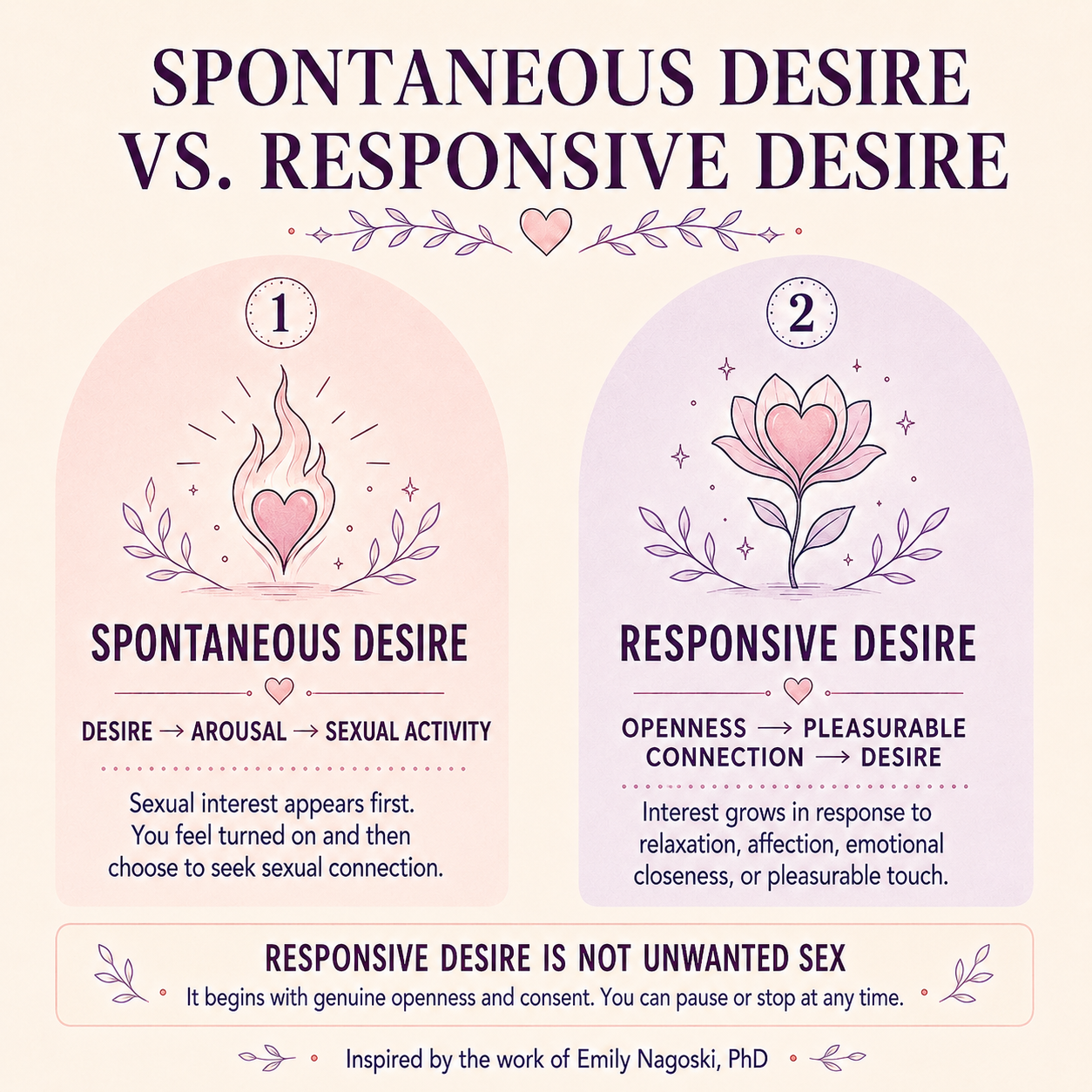
People do not all experience sexual desire in the same way. Some people feel interested in sex before sexual activity begins. Others become interested only after something pleasurable, relaxing, or connecting has already started. These patterns are often called spontaneous desire and responsive desire.
What Is Spontaneous Desire?
Spontaneous desire seems to appear on its own. A person may think about sex, feel turned on, and then decide to initiate sexual activity.
It may sound like:
“I feel horny.”
“I have been thinking about sex all day.”
“I want to have sex tonight.”
“I saw my partner and suddenly wanted them.”
Spontaneous desire is the type most often shown in movies and television. Two people look at each other, instantly feel desire, and cannot keep their hands off one another. Because this is the story we see most often, people may assume that “real” desire should always begin this way.
What Is Responsive Desire?
Responsive desire develops in response to something. A person may not begin with a strong desire for sex, but interest can grow after they feel relaxed, emotionally connected, physically aroused, or pleasantly touched.
It may sound like:
“I was not thinking about sex, but now I am interested.”
“I need time to shift out of work or parenting mode.”
“Desire often shows up after we start kissing.”
“I usually need closeness before I feel sexual.”
“I may be open to connection even when I am not already turned on.”
Someone with responsive desire may need the right conditions before sexual interest appears. These conditions might include privacy, emotional safety, enough time, low stress, affection, pleasurable touch, or confidence that they can stop at any point.
Responsive desire is still real desire. It is not weaker, less passionate, or less valid than spontaneous desire.
Responsive Desire Is Not the Same as Unwanted Sex
Responsive desire should never be used to pressure someone into sexual activity. It does not mean a person should push through discomfort or agree to sex they do not want in the hope that desire will eventually appear.
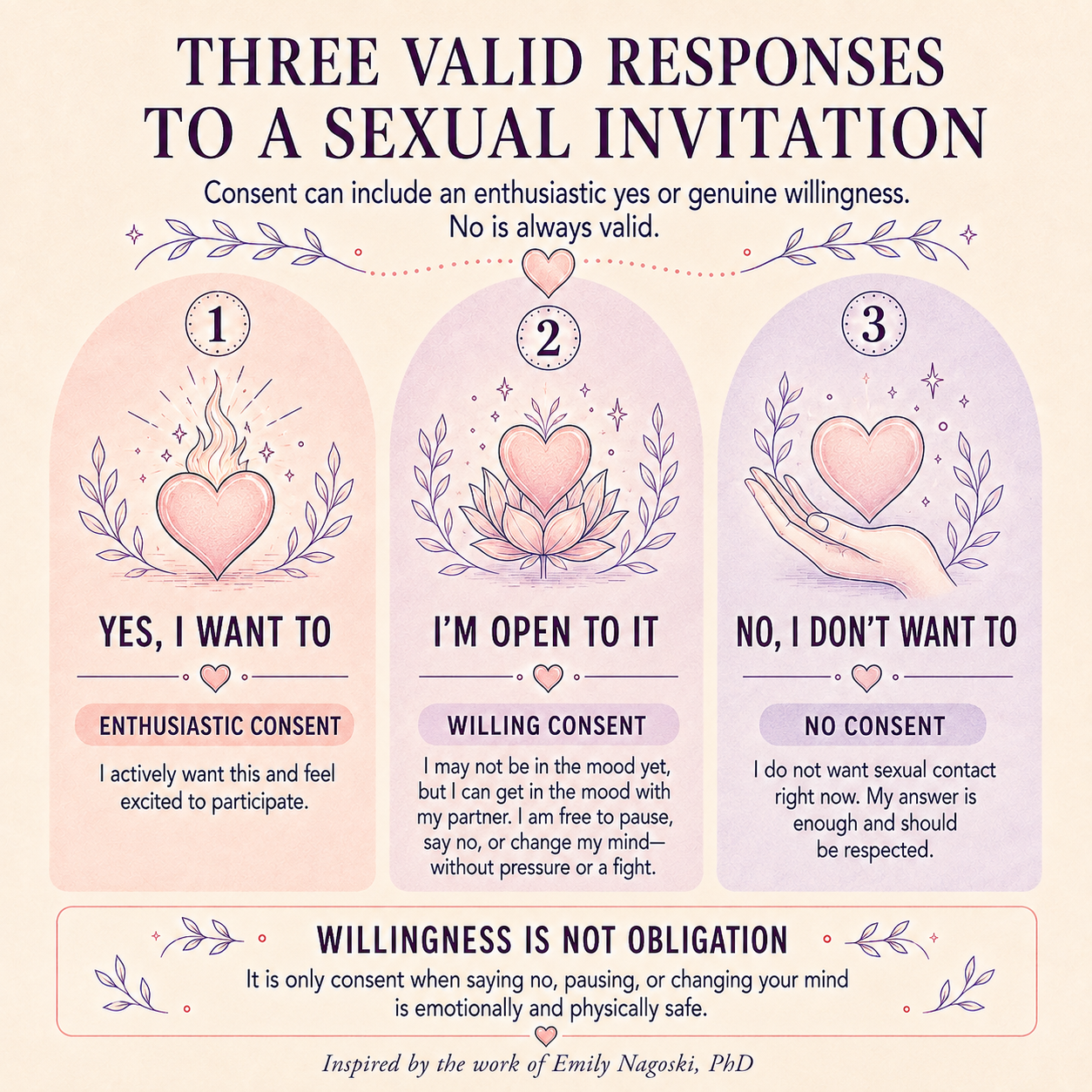
A person might be:
Interested: “Yes, I want this.”
Open or willing: “I am not feeling desire yet, but I would enjoy exploring and seeing what develops.”
Uninterested: “I do not want sexual contact right now.”
Uncomfortable or pressured: “I feel like I cannot say no.”
Only the first two create space to explore responsive desire—and both still require consent. Someone who begins from a place of openness can change their mind at any time. If desire does not develop, there should be no pressure to continue.
Partners May Experience Desire Differently
One partner may experience mostly spontaneous desire, while the other experiences mostly responsive desire. This difference can easily create misunderstanding.
The spontaneous-desire partner may think:
“If my partner wanted me, they would initiate or feel excited before we start.”
The responsive-desire partner may think:
“I never have enough time or space for desire to develop before my partner decides I am rejecting them.”
Neither partner is necessarily doing anything wrong. Their desire may simply begin in different places. Understanding this difference can help couples stop treating responsive desire as a lack of attraction and stop expecting both partners to become interested in exactly the same way.
Most people can experience both spontaneous and responsive desire. The pattern may change with stress, age, hormones, health, medication, parenthood, relationship changes, or the quality of the sexual experiences being offered.
The goal is not to decide which kind of desire is better. The goal is to understand how desire works for each partner and create conditions where sexual interest has room to develop—without pressure, obligation, or shame.
Why Do Couples Develop Desire Differences?
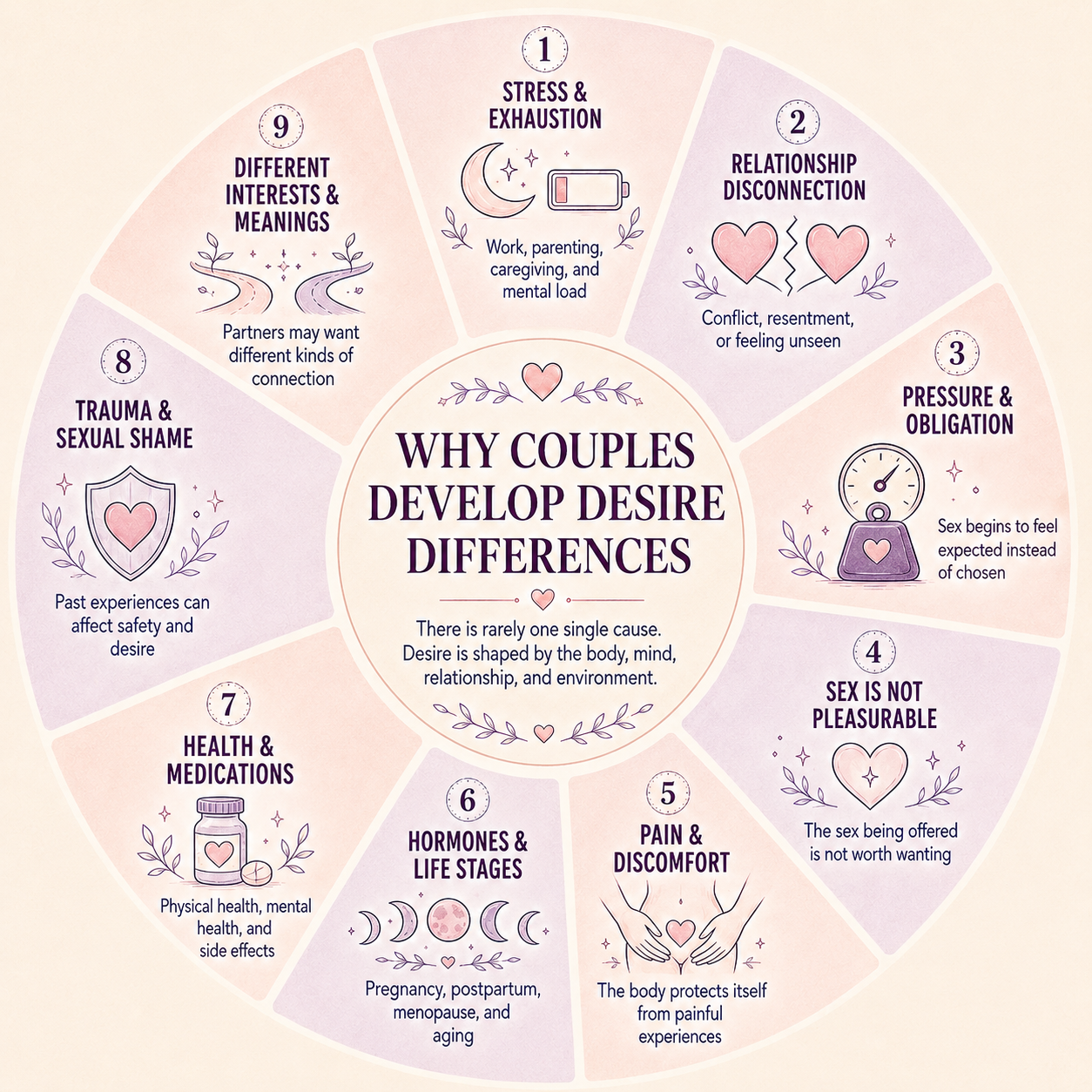
Couples develop desire differences for many reasons. Sexual desire is affected by the body, mind, relationship, environment, and quality of the sexual experiences being offered. It is rarely as simple as one person having a naturally “high” libido and the other having a “low” one.
Desire differences can also change over time. The partner who wants sex more often today may be the partner who wants it less often during another season of life.
Stress, Exhaustion, and the Mental Load
Desire often has trouble appearing when the brain and body are overwhelmed. Work, parenting, caregiving, financial concerns, and household responsibilities can leave little energy for sexual connection.
A person may have difficulty shifting from completing tasks or caring for others into feeling playful, present, and connected to their body. This does not necessarily mean they have lost attraction to their partner. Their nervous system may simply have too much to manage.
Desire may be affected by:
Work stress
Lack of sleep
Parenting and caregiving
Financial concerns
An unequal division of household labor
Feeling responsible for remembering and managing everything
A lack of time or privacy
Feeling emotionally or physically exhausted
Relationship Disconnection
For many people, emotional safety and closeness help create space for sexual desire. Unresolved conflict, resentment, broken trust, or feeling unappreciated can make it difficult to feel sexually open.
Relationship factors may include:
Ongoing arguments
Feeling emotionally disconnected
Unresolved hurt or resentment
A lack of affection outside sexual situations
Feeling unseen or taken for granted
Unequal responsibilities
Poor communication
Trust concerns
Not feeling safe expressing sexual needs or boundaries
This does not mean couples must have a perfect relationship before they can enjoy sex. However, it can be hard to access desire when the relationship feels tense or emotionally unsafe.
Pressure and Obligation
Pressure is one of the biggest barriers to desire. When someone feels responsible for providing sex, keeping a partner happy, or preventing conflict, sex can begin to feel like another task.
Pressure may be direct, such as repeatedly asking after someone has said no. It can also be indirect, such as sulking, withdrawing affection, becoming angry, or making the other person feel guilty.
Over time, the lower-desire partner may begin avoiding kissing, cuddling, or going to bed at the same time because they worry that every form of affection will lead to a request for sex. The higher-desire partner may then feel even more rejected and increase their attempts to initiate. This can create a painful cycle in which both people feel disconnected.
Desire usually grows through freedom and choice—not obligation.
Sex Is Not Pleasurable or Satisfying
Sometimes a person does not want more sex because the sex being offered is not enjoyable for them. This is often overlooked when couples talk about “low libido.”
Desire may decrease when:
Sex feels routine or predictable
There is not enough time to become aroused
Penetration is treated as the main event
One partner’s pleasure receives more attention
A person rarely experiences orgasm
The sexual activities being offered are not activities they enjoy
There is pressure to reach orgasm
A person does not feel able to ask for what they want
Sexual encounters continue after someone becomes uncomfortable
Instead of asking only, “Why don’t you want sex?” couples may need to ask, “What kind of sexual experience would you actually want?”
Sexual Pain or Physical Discomfort
It makes sense for the body to avoid an activity that causes pain. Pain during or after sex can quickly reduce desire and create fear about future sexual experiences.
Possible concerns include:
Vaginal or vulvar pain
Pelvic floor tension
Vaginal dryness
Endometriosis
Pain with erections or ejaculation
Pain following childbirth
Changes after surgery or cancer treatment
Genitourinary syndrome of menopause
Pain connected to certain positions or activities
Sexual pain should not be treated as something a person needs to tolerate for the sake of their relationship. Recurring pain deserves medical evaluation, and treatment may also involve pelvic floor physical therapy or sex therapy.
Hormonal and Reproductive Changes
Hormonal changes can affect desire, arousal, lubrication, erections, sensation, and comfort. They may occur during:
Pregnancy
Postpartum recovery
Breastfeeding
The menstrual cycle
Perimenopause and menopause
Fertility treatment
Gender-affirming hormone therapy
Recovery from illness or surgery
Hormones are only one part of desire. For example, a new parent may also be dealing with exhaustion, body changes, limited privacy, and feeling constantly touched by others. Several factors may be affecting desire at the same time.
Physical and Mental Health
Physical and emotional well-being can change how much energy or interest a person has for sex. Desire may be affected by:
Depression
Anxiety
Chronic stress
Chronic pain
Fatigue
Diabetes
Heart or blood-pressure conditions
Neurological conditions
Cancer and cancer treatment
Body-image concerns
Sleep problems
Substance use
Changes in mobility or physical ability
A health condition does not always remove sexual desire. However, it may change how desire appears or which kinds of sexual connection feel possible.
Medications
Some medications can affect sexual desire, arousal, lubrication, erections, sensation, or orgasm. These may include certain medications used for depression, anxiety, blood pressure, allergies, pain, or cancer treatment.
A change in sexual functioning does not mean someone should stop taking a prescribed medication. A medical provider can help determine whether the medication may be contributing and discuss safe options. Medical guidance recognizes that desire is influenced by a combination of physical health, emotional well-being, medication, personal experiences, beliefs, and relationship factors.
Sexual Trauma and Negative Sexual Experiences
Past sexual trauma can affect desire, but it does not affect every survivor in the same way. Some survivors experience less desire, while others experience more desire or no lasting change.
Desire may be affected by:
Fear of losing control
Difficulty feeling safe during touch
Dissociation or numbness
Body memories or trauma triggers
Shame
Difficulty identifying or expressing boundaries
Previous sexual pressure or coercion
Painful medical or sexual experiences
A person does not need to have a history of trauma for their body to develop a protective response. Repeatedly having painful, unwanted, or obligation-based sex can also teach the nervous system to expect discomfort or pressure.
Religious Messages, Purity Culture, and Sexual Shame
Messages learned about sex can continue to affect desire long after a person’s beliefs have changed.
A person may have learned that:
Sexual desire is sinful or dangerous
Pleasure is selfish
Masturbation is wrong
Certain bodies or sexual interests are shameful
One partner is responsible for meeting the other’s sexual needs
“Good” partners should always be sexually available
Sex should happen naturally without communication
These beliefs can make it difficult to recognize personal desire, ask for pleasure, set boundaries, or remain present during sex.
Different Sexual Interests
Sometimes partners want sex at different rates because they are not interested in the same kind of sex. They may have different preferences related to:
Sexual activities
Pornography
Toys
Monogamy or nonmonogamy
Initiation
Novelty
Emotional connection
Time of day
Length or pace of sexual encounters
A person may appear to have low desire when they actually have low interest in the sexual options currently available. This does not guarantee that every difference can be resolved, but it changes the conversation from “Who is broken?” to “What does each person genuinely enjoy?”
Differences in What Sex Means
Partners may also give sex different meanings. One person may experience sex as the main way they feel loved, desired, or reassured. The other may view sex as one of many possible forms of closeness.
For one person, initiating sex may mean:
“I want to feel close to you.”
For the other, that same initiation may feel like:
“You expect something from me.”
Neither interpretation is automatically wrong. However, these different meanings can create conflict if the couple never talks about them.
Life Stages and Changing Relationships
Desire naturally changes as people and relationships change. A couple’s sexual connection may shift during:
The beginning or end of a relationship
Moving in together
Marriage
Pregnancy or infertility
Raising children
Career changes
Illness or disability
Grief
Menopause
Aging
Retirement
Relationship conflict or repair
A desire difference does not always have one clear cause. It often develops through several physical, emotional, relational, and cultural factors working together.
The most helpful question is usually not, “Which one of us has the wrong libido?” It is:
“What is supporting desire for each of us, what is getting in the way, and what kind of sexual connection would feel safe, pleasurable, and worth wanting?”
When Low Desire Is Not a Problem
Low libido is not automatically a sexual problem. Some people rarely think about sex, want it infrequently, or have no interest in sexual activity at all—and feel completely comfortable that way.
There is no minimum amount of desire a person must experience to be healthy. Low desire may not need treatment when:
The person is not personally distressed by it
They do not want to increase their desire
Their current level of interest feels natural to them
They enjoy intimacy but do not want it very often
They are satisfied with nonsexual forms of connection
They identify as asexual or somewhere on the asexual spectrum
The concern mainly comes from a partner’s expectations or messages about what is “normal”
A person does not have to want sex. They also do not have to want to want sex. Someone may understand that their partner would prefer more sexual connection without wanting to change their own level of desire.
Personal Distress and Relationship Distress Are Different
It can be helpful to separate personal distress from relationship distress.
Personal distress means someone is unhappy or concerned about their own level of desire. They may miss feeling sexual, notice a sudden change, or want to understand why interest has decreased.
Relationship distress means the difference between partners is creating conflict, pressure, resentment, rejection, or loneliness. The lower-desire partner may feel fine with their level of interest but distressed by how the couple handles the difference.
A person should not be treated as if they have a sexual disorder simply because their partner wants more sex. Clinical guidance recognizes that low desire varies from person to person and becomes a possible disorder when it causes significant personal distress—not merely because it falls below a partner’s preferred frequency. Mayo Clinic
Low Desire May Be Providing Important Information
Sometimes low libido is not the problem. It is the body’s response to another problem.
A person may have little interest in sex because:
They are exhausted or overwhelmed
The sex they are having is not pleasurable
They feel pressured or obligated
They do not feel emotionally safe
Their boundaries are not respected
They are carrying unresolved resentment
Affection always seems to lead to a sexual request
They do not enjoy the sexual activities being offered
Their body is responding to stress, illness, medication, or hormonal changes
In these situations, trying to increase desire without addressing the reason it decreased may create more pressure. The better question may not be, “How do we make this person want more sex?” It may be, “What is their lack of desire telling us?”
Asexuality Is Not a Disorder
Some people identify as asexual, meaning they experience little or no sexual attraction. Asexuality is a valid sexual orientation—not an illness or something that needs to be cured.
Asexuality does not always mean having no libido. Many asexual people experience physical arousal, masturbate, or feel a general desire for sexual release. However, that desire may not be directed toward a particular person or gender. Libido and sexual attraction are related, but they are not the same thing.
Asexuality also exists on a spectrum. This may include people who experience sexual attraction rarely, only under certain conditions, or only after developing a strong emotional connection.
Asexual people can have very different feelings about sexual activity. Some are sex-averse or do not want to participate in sex. Others feel neutral about sex, enjoy it, or choose to have sex for pleasure, curiosity, connection, or closeness with a partner. No one experience represents every asexual person.
Asexual people may also want romantic relationships, affection, sensual touch, emotional intimacy, or committed partnership. Others may not. Romantic attraction and sexual attraction are separate experiences, so an asexual person may be romantically attracted to one or more genders while experiencing little or no sexual attraction.
Therapy should never be used to make an asexual person experience sexual attraction. It may be helpful when someone wants support understanding their identity, communicating with a partner, setting boundaries, or navigating a relationship in which partners want different things.
When Someone May Want Support
A person may choose to seek help if:
Their desire changed suddenly
They miss the level of interest they used to experience
Low desire causes them personal distress
They experience pain, difficulty with arousal, or changes in orgasm
They suspect a medication or health condition may be contributing
They want to explore shame, trauma, or relationship concerns
They and their partner cannot discuss the difference without conflict
They want help deciding what a satisfying relationship could look like
Seeking help should be based on the person’s goals—not on forcing them to meet someone else’s preferred frequency.
The goal of sex therapy is not always to increase libido. Sometimes the goal is to reduce shame, understand what the body is communicating, protect consent, and help partners make informed decisions about their relationship. All levels of desire are valid, including little or no desire at all.
When a Change in Desire May Need Medical Attention
Sexual desire naturally changes throughout life. A temporary decrease during a stressful, exhausting, or emotionally difficult season does not always mean something is medically wrong.
However, it may be helpful to speak with a medical provider when your level of desire changes suddenly, lasts for a long time, causes you personal distress, or appears alongside other physical or emotional symptoms.
Consider seeking a medical evaluation if:
Your desire changed suddenly without a clear reason
You miss the level of desire you used to experience
The change is causing you personal distress
Your desire changed after starting or changing a medication
You experience pain during or after sexual activity
You notice changes in erections, lubrication, sensation, or orgasm
You have unusual bleeding, discharge, irritation, or genital discomfort
You feel unusually tired or notice other changes in your energy
Your desire changed during pregnancy, postpartum recovery, breastfeeding, perimenopause, or menopause
Your sexual functioning changed after surgery, cancer treatment, or another medical procedure
You are experiencing symptoms of depression, anxiety, or another mental health condition
You suspect that alcohol or another substance may be affecting your sexual functioning
Health Conditions Can Affect Desire
Sexual desire is connected to overall health. Changes may sometimes be related to:
Hormonal changes
Chronic pain
Diabetes
Thyroid conditions
Heart or blood-pressure concerns
Neurological conditions
Sleep problems
Depression or anxiety
Cancer and cancer treatment
Recovery from illness or surgery
Changes in mobility or physical ability
A change in desire does not prove that you have one of these conditions. A medical provider can help determine whether further evaluation is needed.
Medications Can Affect Sexual Functioning
Some medications may affect desire, arousal, lubrication, erections, sensation, or orgasm. These can include certain medications used for depression, anxiety, blood pressure, allergies, pain, seizures, or cancer treatment.
Do not stop or change a prescribed medication on your own. A healthcare professional can help you consider whether the medication may be contributing and discuss safe options. Depending on the situation, those options might include changing the dose, changing the timing, trying another medication, or treating the sexual side effect directly.
What Might a Medical Provider Ask?
A provider may ask:
When did the change begin?
Was the change sudden or gradual?
Is your desire lower in every situation or only with a partner?
Do you still experience sexual thoughts, arousal, or interest in masturbation?
Are you experiencing pain or other changes in sexual functioning?
Have you started any new medications?
Have there been changes in your mood, sleep, stress, or health?
Are you pregnant, postpartum, breastfeeding, or experiencing menopause-related changes?
Are you personally distressed, or is the concern mainly coming from your partner?
Depending on your symptoms, the provider may review your medications, discuss your mental and physical health, perform an examination, order testing, or refer you to a specialist.
Who Can Help?
You might begin with:
A primary care provider
An OB-GYN or other reproductive-health provider
A urologist
A pelvic floor physical therapist
A sexual-medicine specialist
A psychiatrist or medication prescriber
A qualified sex therapist
Medical care and sex therapy serve different roles. A medical provider can evaluate physical conditions, hormonal changes, or medication side effects. A sex therapist can help with pressure, shame, trauma, communication, relationship patterns, and changes in sexual identity or confidence. Some people benefit from both.
Medical guidance recognizes that desire can be influenced by physical health, emotional well-being, medications, life changes, beliefs, experiences, and the current relationship.
Seeking medical support does not mean your desire is abnormal or that you must increase it. The purpose is to give you information, identify concerns that may be treatable, and help you make choices based on your own goals.
The Desire-Pressure Cycle
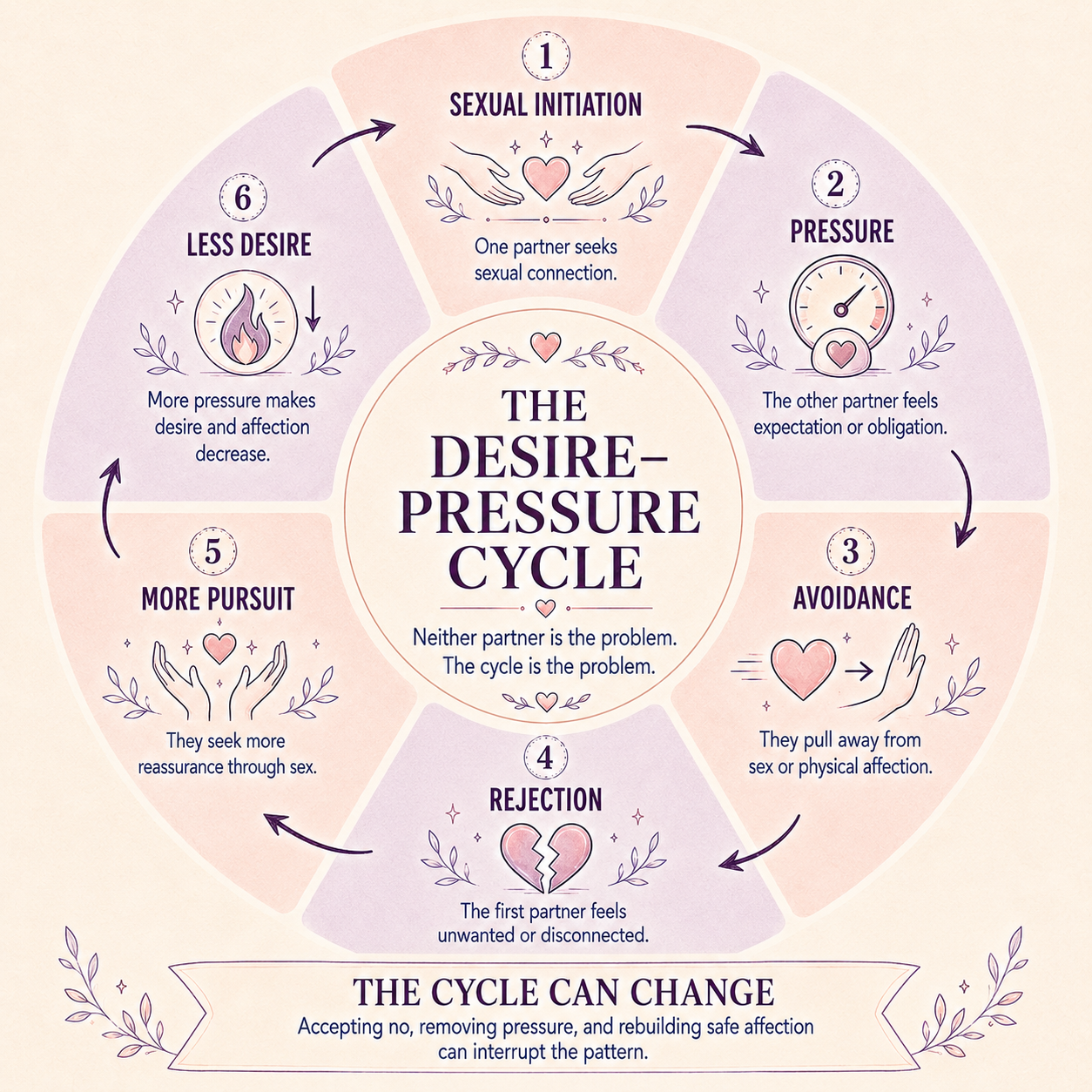
Desire differences often become more painful when couples get caught in a cycle of initiation, pressure, avoidance, and rejection. This is called the desire-pressurecycle.
The cycle may begin when one partner wants sexual connection and initiates. If the other partner is not interested, the first partner may feel rejected, lonely, or unwanted. They may begin initiating more often, asking for explanations, or trying harder to create a sexual response.
The lower-desire partner may then feel watched, pressured, or responsible for the other person’s feelings. Sex can begin to feel like an expectation instead of a choice. As pressure increases, desire often decreases.
The cycle may look like this:
One partner seeks sexual connection.
The other partner feels pressure or expectation.
They avoid sex, initiation, or physical affection.
The first partner feels rejected or unwanted.
They seek more reassurance through sex.
The other partner feels even more pressure.
Desire and affection decrease further.
Both partners may be reacting to a fear of disconnection. One moves closer by pursuing sexual contact, while the other creates distance to protect their boundaries. Each person’s response accidentally strengthens the other person’s fear.
What Pressure Can Look Like
Sexual pressure is not always direct or intentional. It may include:
Repeatedly asking after a partner has said no
Sulking or becoming distant after rejection
Making jokes about how long it has been
Keeping track of sexual frequency
Comparing the relationship to other couples
Treating every kiss or cuddle as the start of sex
Becoming irritated when affection does not lead to sex
Saying that sex is required to prove love or attraction
Making one partner responsible for the other’s mood
Threatening to leave, cheat, or withdraw affection
Agreeing to stop but trying again a few minutes later
A person does not have to intend to be coercive for their behavior to feel pressuring. The impact matters, even when the intention was to seek love, reassurance, or closeness.
Why Pressure Reduces Desire
Desire needs room for freedom, curiosity, and choice. When sex feels required, the nervous system may prepare for an obligation instead of pleasure.
The lower-desire partner may begin to think:
“If I show affection, my partner will expect sex.”
“If I say no, I will hurt them or cause an argument.”
“It is easier to avoid touch altogether.”
Over time, even nonsexual affection can feel risky. The person may avoid kissing, cuddling, changing clothes near their partner, or going to bed at the same time because they do not want to create an expectation.
Meanwhile, the higher-desire partner may think:
“My partner never wants me.”
“I have to keep trying or nothing will happen.”
“Sex is the only time I feel close to them.”
This can make initiation feel more urgent, which creates even more pressure.
The Higher-Desire Partner Is Not Automatically the Problem
Wanting more sex is not wrong. It is valid to miss sexual connection, feel hurt by repeated rejection, or consider sex important within a relationship.
The problem is not the higher-desire partner’s desire. The problem is what happens when sex becomes the main way to receive reassurance—or when disappointment turns into guilt, punishment, or pressure.
The higher-desire partner deserves space to discuss loneliness, rejection, and unmet relationship needs. However, those feelings do not create an obligation for the other partner to have sex.
The Lower-Desire Partner Is Not Automatically the Problem
Wanting less sex is also not wrong. Avoidance may be an attempt to protect the body from pressure, pain, conflict, or unwanted expectations.
The lower-libido partner may still want affection, pleasure, closeness, or a satisfying sexual relationship. They may simply need different conditions—or they may not want sex at the current time.
Treating them as the person who needs to be “fixed” usually creates more shame and strengthens the cycle.
How Couples Can Begin to Interrupt the Cycle
The cycle begins to change when couples stop treating sexual frequency as the only problem and start creating safety around intimacy.
This may include:
Accepting a “no” without punishment or repeated asking
Separating affection from expectations for sex
Discussing desire outside sexual moments
Identifying what sex means to each partner
Expanding the ways the couple experiences closeness
Addressing pain, resentment, exhaustion, or unsatisfying sex
Creating ways to initiate that feel like invitations—not demands
Making room for disappointment without blaming the person who said no
Rebuilding trust that either partner can pause or stop at any time
The goal is not to eliminate initiation or prevent the higher-desire partner from expressing interest. The goal is to make sexual connection an invitation that both people are free to accept, decline, or explore without fear.
When pressure decreases, desire has more room to appear. Even when desire does not increase, couples can communicate more honestly and make decisions from a place of respect rather than fear, guilt, or resentment.
Understanding the Higher-Desire Partner
The higher-desire partner is the person who currently wants sexual connection more often within the relationship. This is a comparison between partners—not a diagnosis or permanent identity.
A person can be the higher-desire partner in one relationship and the lower-desire partner in another. The roles may also change during pregnancy, parenting, illness, stress, menopause, aging, or other life transitions.
Wanting more sex is not wrong. Sexual connection may be an important source of pleasure, closeness, play, reassurance, or emotional intimacy. The higher-desire partner deserves to talk honestly about what sex means to them and how the difference affects them.
What the Higher-Desire Partner May Experience
Repeatedly wanting sex when a partner does not can feel painful. The higher-desire partner may experience:
Rejection
Loneliness
Sadness
Frustration
Shame about wanting sex
Fear that their partner is no longer attracted to them
Worry that the relationship has become platonic
A loss of confidence
Anxiety about initiating
Grief over the sexual relationship they hoped to have
Confusion about why the relationship changed
Resentment about always being the person who initiates
Over time, they may stop hearing “I do not want sex right now” and begin hearing:
“I don’t want you.”
The two statements are not necessarily the same, but repeated rejection can make them feel connected.
Sex May Represent More Than Sexual Release
For some people, sex is one of the main ways they feel emotionally close to a partner. Sexual connection may communicate:
“You still choose me.”
“You find me attractive.”
“Our relationship is different from every other relationship.”
“We are emotionally connected.”
“I am loved and wanted.”
“We are okay.”
When sex carries these meanings, a partner’s lack of interest may feel like a loss of love or security—even when that is not what the lower-desire partner intends.
Understanding this meaning is important. However, sex cannot be the only way someone receives reassurance, affection, or emotional closeness. If one partner becomes responsible for proving love through sexual availability, sex can begin to feel like an obligation.
Why the Higher-Desire Partner May Pursue More
When people feel disconnected, they often reach for the form of connection that feels most reassuring to them. The higher-desire partner may initiate more often because they are trying to reduce loneliness or confirm that the relationship is secure.
They may:
Initiate more frequently
Ask when sex will happen again
Keep track of how long it has been
Try to improve their appearance
Offer more affection in hopes that it leads to sex
Ask whether their partner is still attracted to them
Become upset or withdrawn after hearing no
Push for explanations or solutions
These behaviors may come from hurt rather than an intention to pressure. However, they can still create pressure for the other partner. Good intentions do not erase the impact.
The more pressure the lower-desire partner feels, the more they may avoid sex and affection. The more they avoid, the more rejected the higher-desire partner may feel. This strengthens the desire-pressure cycle.
Their Feelings Matter—But Sex Is Not Owed
The higher-desire partner’s loneliness, frustration, and grief are real. Those emotions deserve care and space within the relationship.
However, emotional pain does not create a right to another person’s body. A partner is never required to have sex to:
Prevent an argument
Prove their love
Reassure someone about their attractiveness
Meet a frequency goal
Stop a partner from sulking
Protect the relationship from infidelity
Manage the other person’s mood
Make rejection feel less painful
A person can feel disappointed by a no while still responding with respect. Disappointment is a feeling. Pressure, punishment, guilt, and repeated asking are behaviors.
A Respectful Response to Rejection
A respectful response might sound like:
“Thank you for telling me.”
“I am disappointed, but I respect your answer.”
“Would you be open to cuddling, or would you prefer space?”
“Can we talk about how we have both been feeling at another time?”
“I want affection to feel safe even when it does not lead to sex.”
Accepting a no calmly does not mean the higher-desire partner must hide their feelings. It means those feelings are discussed separately, without making consent the solution.
What the Higher-Desire Partner May Need
The higher-desire partner may benefit from:
More nonsexual affection
Clearer communication about initiation
Reassurance that they are loved and valued
Honest conversations about attraction
A wider range of intimate experiences
Ways to cope with disappointment without blaming a partner
Permission to experience solo sexuality without shame
Support identifying what sex represents emotionally
Help separating self-worth from a partner’s sexual availability
Clarity about whether the relationship can meet both partners’ needs
Solo sexual expression may meet some needs for pleasure or release, but it may not replace the emotional meaning of partnered sex. Telling someone to “just masturbate” can dismiss their desire for closeness. At the same time, a partner is not required to provide sex simply because masturbation does not meet every need.
The Higher-Desire Partner Is Not Too Much
Higher desire is not a character flaw. Wanting sex frequently does not automatically make someone selfish, shallow, demanding, or sexually compulsive.
The important question is not how much desire a person has. It is how they handle that desire when their partner does not share it.
A higher-desire partner can honor their own sexuality while also respecting the other person’s autonomy. They can express longing without creating obligation, receive a no without retaliation, and work with their partner to build forms of intimacy that are mutually wanted.
The goal is not to shame the higher-desire partner into wanting less. It is to help both people understand the emotions underneath the pattern and create a relationship where desire can be expressed without pressure.
Understanding the Lower-Desire Partner
The lower-desire partner is the person who currently wants sexual connection less often within the relationship. This is a comparison between partners—not a diagnosis, fixed identity, or sign that something is wrong.
A person may be the lower-desire partner in one relationship and the higher-desire partner in another. The roles may also change with stress, health, parenting, medication, hormones, relationship changes, or the quality of the sexual experiences being offered.
Wanting less sex does not mean someone is broken, cold, withholding, or incapable of love. It also does not automatically mean they have lost attraction to their partner.
What the Lower-Desire Partner May Experience
When one partner wants sex more often, the lower-desire partner may feel:
Pressured
Guilty
Inadequate
Broken or abnormal
Responsible for their partner’s mood
Afraid of causing an argument
Anxious about being touched
Frustrated that affection always seems to lead to sex
Ashamed that desire does not appear more easily
Resentful about having sex from obligation
Worried that their partner will leave or cheat
Confused about why their desire changed
Exhausted from trying to manage the difference
They may begin to believe:
“Something is wrong with me.”
“I have to have sex to keep my partner happy.”
“If I show affection, my partner will expect more.”
“It is safer to avoid touch altogether.”
These fears can make desire even harder to access.
Lower Desire Does Not Always Mean No Desire
The lower-libido partner may still want and enjoy sexual connection. Their desire may simply appear less often, take longer to develop, or require different conditions.
They may experience mostly responsive desire. This means interest develops after they feel relaxed, emotionally connected, physically aroused, or pleasantly touched. They may not think about sex ahead of time, but they can enjoy it once genuine, pressure-free connection begins.
The lower-desire partner may also want:
More time to become aroused
Different sexual activities
More emotional connection
Less goal-focused sex
More pleasure directed toward them
Affection that does not lead to sex
More control over pace or depth
Confidence that they can pause or stop
More privacy, rest, or help with responsibilities
Sometimes a person does not have low desire for sex in general. They may have low desire for the kind of sex currently available to them.
Avoidance May Be a Protective Response
Avoidance is often treated as proof that the lower-desire partner does not care. In reality, it may be an attempt to protect themselves from pressure, guilt, pain, or conflict.
They may avoid:
Going to bed at the same time
Changing clothes near their partner
Kissing for too long
Cuddling
Giving massages
Flirting
Talking about sex
Any touch that might be interpreted as an invitation
This does not necessarily mean they dislike affection. They may have learned that affection comes with expectations. If they do not feel free to enjoy touch without continuing, avoiding all touch can feel like the safest option.
Duty Sex Can Reduce Desire Further
Some lower-desire partners agree to sex they do not want because they love their partner, want to prevent conflict, or feel responsible for keeping the relationship stable.
They may tell themselves:
“It has been long enough.”
“My partner has needs.”
“It will be easier if I just do it.”
“I do not want them to feel rejected.”
“Maybe I will get into it once we start.”
There is an important difference between being genuinely open to seeing whether responsive desire develops and agreeing because saying no does not feel emotionally safe.
Repeated obligation-based sex can create resentment, numbness, pain, dissociation, or stronger avoidance. It can teach the body that sexual contact means ignoring its own signals. Pushing through may increase sexual frequency for a short time while making desire and trust worse in the long term.
The Lower-Desire Partner May Not Want to Change
Not every lower-desire partner is personally distressed by their level of desire. Some feel comfortable wanting sex infrequently or not at all. The distress may come from conflict, pressure, or feeling that they are disappointing their partner.
A person does not have to want more sex simply because their partner does. They also do not have to want to want sex.
Therapy should not begin with the assumption that the lower-desire partner must increase their libido. The first step is understanding their experience and goals.
Their Autonomy Matters—And So Does Honest Communication
The lower-desire partner never owes sex. At the same time, avoiding every conversation about the sexual relationship can leave both partners feeling alone and confused.
Honest communication might sound like:
“I love you, and my lower desire is not a punishment.”
“I want affection, but I need it not to become a sexual expectation.”
“I need more time before I know whether I am interested.”
“The kind of sex we have been having is not working for me.”
“I do not want to increase my desire, but I am willing to discuss what this means for our relationship.”
“I want us to find ways to feel close that respect both of us.”
Being honest does not mean promising change. It means helping the couple understand what is and is not possible.
What the Lower-Desire Partner May Need
The lower-desire partner may benefit from:
Freedom to say no without punishment
Affection that does not automatically escalate
More time for arousal and connection
Sexual experiences that focus on mutual pleasure
Treatment for pain or medical concerns
Support with stress and exhaustion
A more equal division of responsibilities
Space to explore personal desires and boundaries
Permission to stop performing a version of sex they do not enjoy
Trauma-informed therapy when past experiences affect safety
Acceptance if they do not want to increase their desire
The Lower-Desire Partner Is Not Broken
Lower libido is not a failure to love, a lack of effort, or proof that someone is sexually defective. It may be a natural level of interest, a temporary response to life circumstances, or important information about the person’s body, relationship, and sexual experiences.
The goal is not to push the lower-desire partner into wanting more. It is to create enough safety and honesty for them to understand what they want, communicate their boundaries, and participate only in forms of intimacy they genuinely choose.
Why Scheduling Sex Does Not Always Work
“Schedule sex” is common advice for couples with different levels of desire. The idea is that if couples make time for sex, it is less likely to be pushed aside by work, parenting, exhaustion, or other responsibilities.
Scheduling can be helpful for some couples. However, it can also create more pressure when it turns sexual connection into an appointment that must end with intercourse or orgasm.
The problem is not necessarily the schedule. The problem is what the couple believes the schedule requires.
When Scheduling Sex May Help
Scheduling may be helpful when:
Both partners genuinely want to make more room for sexual connection
Busy schedules are the main barrier
Both people agree that the plan is flexible
Either partner can change their mind without punishment
The scheduled time is an invitation—not a promise
The couple enjoys the sexual experiences they are making time for
The plan includes enough time to relax and become aroused
Both people help protect the time from distractions
For some couples, planning reduces stress. It allows them to arrange privacy, finish responsibilities, or begin building anticipation before the scheduled time.
Spontaneity is not the only sign of a satisfying sex life. Couples plan dates, vacations, and other meaningful experiences. Planning intimacy does not make it less genuine.
When Scheduling Creates More Pressure
Scheduling may make desire differences worse when:
One partner already feels obligated to have sex
The scheduled time becomes a deadline
Saying no leads to disappointment, guilt, or conflict
Penetration or orgasm is expected
The lower-desire partner spends the day feeling anxious
The higher-desire partner views the plan as a guarantee
The couple ignores pain, resentment, or relationship conflict
The sexual experiences are not pleasurable for both people
Missed plans are treated as failures
The schedule focuses only on frequency
A lower-desire partner may agree to scheduled sex because they want to improve the relationship. But if they spend the day worrying about what will be expected, the schedule can make it even harder for desire to appear.
Instead of creating anticipation, the plan creates a countdown.
A Scheduled Time Is Not Ongoing Consent
Agreeing on Monday to have sex on Saturday does not remove the need for consent on Saturday. Either partner may feel differently when the time arrives.
Someone might be tired, sick, emotionally upset, in pain, or simply not interested. They are still allowed to pause, change the activity, or say no.
A schedule should never mean:
“You agreed earlier, so now you have to follow through.”
Consent must remain freely given, specific, and reversible.
Responsive Desire Is Not a Reason to Push Through
Scheduling is sometimes recommended for people who experience responsive desire. The idea is that they may not feel spontaneous interest beforehand, but desire could develop after affectionate or pleasurable connection begins.
This can be helpful only when the person feels genuinely open to exploring. Responsive desire does not mean starting unwanted sex and hoping the body eventually cooperates.
There is an important difference between:
“I am not turned on yet, but I would enjoy connecting and seeing what develops.”
and:
“I do not want this, but I feel like I have to try.”
The first leaves room for responsive desire. The second is obligation.
Try Scheduling Connection Instead
Rather than scheduling sex, couples can schedule connection time. This creates space for intimacy without requiring a specific sexual outcome.
Connection time might include:
Talking without phones or distractions
Cuddling
Kissing
Giving each other a massage
Taking a bath or shower together
Exploring sensual touch
Reading or watching something erotic
Using a yes, no, maybe list
Engaging in sexual activity if both people want it
Stopping without guilt if desire does not develop
Before the scheduled time, couples can agree on what is available, what is off the table, and how either person can pause or stop.
A helpful invitation might sound like:
“Would you like to set aside some pressure-free time to connect? We do not have to decide ahead of time where it will lead.”
Schedule the Conditions That Support Desire
Couples may also benefit from scheduling what makes desire more possible instead of scheduling sex itself.
That might mean:
Sharing household responsibilities
Arranging childcare
Going to bed earlier
Creating privacy
Planning a date
Setting aside recovery time after work
Offering affection without escalation
Making room for individual rest
Addressing conflict before attempting sexual connection
A calendar cannot create desire by itself. It can only protect the time and conditions in which desire might have room to develop.
Scheduling works best when it supports freedom, pleasure, and connection. It tends to fail when it becomes another way to measure performance or enforce a sexual obligation.
Consent When Partners Have Different Levels of Desire
Consent matters in every sexual relationship, including long-term relationships and marriages. When partners experience different levels of desire, clear consent becomes especially important because one person may feel pressure to protect the other person’s feelings or keep the relationship stable.
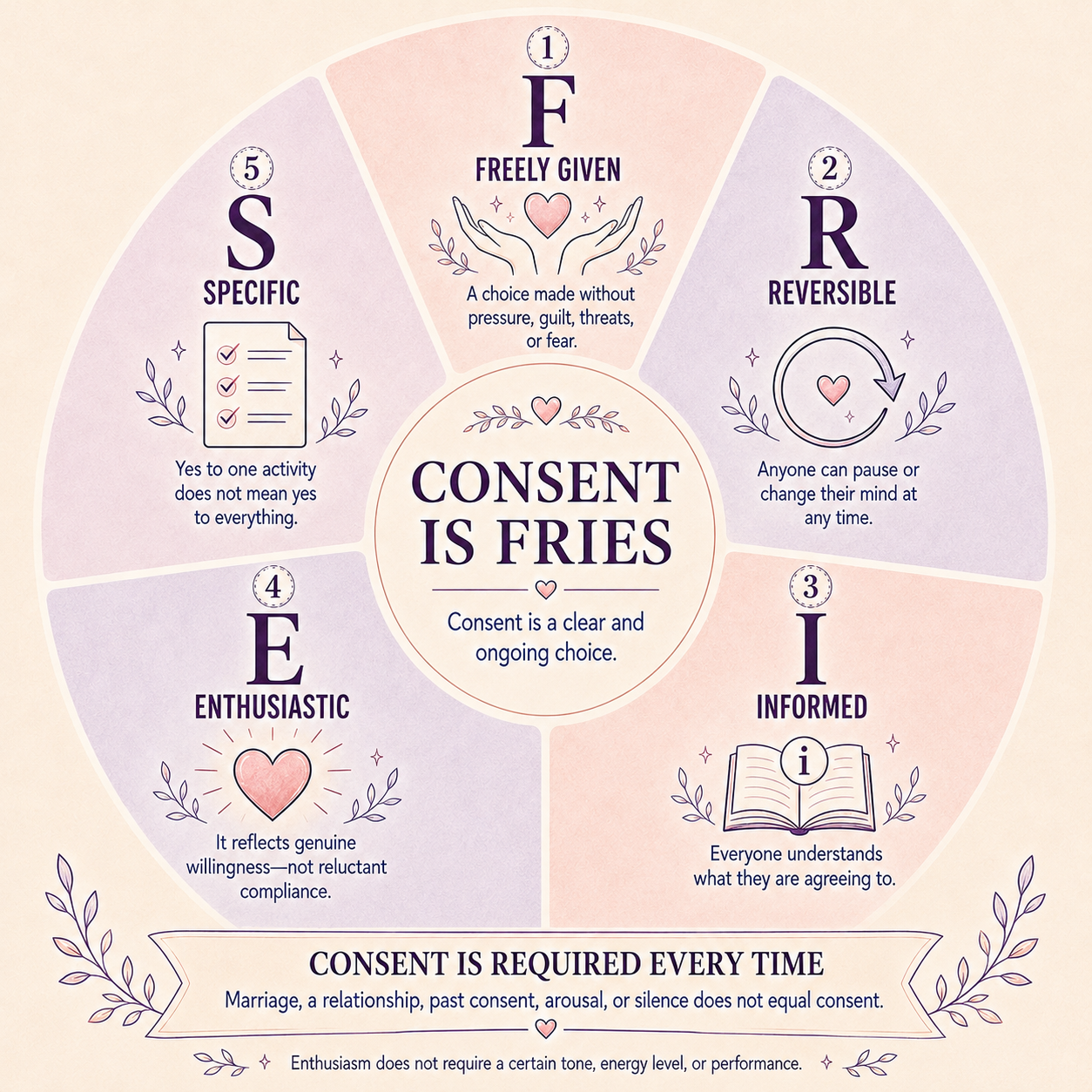
Consent means that each person freely chooses whether and how they participate. It must be:
Freely given: The choice is made without pressure, guilt, threats, or fear.
Reversible: Anyone can change their mind at any time.
Informed: Everyone understands what they are agreeing to.
Enthusiastic: Participation reflects genuine interest or openness—not reluctant compliance.
Specific: Agreeing to one activity does not mean agreeing to every activity.
Being married, living together, having had sex before, or agreeing to a scheduled date does not create ongoing consent.
Desire, Arousal, Willingness, and Consent Are Different
These experiences can overlap, but they are not the same.
Desire means wanting sexual connection.
Arousal is the body’s physical response to stimulation. A person’s body can respond even when they do not want the activity.
Willingness means being genuinely open to exploring an experience, even if strong desire has not appeared yet.
Consent means freely choosing to participate in a specific activity.
A person can consent before feeling aroused, especially if they experience responsive desire. However, consent must begin with genuine willingness—not fear, guilt, or obligation.
Someone might say:
“I am not turned on yet, but I would enjoy kissing and seeing how I feel.”
That is different from:
“I do not want to, but I know you will be upset if I say no.”
The first leaves room for choice and responsive desire. The second suggests pressure.
A Reluctant “Fine” May Not Be Freely Given Consent
A person may verbally agree while their words, tone, or body communicate discomfort.
Possible signs of reluctant compliance include:
Saying “fine” after being asked repeatedly
Becoming quiet, frozen, or disconnected
Turning away or avoiding eye contact
Participating without responding
Saying they are tired or uncertain
Agreeing mainly to prevent an argument
Expressing fear that a partner will become angry
Asking to hurry and get it over with
Saying yes after guilt, threats, or prolonged pressure
When a partner seems hesitant, stop and check in. Do not treat the absence of a strong no as a yes.
A helpful response might be:
“You do not seem comfortable. We can stop. You do not need to take care of my feelings by continuing.”
Consent Can Be Withdrawn at Any Time
Starting a sexual activity does not mean someone must finish it. A person can pause or stop:
After kissing begins
After becoming aroused
After removing clothing
During penetration
Before orgasm
After previously saying yes
During a scheduled sexual encounter
Even if stopping disappoints their partner
Arousal, orgasm, erection, lubrication, or ejaculation does not prove consent. These are body responses, and they do not always reflect what a person wants.
Repeated Asking Can Become Pressure
It is okay to make a respectful sexual invitation. It is not okay to keep asking until a partner gives in.
Pressure may include:
Asking again immediately after hearing no
Rewording the same request several times
Trying a different sexual activity after every no
Touching sexually after a partner declines
Claiming that the partner is being unfair
Reminding them how long it has been
Comparing them to previous partners
Suggesting that a loving partner would agree
Sulking, withdrawing affection, or creating conflict
Threatening to leave, cheat, or end the relationship
Making the partner responsible for managing sexual frustration
If someone changes their answer because continuing to say no feels harder or less safe than giving in, that is not freely chosen participation.
Disappointment Is Allowed; Punishment Is Not
The higher-desire partner may feel sad, frustrated, lonely, or rejected when an invitation is declined. Those feelings are real and do not need to be hidden.
However, the person who said no should not be punished for protecting their boundary.
A respectful response may sound like:
“I am disappointed, but I respect your answer.”
“Thank you for being honest.”
“Would you like nonsexual affection, or would you prefer space?”
“We can talk about our relationship concerns another time.”
“You do not need to have sex to make me feel better.”
The goal is not to prevent disappointment. It is to handle disappointment without turning it into pressure.
Consent Should Apply to Every Part of the Experience
Consent is not one yes at the beginning of sex. Partners should remain able to communicate throughout the experience.
Check-ins might include:
“Would you like me to keep going?”
“Does this feel good?”
“Would you like more, less, or something different?”
“Are you still comfortable?”
“Do you want to pause?”
“Would you like this touch to remain nonsexual?”
“What sounds good to you right now?”
Partners do not need to ask a formal question every few seconds. Consent can also be communicated through active participation, clear body language, and established signals. However, when there is uncertainty, slowing down and asking is always appropriate.
Create Safety Around Saying No
Couples with desire differences need to know that a no will be respected. This may require agreeing that:
No explanation is required in the moment
Asking once is enough
A no to sex is not a rejection of the entire relationship
Affection can continue without sexual escalation
Either partner can pause or change activities
Disappointment will be managed without punishment
Relationship concerns will be discussed outside sexual moments
When people trust that they can say no, their yes becomes more meaningful. They may also feel safer exploring responsive desire because they know that beginning an activity does not remove their ability to stop.
Consent Does Not Solve Every Compatibility Question
Respecting a partner’s no does not mean the higher-desire partner must pretend that sexual connection is unimportant. Both people are allowed to be honest about what they want from a relationship.
One partner has the right to decline sex. The other has the right to decide whether the relationship still meets their needs. Neither person has the right to use pressure or unwanted sex as the solution.
Sometimes couples need support determining whether a mutually satisfying relationship is possible. Sex therapy can help partners discuss desire, boundaries, grief, and compatibility without treating either person’s body as something to negotiate away.
Consent is not an obstacle to intimacy. It is what makes safe, trusting, and mutually chosen intimacy possible.
Duty Sex and the Cost of Pushing Through
Duty sex is sexual activity someone agrees to mainly because they feel guilty, pressured, afraid of conflict, or responsible for meeting a partner’s needs. They may participate even though they do not genuinely want or feel open to the experience.
Duty sex can happen in relationships that are otherwise loving. A person may believe that having sex is part of being a “good” partner or that the relationship will suffer if they say no.
They may think:
“It has been long enough.”
“My partner has needs.”
“I do not want to disappoint them.”
“They will be upset if I say no.”
“It will be easier to get it over with.”
“Maybe I will get into it once we start.”
“I need to do this to keep the relationship together.”
“If I do not have sex, my partner might leave or cheat.”
Over time, repeatedly ignoring these internal signals can affect desire, safety, and trust.
Duty Sex Is Different From Willing Consent
A person does not need to begin every sexual experience with strong, spontaneous desire. Someone who experiences responsive desire may choose to begin from a place of genuine openness.
Willing consent might sound like:
“I am not turned on yet, but connecting sounds good. I would like to see whether desire develops.”
Duty sex sounds more like:
“I do not want this, but I feel like I should do it.”
The difference is freedom.
With willing consent, the person feels emotionally and physically safe saying no, changing the activity, pausing, or stopping. With duty sex, saying no may feel as if it will lead to guilt, anger, rejection, conflict, or consequences.
Sexual interest may grow after an experience begins, but no one should have to push through unwanted contact in the hope that desire eventually appears.
Why People Agree to Sex They Do Not Want
A person may agree because they:
Love their partner and want them to feel cared for
Fear hurting their partner’s feelings
Want to prevent an argument
Feel responsible for their partner’s mood
Have learned that sex is a marital or relationship obligation
Believe their partner will leave or cheat
Feel ashamed about having lower desire
Have difficulty identifying or expressing boundaries
Freeze or comply when they feel pressured
Have been taught that their own pleasure does not matter
Want affection and believe sex is the only way to receive it
Feel unable to withdraw consent once an activity begins
These responses do not make someone weak. They may reflect attempts to maintain closeness, avoid conflict, or stay emotionally safe.
The Short-Term Result Can Hide the Long-Term Cost
Duty sex may appear to solve a desire difference because the couple has sex more often. The higher-desire partner may feel temporarily reassured, and the immediate conflict may end.
However, the lower-desire partner’s body may begin connecting sexual contact with pressure, performance, or loss of control.
Over time, this can lead to:
Less sexual desire
Avoidance of affection
Resentment
Anxiety before sexual contact
Difficulty becoming aroused
Pain or pelvic floor tension
Numbness or dissociation
Feeling disconnected from the body
Difficulty reaching orgasm
Fear of disappointing a partner
Loss of trust
A stronger desire-pressure cycle
Increasing sexual frequency is not a success if one partner is becoming less safe, less connected, or less able to choose.
Pushing Through Can Affect Nonsexual Affection
When kissing, cuddling, or massage frequently becomes sex, the lower-desire partner may begin avoiding all forms of physical closeness.
They may worry:
“If I let this continue, I will have to finish what I started.”
“If I cuddle, my partner will assume I want sex.”
“If I become aroused, I will lose the right to stop.”
This can make both partners feel more disconnected. The higher-desire partner loses affection as well as sex, while the lower-desire partner loses access to touch that once felt comforting.
Rebuilding trust may require creating forms of affection that are clearly allowed to remain nonsexual.
Arousal Does Not Remove the Right to Stop
The body can respond to stimulation even during an unwanted or emotionally uncomfortable experience. A person may experience lubrication, an erection, physical pleasure, or orgasm without wanting the activity.
These body responses do not prove that someone consented or secretly wanted what happened. They also do not create an obligation to continue.
A person can stop at any point—even if:
Their body is aroused
They previously said yes
Their partner is close to orgasm
Penetration has begun
The encounter was scheduled
They have stopped before
Their partner is disappointed
Starting something does not mean anyone has to finish it.
Duty Sex Can Also Affect the Higher-Desire Partner
Many higher-desire partners do not want sex that their partner is merely enduring. They may feel hurt, guilty, confused, or unwanted when they realize that participation was based on obligation.
They may begin questioning whether a yes is genuine or feel afraid to initiate at all.
This is why honest communication matters. The goal is not for the lower-desire partner to become better at pretending. It is for both people to know that sexual connection is mutually chosen.
How Couples Can Move Away From Duty Sex
Couples may begin by agreeing that:
Sex is never owed
A no will not lead to punishment or repeated asking
Either person can pause or stop at any time
Affection does not have to become sexual
Arousal does not require continuing
Scheduled connection is not a promise of sex
Disappointment can be expressed without blame
Both partners’ pleasure and comfort matter
Relationship concerns will be discussed outside sexual moments
The couple may need to temporarily remove certain activities from the table while rebuilding safety. They can explore affection, sensuality, and pleasure without requiring penetration or orgasm.
A helpful check-in may be:
“Do you genuinely want or feel open to this, or do you feel like you should say yes?”
The person asking must also be prepared to accept the answer.
When Additional Support May Be Needed
Sex therapy may help couples recognize obligation, rebuild safe affection, improve communication, and create a sexual relationship based on mutual choice.
Individual support may be more appropriate when someone:
Feels afraid to say no
Experiences punishment or retaliation after declining
Freezes or dissociates during sex
Has experienced sexual trauma
Is unsure whether their boundaries are being respected
Does not feel safe discussing the issue with their partner
No one should be pressured to attend couples sex therapy with a partner they fear.
The goal is not to judge someone for having agreed to unwanted sex in the past. People make the best choices they can within difficult situations. The goal is to create a future in which every yes is meaningful, every no is respected, and no one has to disconnect from themselves to protect the relationship.
How to Talk About Different Sex Drives
Talking about different sex drives can feel vulnerable. The higher-desire partner may fear another rejection, while the lower-desire partner may worry that the conversation will become another attempt to get more sex.
A productive conversation is not about deciding who is right or negotiating how much sex one partner owes the other. The goal is to understand each person’s experience and identify what would help intimacy feel safer, more honest, and more satisfying.
Choose the Right Time
Do not begin the conversation:
Immediately after sexual rejection
During an argument
In the middle of sexual activity
When either person is tired, rushed, or distracted
When one partner feels trapped or unable to leave
As a surprise during a romantic or sexual moment
Choose a calm, private time when neither person is expected to participate in sex afterward.
You might begin by saying:
“I would like to talk about how we have both been feeling about intimacy. I am not asking for sex tonight. I want us to understand each other better. When would feel like a good time?”
This separates the conversation from an immediate sexual request.
Treat the Pattern as the Problem
Avoid beginning with:
“You never want sex.”
“You care too much about sex.”
“You need to fix your libido.”
“You are always rejecting me.”
These statements make one partner the problem and usually lead to defensiveness.
Try:
“I think we have gotten caught in a pattern where I feel rejected and you feel pressured. I do not want either of us to keep feeling this way.”
The couple is on the same side, looking at a shared cycle.
Speak From Your Own Experience
Use “I” statements to describe feelings, needs, and experiences without assuming what your partner intends.
The higher-desire partner might say:
“Sex helps me feel close and chosen. When we go a long time without it, I start feeling lonely and unattractive. I know that does not mean you owe me sex, but I want you to understand what comes up for me.”
The lower-libido partner might say:
“When I feel that affection may lead to an expectation for sex, I become tense and avoid touch. I want closeness with you, but I need to know that I can enjoy affection without being required to continue.”
Both people can be honest without turning their feelings into demands.
Begin With What You Value
Before focusing on what is missing, name what matters about the relationship.
For example:
“I love you and care about our relationship.”
“I want us to have a form of intimacy that feels good for both of us.”
“I miss feeling connected to you.”
“I do not want sex to be a source of pressure or resentment.”
“I want both of us to feel wanted and respected.”
This reminds both partners that the goal is connection—not winning.
Ask Curious Questions
Questions should help you understand your partner rather than prove a point.
Try asking:
“What does sex mean to you?”
“What helps you feel open to sexual connection?”
“What makes sex feel pressured?”
“How do you prefer to be approached?”
“What happens inside you when I initiate?”
“What happens inside you when I say no?”
“Which kinds of touch feel connecting right now?”
“What do you enjoy about our sexual relationship?”
“What would you like to change?”
“Do you feel free to pause or stop?”
“Are there activities we have treated as required?”
“Is the sex we are having pleasurable for you?”
“What helps you feel loved outside of sex?”
“What kind of intimacy would feel worth wanting?”
Listen to the answer without immediately correcting, defending, or offering a solution.
Do Not Reduce the Conversation to Frequency
“How often should we have sex?” may seem like the main question, but frequency is usually only one part of the problem.
Couples may also need to discuss:
The quality of sexual experiences
How sex is initiated
How rejection is handled
How much time is available for arousal
Which activities are enjoyable
Whether pain is present
Whether affection feels safe
How responsibilities are divided
What helps each person feel connected
Whether either partner has been participating from obligation
What sex represents emotionally
Choosing a number cannot repair pain, resentment, pressure, or sex that is not mutually pleasurable.
Talk About Initiation
The couple can identify which forms of initiation feel inviting and which feel pressuring.
Ask:
“How would you like me to show interest?”
“Are there times or settings when initiation feels better?”
“Would you prefer a direct question or more gradual affection?”
“How can you say ‘maybe’ without it becoming a promise?”
“How can you say no while still expressing care?”
“How should we respond when an invitation is declined?”
A respectful initiation might sound like:
“Would you be interested in some pressure-free intimate time tonight? It is completely okay if the answer is no.”
The person making the invitation must genuinely mean that no is acceptable.
Create More Than Two Possible Answers
Sexual invitations often feel as if they have only two answers: yes to everything or no to all connection.
Couples can make room for:
“Yes, I want that.”
“I am open to starting slowly and checking in.”
“I want affection but not sexual touch.”
“I would enjoy a different activity.”
“Not tonight, but I would like to reconnect soon.”
“No, I need space.”
“I am not sure yet.”
A maybe is not a delayed yes. It requires continued communication and can become either yes or no.
Learn to Hear No Without Punishment
The person receiving a no can acknowledge their disappointment without making the other partner responsible for fixing it.
A respectful response might be:
“I am disappointed, but I respect your answer.”
“Thank you for being honest.”
“Would nonsexual affection feel good, or would you rather have space?”
“We can talk about our larger concerns at another time.”
A no should not lead to repeated asking, arguments, silent treatment, guilt, or threats.
Be Honest About Difficult Information
A healthy conversation may include information that is painful to hear.
A partner may say:
“I have been having sex from obligation.”
“I do not enjoy the kind of sex we usually have.”
“I miss feeling sexually connected to you.”
“I do not want to increase my desire.”
“I need more affection that does not lead to sex.”
“Sex is more important to me than I have admitted.”
“I am not sure our needs are compatible.”
Honesty does not guarantee an easy solution, but avoiding the truth usually allows resentment and pressure to grow.
Pause When the Conversation Becomes Overwhelming
Either partner can request a break if the conversation becomes too heated or emotionally intense.
Try:
“I want to continue this conversation, but I am becoming overwhelmed. Can we pause and return to it tomorrow at 7:00?”
Choose a specific time to return so the pause does not feel like permanent avoidance.
End With One Small Next Step
Do not try to solve the entire sexual relationship in one conversation. Choose one small, mutual step.
That might be:
Setting aside pressure-free connection time
Agreeing that cuddling will not escalate
Trying a new way of initiating
Making an appointment with a medical provider
Addressing pain
Sharing household responsibilities differently
Creating a yes, no, maybe list
Scheduling a conversation with a sex therapist
Checking in again next week
A helpful closing question is:
“What is one change that would help you feel more understood and safer this week?”
The goal is not to force agreement. It is to create a relationship where both people can tell the truth about desire, disappointment, pleasure, and boundaries without fear or shame.
How Couples Can Navigate Desire Differences
Navigating desire differences is not about finding the perfect sexual frequency. It is about creating a relationship where both partners can be honest, consent is protected, and intimacy feels meaningful rather than pressured.
The goal is not automatically to make the lower-desire partner want more sex or the higher-desire partner care less about sex. It is to understand what each person needs and determine whether the couple can create a sexual relationship that respects both people.
Stop Treating One Partner as the Problem
The lower-desire partner is not broken, and the higher-desire partner is not too much. The shared pattern is the problem.
Instead of asking:
“How do we fix the partner who does not want enough sex?”
Ask:
“What creates desire, pressure, pleasure, and disconnection between us?”
This change helps couples work together rather than arguing over whose libido is more normal.
Make It Safe to Say No
Desire is unlikely to grow when a person does not feel free to decline.
A no should not lead to:
Repeated asking
Guilt
Anger
Silent treatment
Withdrawal of affection
Threats
A debate about whether the reason is good enough
Pressure to offer another sexual activity
When a no is respected, the lower-desire partner may feel safer enjoying affection or exploring responsive desire. They know that beginning an activity does not mean losing the right to stop.
A respectful response might be:
“I am disappointed, but I respect your answer. Would another kind of connection feel good, or would you prefer space?”
Separate Affection From Sexual Expectations
If every kiss, cuddle, or massage becomes an attempt to have sex, the lower-desire partner may begin avoiding all physical affection.
Couples can intentionally create touch that will not escalate, such as:
Holding hands
Cuddling
Kissing
Hugging
Giving a back rub
Sitting close together
Resting in bed together
Offering comforting touch
Before beginning, clarify the boundary:
“Would you like to cuddle for a while? I am not expecting it to become sexual.”
Then honor that agreement, even if someone becomes aroused. Arousal does not require escalation.
Expand the Definition of Sex and Intimacy
Couples can become trapped in the belief that sex only counts if it includes penetration or orgasm. A broader definition creates more possibilities for mutually wanted connection.
Intimacy might include:
Making out
Sensual touch
Mutual masturbation
Using toys
Oral sex
Erotic massage
Watching or reading something erotic
Sharing fantasies
Showering together
Nonsexual affection
Emotional closeness
Pleasure that does not have a specific goal
These activities should not be treated as lesser substitutes or consolation prizes. Any form of intimacy can be meaningful when both people genuinely choose it.
Improve the Sex Being Offered
A person may not want more sex because the sex they are having is not enjoyable, comfortable, or worth the effort.
Couples can ask:
Does each person experience pleasure?
Is there enough time for arousal?
Can both partners request what they want?
Is penetration treated as required?
Is orgasm treated as the goal?
Does anyone experience pain?
Are there activities one person participates in mainly from obligation?
Does the experience feel playful, connected, and emotionally safe?
Would either person want sex if it looked different?
Increasing the quality of sexual experiences may be more helpful than increasing the frequency.
Create an Intimacy Menu
An intimacy menu gives couples more options than “sex” or “no sex.” Together, create three categories.
Affectionate connection might include:
Hugging
Holding hands
Cuddling
Kissing
Talking in bed
Sensual connection might include:
Massage
Showering together
Making out
Touching over clothing
Lying together without a goal
Sexual connection might include:
Mutual masturbation
Using toys
Oral sex
Penetration
Each partner can identify which activities currently feel like a yes, no, or maybe. These answers can change, so continue checking in.
Develop a Better Way to Initiate
Initiation should feel like an invitation—not a demand or test of love.
Partners can discuss:
Which kinds of initiation feel good
Which kinds feel pressuring
When initiation is most welcome
Whether they prefer direct or gradual invitations
How to communicate openness without making a promise
How to say no with care
How disappointment will be handled
A clear initiation might sound like:
“Would you be interested in some intimate time tonight? It is okay if the answer is no or if you only want affection.”
The person asking must genuinely be willing to accept any answer.
Create a Signal for Openness
Some couples find it helpful to use a simple signal showing openness to sexual or sensual connection.
This might be:
A certain phrase
A note or message
A candle placed in a specific location
A shared calendar symbol
One partner saying, “I am open to being approached tonight”
The signal means open to an invitation—not guaranteed consent. Either person can still change their mind.
Schedule Pressure-Free Connection
Scheduling can help couples protect time from work, parenting, and other responsibilities. However, schedule connection rather than a required sexual outcome.
The agreement might be:
“We will set aside an hour to connect. We may talk, cuddle, kiss, explore touch, or have sex. Either of us can stop without guilt.”
This creates room for responsive desire while protecting consent.
Create the Conditions That Support Desire
Instead of asking only how to increase libido, identify what helps desire become possible.
Helpful conditions may include:
More sleep
Privacy
Shared household responsibilities
Childcare
Emotional connection
Time to transition out of work or parenting mode
Affection without expectation
Addressing unresolved conflict
Feeling attractive or comfortable in the body
Enough time for arousal
Treatment for pain
Trying new sexual activities
Feeling free to stop
Desire cannot be demanded, but couples can remove some of the barriers that keep it from appearing.
Make Room for Solo Sexuality
Masturbation can be a healthy part of a relationship. It may allow either partner to experience pleasure, explore interests, or meet some sexual needs without placing responsibility on the other person.
Couples may need to discuss:
Privacy
Pornography
Toys
Shared versus private sexual expression
What feels respectful within their relationship agreements
Solo sex does not replace every emotional need connected to partnered intimacy. It can, however, reduce the belief that one partner must be available whenever the other experiences desire.
Address Medical and Emotional Barriers
Desire differences may be affected by:
Hormonal changes
Medication side effects
Difficulty reaching orgasm
Depression or anxiety
Chronic illness
Sleep problems
Religious or cultural shame
Relationship resentment
A medical provider, pelvic floor physical therapist, individual therapist, or sex therapist may be part of the support team. The goal is not to search for a medical problem in every lower-desire partner. It is to evaluate concerns when the person wants help or notices a distressing change.
Check In Without Monitoring
Couples can schedule regular conversations about intimacy without turning them into performance reviews.
Ask:
“What has felt connecting lately?”
“Have you felt pressured?”
“Have you felt wanted and appreciated?”
“Is there any kind of touch you want more or less of?”
“What has been getting in the way of connection?”
“Is there anything you would like to explore?”
“What is one thing that would help this week?”
Avoid keeping score or using the conversation to prove that one partner is not doing enough.
Accept That Not Every Difference Can Be Solved
Some couples find a flexible and satisfying middle ground. Others discover that their sexual needs, boundaries, or relationship goals are deeply different.
Respecting consent does not require someone to remain in a relationship that does not meet their needs. At the same time, sexual dissatisfaction does not give anyone the right to pressure a partner.
Couples sex therapy can help couples explore what is possible, grieve what may not be possible, and make informed decisions about the relationship.
Success does not mean reaching a particular number of sexual encounters. It means creating as much honesty, freedom, pleasure, and mutual respect as possible—and recognizing when the available options do or do not work for both people.
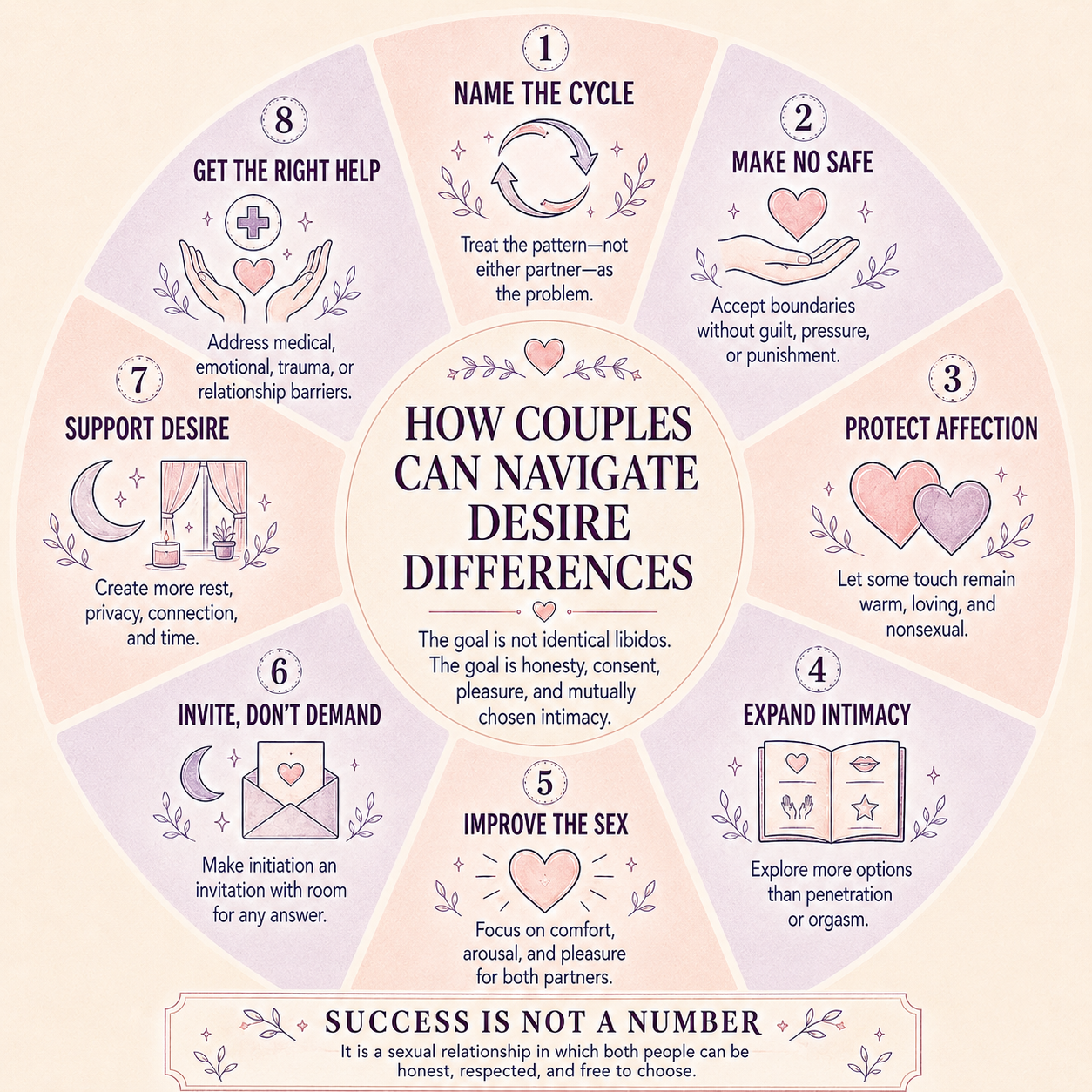
What Healthy Compromise Should—and Should Not—Mean
Couples are often told to compromise when they want different amounts of sex. However, sexual compromise cannot work like compromising over a restaurant, vacation, or household chore.
A healthy compromise does not require one person to participate in unwanted sexual activity. A person’s body is not the thing being divided in half.
The goal is to find choices that respect both partners’ needs, boundaries, and autonomy—not to calculate how much unwanted sex one partner should tolerate.
What Healthy Compromise Can Mean
Healthy compromise may involve:
Making time for honest conversations about intimacy
Creating more opportunities for pressure-free connection
Exploring a wider range of sexual and nonsexual activities
Finding ways to initiate that feel inviting rather than demanding
Allowing either partner to suggest intimacy
Making affection available without sexual expectations
Sharing household and caregiving responsibilities more fairly
Protecting time for rest, privacy, and connection
Addressing medical concerns or sexual pain
Trying activities that both partners are genuinely interested in
Allowing solo sexual expression within agreed relationship boundaries
Learning how to handle rejection without guilt or punishment
Seeking sex therapy or medical support when appropriate
Partners can compromise about the conditions surrounding intimacy. They can discuss time, setting, initiation, communication, activities, and how they support one another.
Consent itself is not a compromise.
Compromise Can Include Willing Consent
A person does not need to feel spontaneous desire before every sexual experience. Someone may be genuinely open to affectionate or sexual connection and choose to see whether responsive desire develops.
Willing consent may sound like:
“I am not turned on yet, but I would enjoy starting slowly and seeing how I feel.”
This can be a healthy choice when the person:
Feels emotionally and physically safe
Is genuinely open to the experience
Can choose which activities they want
Can pause or stop without consequences
Knows their partner will accept a no
Is not participating mainly from guilt or fear
Does not need to pretend to enjoy the experience
Willingness is not the same as obligation. If someone feels that they have to say yes to protect the relationship or manage their partner’s feelings, that is not healthy compromise.
What Healthy Compromise Should Not Mean
Compromise should not mean:
Agreeing to sex you do not want
Meeting a required sexual quota
Taking turns between wanted and unwanted sex
Continuing because your partner is already aroused
Allowing painful activity
Pretending to enjoy sex
Ignoring dissociation, fear, or discomfort
Accepting guilt, anger, or silent treatment after saying no
Letting one partner decide what counts as enough sex
Requiring the lower-desire partner to increase their libido
Requiring the higher-desire partner to pretend sex does not matter
Using threats of cheating or ending the relationship
Treating access to a partner’s body as a relationship duty
A compromise that repeatedly harms one partner is not a healthy middle ground.
Fair Does Not Always Mean Equal
Couples sometimes try to create fairness by choosing a number between each person’s preferred frequency. For example, if one person wants sex four times a week and the other wants it once a month, they may choose once a week.
This may look equal on paper, but it does not address whether each sexual experience is freely chosen, pleasurable, or comfortable.
Fairness means that both partners’ experiences matter. It does not mean splitting the numerical difference.
A fair agreement might include:
Sexual connection only when both people want or feel genuinely open to it
More frequent nonsexual affection
Dedicated time for connection without a required outcome
More attention to the lower-desire partner’s pleasure
More verbal affection and reassurance for the higher-desire partner
Clear space for solo sexuality
Regular conversations about how the agreement feels
The Higher-Desire Partner Should Not Have to Disappear
Protecting consent does not mean the higher-desire partner must stop talking about sex, hide their disappointment, or act as if sexual connection is unimportant.
They are allowed to say:
“I respect your boundary, and I am also struggling with how little sexual connection we have.”
They can ask for affection, reassurance, conversation, and support. They can also decide whether the relationship meets their needs.
What they cannot do is make sex the price of maintaining the relationship or use emotional consequences to obtain it.
The Lower-Desire Partner Should Not Have to Perform
The lower-desire partner should not be required to provide sexual activity to prove love, attraction, or commitment.
They are allowed to say:
“I care about you, but I do not want sexual contact right now.”
They are also allowed to be honest if they do not want to increase their desire. However, honesty may require discussing what that means for the relationship rather than avoiding the subject completely.
Autonomy does not require promising change. It does require truthful communication when possible and safe.
Sometimes There Is No Acceptable Middle Ground
Not every desire difference can be solved through compromise.
One partner may not want a sexual relationship, while the other considers sexual connection essential. Partners may have sexual interests or relationship needs that cannot be combined in a way that works for both people.
In these situations, the choices may be painful. Couples might consider:
Redefining the relationship
Consensual changes to relationship agreements
Accepting a relationship with little or no sex
Ending the relationship
Seeking sex therapy to clarify what each person can and cannot accept
No one must agree to nonmonogamy or another relationship structure to solve a desire difference. Any change must be freely chosen by everyone involved.
Couples sex therapy can help couples explore their options, but it cannot create compatibility where no mutually acceptable option exists.
Healthy compromise means flexibility without self-abandonment. It asks both partners to care about each other’s experiences while recognizing that love does not require access to another person’s body—and consent does not require ignoring the importance of sexual connection.
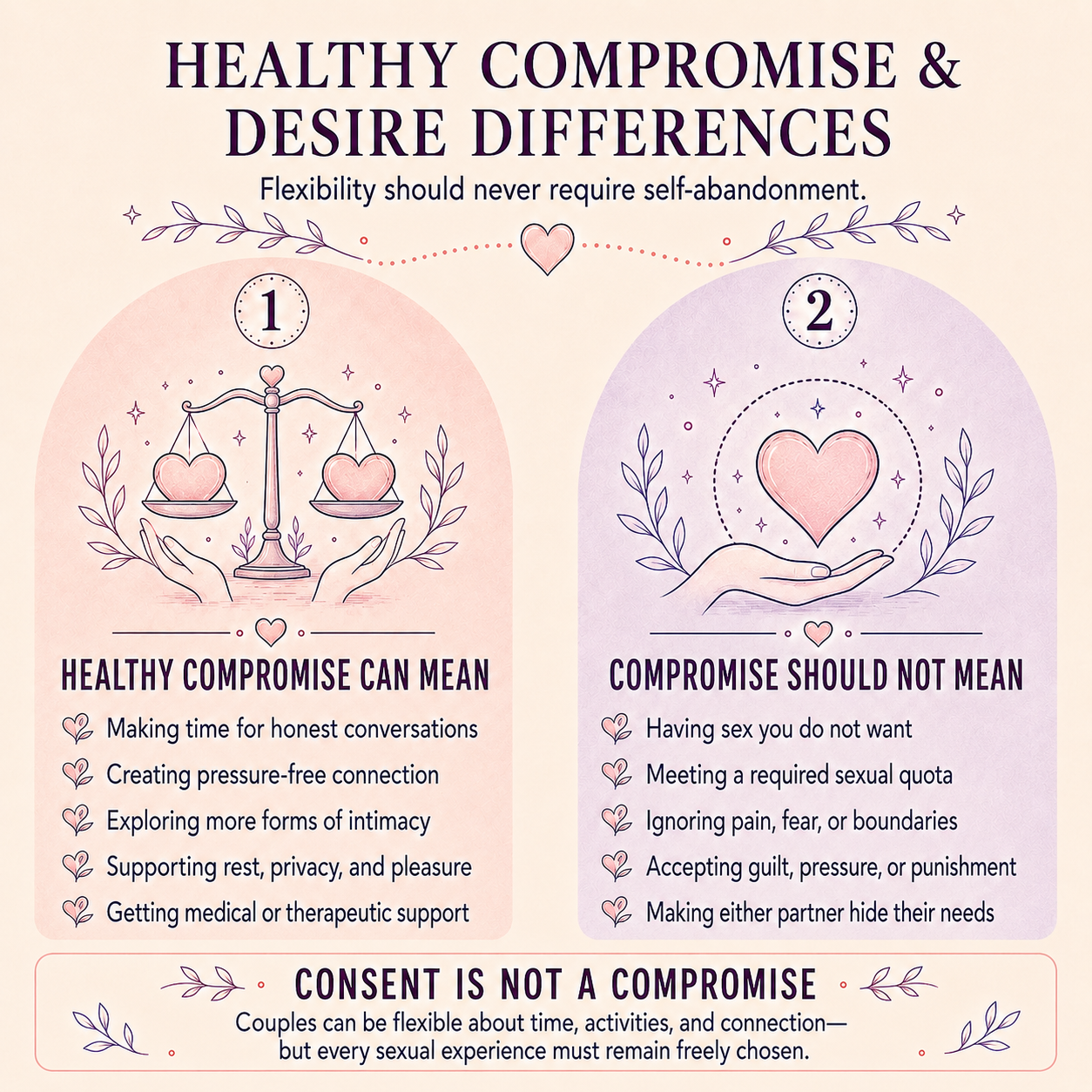
When Are Desire Differences a Sign of Sexual Incompatibility?
Different libidos do not automatically mean two people are sexually incompatible. Most partners will experience differences in desire, timing, interests, or preferred activities.
Sexual incompatibility becomes a concern when partners want fundamentally different sexual relationships and cannot find an option that both people can genuinely accept.
This does not mean either person is broken, selfish, or wrong. Two valid sets of needs can still be difficult—or impossible—to combine.
What Does Sexual Compatibility Mean?
Sexual compatibility does not require partners to:
Have identical libidos
Want sex at the same time
Enjoy every activity equally
Share every fantasy
Reach orgasm in the same way
Never experience disappointment
Have a particular amount of sex
Compatibility means that there is enough overlap, flexibility, communication, and mutual respect for both people to feel that the relationship works.
A couple may be compatible even with a significant desire difference if they can create an intimate life that both people freely choose.
Signs the Difference May Be a Compatibility Issue
A desire difference may reflect deeper incompatibility when:
One partner wants a sexual relationship and the other wants little or no sexual contact
Sexual connection is essential to one partner but unimportant to the other
One partner wants to increase sexual connection while the other does not want change
Partners want fundamentally different types of sexual activity
Important sexual interests cannot be explored together consensually
Partners want different relationship structures, such as monogamy and nonmonogamy
One partner needs emotional connection before sex while the other does not want that kind of intimacy
The available compromises leave one or both people chronically unhappy
Either partner must regularly abandon important needs or boundaries to maintain the relationship
Both people have communicated honestly and still cannot identify a mutually acceptable way forward
The key question is not whether the difference exists. It is whether there is a shared relationship that both people can live in without pressure, resentment, or self-abandonment.
A Difficult Pattern Is Not Always Incompatibility
Sometimes couples assume they are incompatible when the real problem is:
The sex is not pleasurable
Sexual pain has not been addressed
One partner feels pressured
Affection always leads to sexual expectations
There is unresolved relationship conflict
Stress and exhaustion leave little room for desire
Medication or health changes are affecting sexual functioning
The couple does not know how to communicate about sex
One partner experiences responsive desire but expects spontaneous desire
Past trauma or sexual shame is affecting safety
The couple defines sex too narrowly
When these barriers are addressed, the couple may discover more sexual overlap than they thought.
Sex therapy cannot guarantee compatibility, but it can help determine whether the issue is a changeable pattern or a fundamental difference.
Compatibility Cannot Be Created Through Pressure
Telling a partner, “We are sexually incompatible unless you have more sex with me,” can become another form of pressure.
A compatibility conversation should not be used to:
Threaten a partner into sexual activity
Create fear that the relationship will end after every no
Demand a specific frequency
Push someone into nonmonogamy
Require participation in unwanted activities
Make one person responsible for solving the entire issue
It is valid to decide that sexual connection is essential to you. It is not valid to use that need to override another person’s consent.
A respectful statement might sound like:
“I respect that you do not want more sexual contact. I also need to be honest that an ongoing sexual relationship is important to me. I would like us to discuss whether there is an option that works for both of us.”
This communicates the seriousness of the difference without turning it into a demand for sex.
Questions That Can Clarify Compatibility
Couples may ask:
What kind of sexual relationship does each of us want?
How important is partnered sex to each person?
Is either person hoping the other will become someone different?
Do we enjoy the sex we currently have?
Are there mutually desired activities we have not explored?
Does the lower-desire partner want to increase desire?
Does the higher-desire partner feel able to accept less sexual contact?
Can affection remain available without sexual expectations?
Are both people free to say no?
Can we discuss disappointment without blame?
Are there medical, emotional, or relationship barriers we have not addressed?
Would either person feel fulfilled if the relationship remained exactly as it is?
What options are genuinely acceptable to both of us?
What would each of us be giving up to remain together?
Can we accept those losses without long-term resentment?
These questions may reveal opportunities for change—or confirm that the difference is fundamental.
Nonmonogamy Is Not an Automatic Solution
Some couples consider opening the relationship when they have different levels of desire. Consensual nonmonogamy can work for people who genuinely want that relationship structure.
It is unlikely to be a healthy solution when:
One person agrees mainly from fear of losing the relationship
It is introduced as an ultimatum
Trust is already damaged
The couple cannot communicate about boundaries
It is expected to repair resentment or coercion
One partner does not want nonmonogamy
No one is required to accept an open relationship to compensate for having lower desire. No one is required to remain in a relationship that cannot meet an important need, either.
Sometimes Love Is Not Enough to Create Compatibility
Two people can love and respect each other while recognizing that they want different kinds of relationships.
Possible choices may include:
Accepting the difference
Redefining what intimacy looks like
Changing relationship agreements consensually
Remaining in a relationship with little or no sex
Seeking therapy to explore unresolved barriers
Ending the relationship with honesty and care
None of these choices is easy. Ending a relationship because of sexual incompatibility does not mean the relationship lacked love or value.
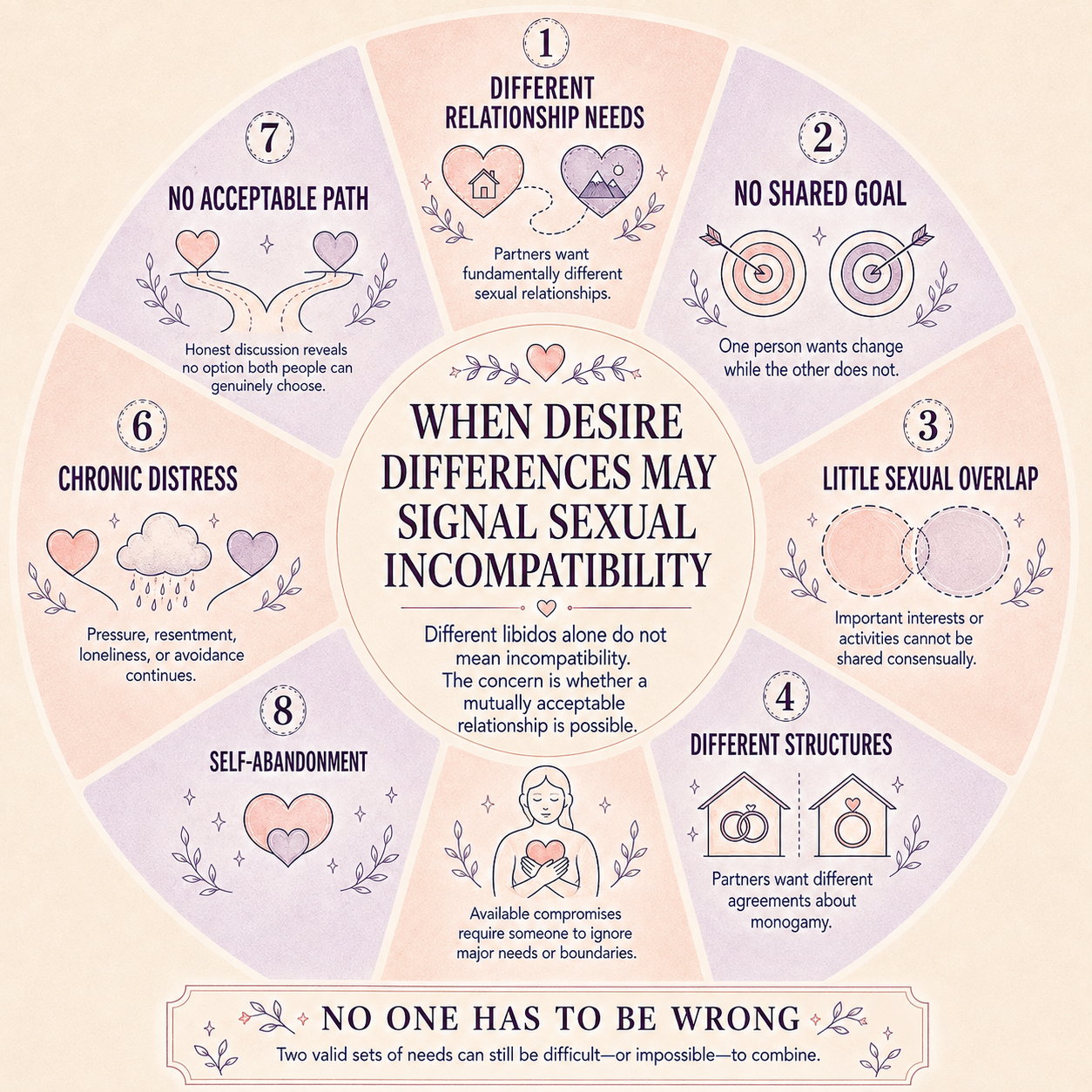
How Sex Therapy Can Help
Sex therapy can provide a place to:
Separate desire from pressure
Identify changeable barriers
Clarify sexual needs and boundaries
Explore a wider range of intimate options
Process grief and resentment
Evaluate possible relationship agreements
Determine what each person can genuinely accept
Make decisions without forcing either partner to change
The goal is not to keep every couple together. It is to help both people understand the difference clearly and decide what honors their needs, boundaries, and well-being.
Desire differences become a sign of incompatibility when there is no mutually acceptable path forward—not simply because two people want different amounts of sex.
When Individual sex Therapy May Be Helpful
Desire differences happen within a relationship, but some parts of the experience may be easier or safer to explore individually.
Individual sex therapy can give someone a private space to understand their desire, boundaries, history, identity, and emotional responses without feeling responsible for protecting a partner’s feelings.
It should not be used to identify which partner is “the problem” or to make the lower-desire partner want more sex.
Reasons Someone May Choose Individual Therapy
Individual therapy may be helpful when someone wants support with:
Religious shame or purity culture
Anxiety about sex
Depression or chronic stress
Body-image concerns
Fear of rejection
Difficulty identifying personal desires
Difficulty setting or communicating boundaries
Guilt about saying no
Feeling responsible for a partner’s emotions
Dissociation or numbness during sex
Grief after illness, surgery, childbirth, or other body changes
Questions about sexual orientation or gender identity
Exploring asexuality
Changes in desire that feel confusing or distressing
Deciding whether a relationship still meets their needs
A person does not need to be in crisis or have a diagnosis to seek support.
Sexual Trauma and the Nervous System
Past sexual trauma may affect desire, arousal, trust, boundaries, and the ability to remain present during intimacy.
A survivor may:
Freeze or become quiet during sex
Feel disconnected from their body
Experience fear without knowing why
Avoid certain kinds of touch
Struggle to recognize what they want
Agree to sex automatically
Feel guilty for setting boundaries
Experience intrusive memories or body sensations
Want intimacy while also feeling unsafe
These responses are not failures. They may be ways the nervous system learned to protect the person.
Trauma-informed therapy can help someone understand these responses, strengthen boundaries, and rebuild a sense of choice. EMDR may also help process traumatic memories, negative beliefs, and present-day triggers when it is clinically appropriate.
Trauma therapy should never begin with the goal of making someone sexually available to a partner.
Religious Shame and Purity Culture
People may continue carrying sexual messages they learned from family, religion, or culture even after their beliefs have changed.
They may have learned that:
Sexual desire is dangerous
Pleasure is selfish
Masturbation is wrong
Certain fantasies or interests are shameful
One partner is responsible for meeting the other’s sexual needs
Saying no makes someone a bad spouse
A “good” person should not want sex—or should always provide it
Individual therapy can help someone examine these messages, decide what they believe now, and develop a sexual identity based on their own values rather than fear or shame.
Understanding Personal Desire
Some people have spent so much time responding to a partner’s desires that they are unsure what they want for themselves.
Individual sex therapy can create space to explore:
What helps desire appear
What reduces desire
Whether sex feels pleasurable
Which forms of touch feel wanted
What fantasies or interests feel meaningful
Whether someone experiences spontaneous or responsive desire
Whether they want to increase their desire
What sex represents emotionally
Which boundaries have been difficult to express
What a satisfying sexual life would look like without outside expectations
The goal is not to find the “correct” answer. It is to help the person recognize and trust their own experience.
Support for the Higher-Desire Partner
The higher-desire partner may benefit from individual therapy when they experience:
Intense pain after sexual rejection
Fear that a partner’s no means they are unlovable
Difficulty managing disappointment
A need for frequent sexual reassurance
Shame about their level of desire
Anger or resentment about the difference
Anxiety about initiating
Difficulty respecting boundaries
Grief about the relationship they hoped to have
Uncertainty about whether to remain in the relationship
Therapy can help them understand what sex represents, develop additional ways to experience closeness, and communicate their needs without creating pressure.
The goal is not to convince them that sex should not matter.
Support for the Lower-Desire Partner
The lower-desire partner may benefit from individual therapy when they:
Feel broken or inadequate
Experience guilt after saying no
Have sex from obligation
Avoid affection because it may lead to sex
Feel disconnected from their body
Do not know what they enjoy
Want help understanding a change in desire
Experience trauma responses during intimacy
Feel unsure whether their boundaries are respected
Want to explore asexuality or another identity
Need support deciding whether they want sexual change
The goal is not to increase their libido unless that is something they personally want.
Therapy Can Help With Relationship Decisions
Individual therapy can also help someone consider difficult questions, such as:
Can I accept the relationship as it is?
Am I staying because I want to or because I am afraid to leave?
Do I feel safe saying no?
Are my needs and boundaries respected?
Am I hoping my partner will become someone different?
What am I willing—and unwilling—to compromise?
Is this a difficult pattern or a fundamental incompatibility?
What would I choose if I were not acting from guilt or fear?
A therapist should not make the decision for the client. Therapy can help the person understand their options and make a decision that reflects their values.
When Individual Therapy May Be Safer Than Couples Therapy
Individual support may be more appropriate when:
Someone is afraid of their partner
Saying no leads to threats or retaliation
Sexual activity involves coercion
One partner uses information from therapy against the other
There is emotional, physical, or sexual abuse
Someone cannot speak honestly in front of their partner
Couples sessions increase danger at home
Couples sex therapy requires enough safety for both people to speak freely. No one should be pressured to attend couples therapy with a partner they fear.
Individual Therapy and Medical Care May Work Together
A sudden or distressing change in desire may also need medical evaluation. Therapy cannot diagnose hormonal concerns, medication side effects, sexual pain, or other physical conditions.
Someone may benefit from both medical care and therapy when desire is affected by several overlapping factors.
Individual therapy is not about fixing a person’s libido. It is about helping them understand themselves, heal from experiences that affect intimacy, communicate more clearly, and make choices without pressure or shame.
When Couples Therapy May Not Be Enough
Couples sex therapy can help partners communicate, understand the desire-pressure cycle, rebuild trust, and explore more satisfying forms of intimacy. However, not every sexual or relationship concern can—or should—be addressed through couples therapy alone.
Some situations require individual therapy, medical treatment, specialized support, safety planning, or honest decisions about compatibility.
Recognizing these limits does not mean therapy has failed. It means the couple needs a different kind or level of support.
When There Is Fear, Coercion, or Abuse
Couples therapy requires enough safety for both people to speak honestly. It may not be appropriate when one partner is afraid of the other or expects consequences for telling the truth.
Warning signs include:
Fear of saying no to sex
Sexual activity that happens after threats, guilt, or repeated pressure
Anger or retaliation when a boundary is set
Threats of violence, abandonment, cheating, or financial harm
Physical violence
Forced or unwanted sexual activity
Monitoring, stalking, or controlling behavior
One partner using information from therapy against the other
A person changing what they say in sessions because they fear what will happen at home
Therapy sessions increasing danger after the couple leaves
In these situations, asking both people to improve communication can place responsibility on the person being harmed. It can also give the abusive partner more information to use for control.
Individual, confidential support and safety planning may be a safer first step. No one should be pressured to attend couples therapy with a partner they fear.
When Consent Is Not Being Respected
A desire difference cannot be resolved if one partner believes they are entitled to sexual access.
Couples sex therapy may not be enough when someone:
Refuses to accept no
Continues sexual touching after being asked to stop
Uses guilt or punishment to obtain sex
Treats marriage or commitment as automatic consent
Believes a partner must meet a sexual quota
Pressures a partner into painful or unwanted activities
Uses therapy to find better ways to persuade the other person
Does not take responsibility for coercive behavior
The first goal must be safety and respect for consent—not increasing sexual frequency or improving communication.
When Medical Evaluation Is Needed
Therapy cannot diagnose or treat physical conditions that may affect sexual desire or functioning.
Medical support may be needed when someone experiences:
A sudden or unexplained change in desire
Sexual pain
Changes in erections, lubrication, sensation, or orgasm
Bleeding, irritation, or other genital symptoms
Significant fatigue or other physical changes
Medication side effects
Hormonal or menopause-related changes
Changes following childbirth
Sexual concerns after surgery or cancer treatment
Symptoms of depression or another health condition
A person may benefit from working with a primary care provider, OB-GYN, urologist, pelvic floor physical therapist, sexual-medicine specialist, or medication prescriber.
Medical care and couples therapy may work together, but one cannot replace the other.
When Individual Trauma Work Is Needed
Couples therapy can help a partner understand trauma responses, but it is not always the best place to process traumatic memories.
Individual trauma therapy may be helpful when someone experiences:
Flashbacks or intrusive memories
Dissociation during sex
Freezing or automatically complying
Panic during touch
Difficulty recognizing personal boundaries
Shame related to sexual trauma
Fear connected to medical procedures
Body memories or intense triggers
A history of sexual coercion within the current relationship
Individual therapy can help someone rebuild safety, strengthen choice, and process traumatic experiences at their own pace. EMDR may be helpful when clinically appropriate.
Trauma treatment should never be used to make someone more sexually available to a partner.
When One or Both Partners Cannot Be Honest
Couples therapy has limited value when important information cannot be discussed.
This might happen when:
Someone is afraid of the other partner’s reaction
One partner refuses to discuss sex at all
A person agrees with everything in therapy but acts differently at home
One or both partners repeatedly hide important information
Either person attends only to prove that the other is the problem
A partner uses therapy language to manipulate or silence the other
There are major secrets affecting the relationship
The therapist may recommend individual sessions, a different form of treatment, or a pause in couples work.
When Substance Use or Another Condition Is Unstable
Active addiction, untreated severe mental health symptoms, or another serious condition may make relationship work difficult.
Couples therapy may need to happen alongside—or after—specialized treatment when:
Substance use affects consent or safety
Someone frequently initiates sex while intoxicated
Mood episodes cause dangerous or unpredictable behavior
A person cannot participate consistently in therapy
Sexual behavior feels out of control and causes harm
A condition prevents either partner from following agreements
This does not mean someone must become perfect before receiving relationship support. It means the condition may require direct treatment rather than expecting couples therapy to solve it indirectly.
When Only One Partner Is Willing to Participate
Couples therapy cannot create change when one partner refuses to examine the pattern.
Progress may be limited when someone:
Insists that only their partner needs to change
Refuses to respect sexual boundaries
Will not discuss their own behavior
Attends only to prevent a breakup
Repeatedly breaks agreements without taking responsibility
Expects the therapist to convince the other person to provide more sex
Is unwilling to consider any form of intimacy beyond their preferred one
One person can still benefit from individual therapy, but they cannot do relationship work for both partners.
When the Issue Is Fundamental Incompatibility
Therapy can help couples communicate and explore options. It cannot create a mutually acceptable relationship when partners want fundamentally different things.
For example:
One person wants an ongoing sexual relationship and the other does not
One partner considers sex essential while the other does not want sexual change
Important sexual interests cannot be shared consensually
Partners want different relationship structures
Every available compromise requires one person to abandon a major need or boundary
Neither person can accept the relationship the other wants
The purpose of therapy may shift from “How do we fix this?” to “What choices are honest and respectful?”
Sometimes the healthiest outcome is acceptance, a consensual change in the relationship, or separation.
Couples Therapy Is Not Designed to Keep Every Couple Together
The success of couples sex therapy should not be measured only by whether the relationship continues.
Therapy may help partners:
Understand why the current pattern is not working
Take responsibility for harm
Clarify needs and boundaries
Decide what changes are possible
Recognize incompatibility
End a relationship with greater honesty and care
Create a safer plan for moving forward
Staying together is not a successful outcome if one person must tolerate pressure, fear, unwanted sex, or ongoing self-abandonment.
Finding the Right Kind of Support
Depending on the concern, helpful support may include:
Individual therapy
Trauma therapy or EMDR
Medical evaluation
Pelvic floor physical therapy
Substance-use treatment
Psychiatric care
Sexual-medicine treatment
Domestic violence advocacy
Legal consultation
Separation or discernment counseling
If you feel afraid of your partner or experience relationship abuse, the National Domestic Violence Hotline offers confidential support at 800-799-SAFE (7233) or by texting START to 88788. If you have experienced sexual assault or abuse, contact RAINN’s National Sexual Assault Hotline at 800-656-HOPE (4673) or text HOPE to 64673. If you are in immediate danger, call emergency services.
Couples sex therapy can be valuable, but it is not a substitute for safety, medical care, individual healing, or sexual compatibility. The right support begins by identifying what the situation actually requires.
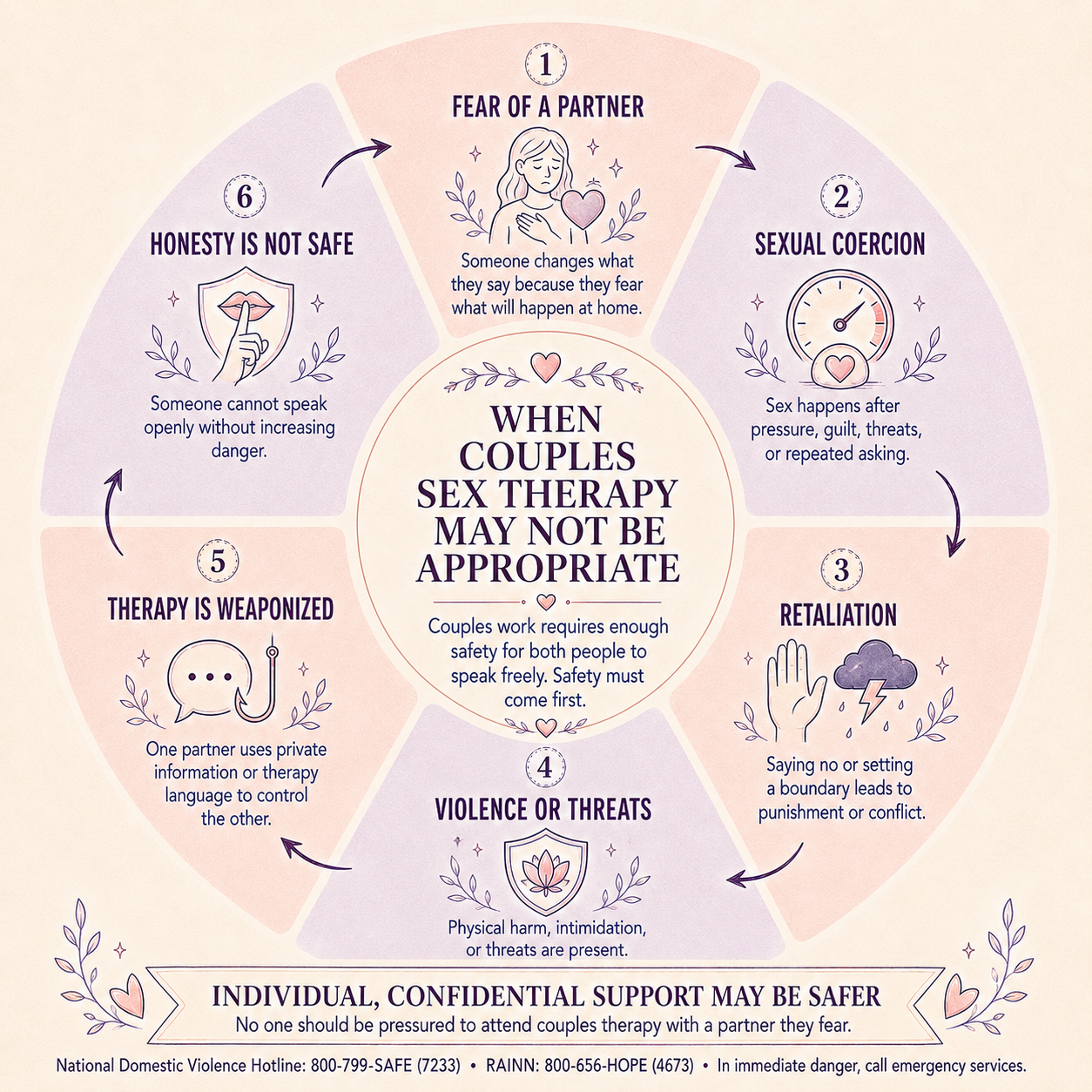
Frequently Asked Questions About Desire Differences
Is It Normal for Couples to Have Different Sex Drives?
Yes. Most couples experience differences in sexual desire at some point. Partners may want sex with different frequency, at different times, or under different conditions.
A desire difference does not mean either partner has a sexual problem. It becomes a concern when the difference creates distress, pressure, resentment, avoidance, or loneliness.
How Often Should Couples Have Sex?
There is no correct amount of sex for a couple to have. Some couples want sexual connection several times a week, while others prefer it occasionally or not at all.
Sexual frequency does not measure the health of a relationship. The more helpful questions are whether both people feel respected, can communicate honestly, and freely choose the sexual experiences they share.
Why Does My Partner Want Sex More Than I Do?
Partners may experience different levels or styles of desire. Your desire can also be affected by stress, sleep, health, medication, hormones, relationship concerns, sexual pain, past experiences, or whether the sex being offered is pleasurable.
Wanting less sex than your partner does not automatically mean you have low libido. It means there is a difference between what each of you currently wants.
Why Do I Want Sex More Than My Partner?
Your desire may naturally appear more often, or sex may be an important source of pleasure, reassurance, and emotional connection for you.
Wanting more sex does not make you needy, selfish, or overly sexual. However, your desire does not create an obligation for your partner. The challenge is learning how to express your needs without creating pressure.
Does Low Desire Mean I Am No Longer Attracted to My Partner?
Not necessarily. Someone can find their partner attractive and still experience little sexual desire.
Desire may be affected by exhaustion, stress, medication, hormones, pain, relationship tension, pressure, or the kind of sex being offered. Attraction and desire are connected, but they are not the same experience.
Can Someone Love Their Partner and Not Want Sex?
Yes. Love and sexual desire are different experiences. A person can feel emotionally committed, affectionate, and deeply connected while wanting sex rarely or not at all.
Some people also identify as asexual and experience little or no sexual attraction. This does not prevent them from loving someone or wanting a romantic relationship.
What Is Responsive Desire?
Responsive desire means sexual interest develops in response to something pleasurable or connecting. A person may not think about sex ahead of time, but interest can grow after relaxation, affection, emotional closeness, or enjoyable touch begins.
Responsive desire starts with genuine openness—not unwanted sex. A person can pause, stop, or change their mind at any time.
Can Stress Cause Low Desire?
Yes. Stress can make it difficult to feel present, relaxed, playful, or connected to the body. Work, parenting, caregiving, financial concerns, lack of sleep, and the mental load can all affect sexual interest.
Reducing stress does not guarantee that desire will increase, but it may remove one of the barriers preventing it from appearing.
Can Medication Affect Sexual Desire?
Yes. Some medications may affect desire, arousal, lubrication, erections, sensation, or orgasm. These can include certain medications used for depression, anxiety, blood pressure, allergies, pain, seizures, or cancer treatment.
Do not stop a prescribed medication on your own. Speak with the healthcare professional who prescribed it about the change and any safe options.
Can Menopause Cause Desire Differences?
Yes. Perimenopause and menopause may affect desire, arousal, lubrication, genital sensation, sleep, energy, and comfort during sex. At the same time, not everyone experiences lower desire during menopause.
A medical provider can help evaluate new or distressing symptoms. Sex therapy may help couples adapt to changes in desire, sexual functioning, and intimacy.
Why Does Pressure Make Me Want Sex Less?
Desire needs freedom and choice. When sex feels expected, the nervous system may prepare for obligation instead of pleasure.
Pressure can also make affection feel risky. If every kiss or cuddle is expected to lead to sex, you may begin avoiding all forms of touch to protect your boundaries.
How Should I Respond When My Partner Says No?
Accept the answer without repeated asking, guilt, anger, or punishment. You are allowed to feel disappointed, but your partner is not responsible for fixing that disappointment through sex.
You might say:
“I am disappointed, but I respect your answer. Would another kind of connection feel good, or would you prefer space?”
Is Scheduling Sex Helpful?
It can be. Scheduling may help when both partners want sexual connection but struggle to protect time for it.
Scheduling is less helpful when it creates a deadline or obligation. A better option may be scheduling pressure-free connection time with no required activity or outcome. Agreeing in advance does not remove anyone’s right to say no later.
Should I Have Sex When I Am Not in the Mood?
You do not have to feel spontaneous desire before every sexual experience. You may choose to begin from a place of genuine openness and see whether responsive desire develops.
However, you should not push through sex you do not want. Ask yourself whether you feel curious and free to stop—or guilty and afraid to say no. Willingness is different from obligation.
What Is Duty Sex?
Duty sex is sexual activity someone agrees to mainly because they feel guilty, pressured, afraid of conflict, or responsible for meeting a partner’s needs.
Repeated duty sex may reduce desire and create resentment, anxiety, pain, numbness, or avoidance. Increasing frequency is not healthy if someone must disconnect from themselves to make it happen.
Can Different Sex Drives Ruin a Relationship?
Different sex drives do not automatically ruin relationships. Many couples navigate significant desire differences successfully.
The pattern becomes harmful when it involves pressure, coercion, chronic resentment, avoidance, or a lack of honest communication. How couples handle the difference often matters more than the size of the difference.
Are We Sexually Incompatible?
Possibly, but wanting different amounts of sex does not automatically mean you are incompatible. Sexual compatibility means there is enough overlap and flexibility to create a relationship that both people can genuinely accept.
Incompatibility may be present when partners want fundamentally different sexual relationships and every available option requires one person to abandon an important need or boundary.
Can a Sexless Relationship Be Healthy?
Yes. A relationship with little or no sex can be healthy when both partners freely choose and feel satisfied with that arrangement.
It becomes a concern when one person feels chronically lonely, pressured, misled, or unable to discuss the issue. The number of sexual encounters matters less than whether the relationship works for both people.
Can Sex Therapy Increase Libido?
Sex therapy may help identify barriers that affect desire, such as pressure, shame, trauma, relationship conflict, unsatisfying sex, or limited sexual communication.
It cannot guarantee that someone’s libido will increase. The goal may instead be to reduce distress, improve pleasure, protect consent, clarify needs, or help a couple decide what kind of relationship is possible.
Can Sex Therapy Help Couples With Different Sex Drives?
Yes. Sex therapy can help couples interrupt the desire-pressure cycle, communicate more safely, improve the quality of sexual experiences, and expand their definition of intimacy.
The sex therapist should not treat the lower-desire partner as the problem or pressure them to provide more sex. Both partners’ experiences and boundaries matter.
What If I Do Not Want to Increase My Desire?
You do not have to want more sex or want to want more sex. All levels of desire are valid, including little or no desire.
You may still need to communicate honestly with your partner about what you do and do not want. Your partner is also allowed to consider whether the relationship can meet their needs. Neither person has to be wrong for the difference to be important.
What If My Partner Refuses to Discuss Our Sex Life?
You cannot force someone to communicate or participate in therapy. You can explain why the issue matters to you, request a calm conversation, and be clear that you are not demanding immediate sexual activity.
If your partner continues to refuse, individual therapy may help you clarify your needs, boundaries, and choices. One person cannot do relationship work for both partners.
When Should I See a Medical Provider About Low Desire?
Consider a medical evaluation when desire changes suddenly, causes personal distress, begins after a medication change, or appears with pain, fatigue, erection changes, vaginal dryness, changes in orgasm, or other physical symptoms.
A medical provider can evaluate possible physical causes. Do not stop or change prescribed medication without speaking with the professional who prescribed it.
How Can We Rebuild Intimacy Without Making Sex the Goal?
Begin by creating forms of connection that do not have to escalate. This might include cuddling, kissing, holding hands, massage, talking in bed, or going on a date.
State the boundary clearly and honor it:
“Let’s cuddle tonight. We are not going to turn it into sex.”
When affection becomes safe again, couples may feel less pressure and more freedom to discover which forms of intimacy they genuinely want.
Can We Fix Desire Differences on Our Own?
Some couples can improve the pattern through honest communication, respect for consent, better sexual experiences, and more pressure-free connection.
Professional support may be helpful when conversations become repetitive or painful, sex happens from obligation, medical concerns are present, trauma affects intimacy, or the couple cannot identify an option that works for both people.
What Is the Most Important Thing to Remember About Desire Differences?
Neither partner is automatically the problem. Wanting more sex is not wrong, and wanting less sex is not wrong.
The goal is not to force matching libidos. It is to create as much honesty, consent, safety, pleasure, and mutual respect as possible—and to recognize when the available relationship does or does not work for both people.
Getting Help for Desire Differences in Scottsdale, Arizona
You do not need identical sex drives to have a connected relationship. However, you may need a safer and more productive way to talk about desire, rejection, consent, pleasure, and intimacy.
At The Connection Couch, Holly Nelson, LPC, provides sex and intimacy therapy for individuals and couples navigating different levels of sexual desire in Scottsdale, Arizona.
Therapy may be helpful if:
One partner wants sex more often than the other
The higher-desire partner feels rejected, lonely, or unwanted
The lower-desire partner feels pressured, guilty, or broken
Affection has decreased because it always seems to lead to sex
Sexual activity happens from obligation
Conversations about sex turn into arguments
Stress, parenting, health, medication, or life changes have affected desire
Sex is painful or not pleasurable
Sexual trauma or religious shame affects intimacy
You are unsure whether the difference can be managed
You are questioning whether you are sexually compatible
How Sex and Intimacy Therapy Can Help
Sex and intimacy therapy does not begin by deciding that the lower-desire partner needs to want more sex. It also does not ask the higher-desire partner to pretend that sexual connection does not matter.
Instead, therapy may help you:
Understand spontaneous and responsive desire
Identify what supports or blocks desire
Interrupt the desire-pressure cycle
Discuss rejection without blame
Create safer ways to initiate
Rebuild affection without sexual expectations
Address duty sex and pressure
Communicate boundaries more clearly
Expand your definition of sex and intimacy
Improve pleasure and emotional connection
Process sexual shame or traumatic experiences
Explore healthy compromises
Determine whether a mutually satisfying relationship is possible
The goal is not to reach a required amount of sex. The goal is to create a relationship in which both people can be honest, respected, and free to choose.
Trauma-Informed Support for Desire and Intimacy
Past sexual trauma, painful experiences, medical procedures, or religious shame can affect the nervous system’s response to intimacy.
Someone may consciously want closeness while their body freezes, disconnects, becomes tense, or prepares for danger. These responses are not failures. They may be ways the body learned to protect itself.
Trauma-informed therapy can help you understand these responses, strengthen boundaries, and rebuild a sense of safety. EMDR may also be used when traumatic memories, negative beliefs, or present-day triggers affect sexual connection.
Trauma therapy is never used to make someone more sexually available to a partner.
Therapy for Individuals and Couples
Couples sex therapy may help when both partners want support understanding and changing the pattern between them.
Individual therapy may be helpful when you want private space to explore:
Your personal relationship with desire
Religious or cultural shame
Body image
Asexuality or sexual identity
Boundaries and consent
Fear of rejection
Grief after medical or life changes
Whether the relationship still works for you
In some cases, therapy may work alongside medical care, pelvic floor physical therapy, or another sexual-health provider.
Desire Differences Are Not About Finding the Broken Partner
The partner who wants more sex is not automatically demanding or overly sexual. The partner who wants less sex is not automatically withholding or dysfunctional.
Both people may be trying to protect something important. One may be reaching for closeness, reassurance, or erotic connection. The other may be protecting safety, autonomy, authenticity, or freedom from pressure.
Therapy can help you understand what is happening underneath the conflict and decide what kind of intimacy both people can genuinely choose.
Sex and Intimacy Therapy in Scottsdale
If different sex drives have become a source of pressure, rejection, resentment, or distance, you do not have to keep repeating the same painful conversation.
The Connection Couch offers compassionate, trauma-informed support for individuals and couples working through desire differences, low desire, painful sex, sexual trauma, and intimacy concerns in Scottsdale, Arizona.
About the Author
Holly Nelson, LPC, is a licensed professional counselor and trauma therapist at The Connection Couch in Scottsdale, Arizona. She provides sex and intimacy therapy for individuals and couples navigating desire differences, low libido, sexual pain, performance anxiety, difficulty reaching orgasm, and changes in intimacy after illness, surgery, or major life transitions.
Holly also specializes in EMDR and sexual trauma recovery. Her work helps clients understand how the nervous system, past experiences, relationship patterns, shame, and pressure can affect desire and sexual connection. Her approach is trauma-informed, sex-positive, and grounded in the belief that there is no “correct” amount of sex to want.
Holly does not treat the partner who wants more or less sex as the problem. She helps couples communicate more honestly, protect consent, reduce pressure, and explore forms of intimacy that feel safe, pleasurable, and mutually chosen.
References and Source Material
This guide was informed by current research on sexual desire discrepancy, sexual health guidance, consent education, and the work of Emily Nagoski, PhD. The information is educational and is not a substitute for individualized medical care, mental health treatment, or legal advice.
Books
Nagoski, E. (2021). Come as You Are: The Surprising New Science That Will Transform Your Sex Life (revised and updated edition). Simon & Schuster.
View publisher information
Nagoski, E. (2024). Come Together: The Science (and Art!) of Creating Lasting Sexual Connections. Ballantine Books.
View publisher information
These books informed discussions of spontaneous and responsive desire, the context surrounding desire, willing versus enthusiastic consent, pressure-free intimacy, and the qualities associated with satisfying long-term sexual relationships.
Sexual Desire Differences and Relationships
Dewitte, M., Carvalho, J., Corona, G., Limoncin, E., Pascoal, P., Reisman, Y., & Štulhofer, A. (2020). Sexual desire discrepancy: A position statement of the European Society for Sexual Medicine. Sexual Medicine, 8(2), 121–131.
https://doi.org/10.1016/j.esxm.2020.02.008
Rosen, N. O., Bailey, K., & Muise, A. (2018). Degree and direction of sexual desire discrepancy are linked to sexual and relationship satisfaction in couples transitioning to parenthood. The Journal of Sex Research, 55(2), 214–225.
https://doi.org/10.1080/00224499.2017.1321732
Vowels, L. M., & Mark, K. P. (2020). Strategies for mitigating sexual desire discrepancy in relationships. Archives of Sexual Behavior, 49(3), 1017–1028.
https://doi.org/10.1007/s10508-020-01640-y
These sources informed the sections discussing how common desire differences are, the desire-pressure cycle, relationship satisfaction, communication, partnered strategies, and the importance of treating desire discrepancy as a shared relationship concern rather than an individual defect.
Medical and Sexual Health Information
Mayo Clinic. (2024). Low sex drive in women: Symptoms and causes.
https://www.mayoclinic.org/diseases-conditions/low-sex-drive-in-women/symptoms-causes/syc-20374554
Mayo Clinic. (2024). Low sex drive in women: Diagnosis and treatment.
https://www.mayoclinic.org/diseases-conditions/low-sex-drive-in-women/diagnosis-treatment/drc-20374561
Mayo Clinic. (2024). Female sexual dysfunction: Symptoms and causes.
https://www.mayoclinic.org/diseases-conditions/female-sexual-dysfunction/symptoms-causes/syc-20372549
Mayo Clinic. (2024). Painful intercourse: Symptoms and causes.
https://www.mayoclinic.org/diseases-conditions/painful-intercourse/symptoms-causes/syc-20375967
Mayo Clinic. (2024). Painful intercourse: Diagnosis and treatment.
https://www.mayoclinic.org/diseases-conditions/painful-intercourse/diagnosis-treatment/drc-20375973
Mayo Clinic. (2024). Anorgasmia in women: Symptoms and causes.
https://www.mayoclinic.org/diseases-conditions/anorgasmia/symptoms-causes/syc-20369422
These resources informed discussions of medication side effects, hormonal and life changes, physical and mental health, sexual pain, orgasm concerns, and when a change in desire may need medical attention.
Consent Education
Planned Parenthood. (n.d.). What is sexual consent?
https://www.plannedparenthood.org/learn/relationships/sexual-consent
The FRIES model describes consent as:
Freely given
Reversible
Informed
Enthusiastic
Specific
This source informed the guide’s discussions of ongoing consent, changing one’s mind, specific consent, pressure, and the difference between willing participation and reluctant compliance.
Additional Educational Resources From Emily Nagoski
Nagoski, E. Come as You Are worksheets and educational resources.
https://www.emilynagoski.com/come-as-you-are-worksheets
Nagoski, E. Books and resources.
https://www.emilynagoski.com/books
These resources support the guide’s discussions of sexual context, stress, desire, arousal, and the factors that activate or reduce sexual interest.
Safety and Survivor Support
National Domestic Violence Hotline. (n.d.). Domestic violence support and safety planning.
https://www.thehotline.org/
Call 800-799-SAFE (7233) or text START to 88788.
Rape, Abuse & Incest National Network. (n.d.). National Sexual Assault Hotline.
https://rainn.org/help-and-healing/hotline/
Call 800-656-HOPE (4673) or text HOPE to 64673.