
The Complete Guide to Erectile Dysfunction & Performance Anxiety: Causes, Treatment, and When to Seek Help. Sex therapy that supports in scottsdale, az
By Holly Nelson, LPC | EMDR Certified Therapist | AASECT Certified Sex Therapist (In Progress)
Erectile dysfunction (ED) and performance anxiety are two of the most common sexual concerns affecting men, yet they're also among the most misunderstood. Many people assume erectile dysfunction is simply a normal part of aging or that performance anxiety means "it's all in your head." In reality, erections are influenced by your physical health, mental health, relationships, hormones, medications, lifestyle, and stress levels. For many people, the cause is a combination of several factors.
If you've ever wondered:
Why can I get an erection during masturbation but not with my partner?
Is my erectile dysfunction physical or psychological?
Can anxiety really cause erectile dysfunction?
Does stress affect erections?
Should I see a doctor or a sex therapist?
Can erectile dysfunction be treated?
You're in the right place.
The good news is that erectile dysfunction is highly treatable. Whether your symptoms began suddenly or have developed over time, understanding what's causing them is the first step toward finding effective treatment.
This guide combines the latest medical research with evidence-based psychological approaches to help you understand why erectile dysfunction happens and what you can do about it. You'll learn how erections work, the difference between physical and psychological erectile dysfunction, common medical and mental health causes, how healthcare providers diagnose ED, available treatment options, and practical strategies for rebuilding confidence and intimacy.
You'll also learn why performance anxiety deserves its own conversation. Anxiety doesn't just affect your thoughts—it can directly affect the body's ability to achieve and maintain an erection. For many men, one difficult sexual experience can create a cycle of worry that makes future sexual experiences even more challenging. The encouraging news is that this cycle can be broken.
Whether you're experiencing occasional erection difficulties, persistent erectile dysfunction, or performance anxiety that's interfering with your sex life, you're not alone. Millions of men experience these concerns every year, and seeking help is a sign of taking care of your health—not a sign of weakness.
By the end of this guide, you'll have a clearer understanding of what's happening, when it's time to seek medical or psychological support, and the evidence-based treatments that can help you move forward with confidence.
Table of Contents
Part 1: Understanding Erectile Dysfunction
What Is Erectile Dysfunction (ED)?
How Erections Work: The Science Behind an Erection
Is Erectile Dysfunction Normal?
Erectile Dysfunction vs. Performance Anxiety: What's the Difference?
Can Erectile Dysfunction Be Temporary?
Part 2: Why Erectile Dysfunction Happens
The Most Common Causes of Erectile Dysfunction
Medical Causes of Erectile Dysfunction
Mental Health and Erectile Dysfunction
Performance Anxiety: Why Your Mind Can Affect Your Erection
Relationship Factors That Affect Erections
How Stress, Burnout, and Life Changes Affect Sexual Performance
Medications That Can Cause Erectile Dysfunction
Hormones and Erectile Dysfunction
How Trauma Can Affect Erections
Lifestyle Factors That Influence Erectile Function
Part 3: Erectile Dysfunction Across Different Populations
Erectile Dysfunction in Younger Men
Erectile Dysfunction in Midlife
Erectile Dysfunction and Aging
Erectile Dysfunction After Prostate Cancer or Pelvic Surgery
Erectile Dysfunction in LGBTQ+ Relationships
Erectile Dysfunction in New Relationships vs. Long-Term Relationships
Part 4: Diagnosis and Treatment
How Erectile Dysfunction Is Diagnosed
When Should You See a Medical Provider?
What Medical Tests Might Be Recommended?
When Should You See a Urologist?
When Should You See a Sex Therapist?
Evidence-Based Treatment Options for Erectile Dysfunction
Can ED Medication Help? (Viagra®, Cialis®, Levitra®, and Stendra®)
Can Testosterone Help?
Can Sex Therapy Help?
Can Couples Therapy Help?
Other Medical Treatments for Erectile Dysfunction
Part 5: Overcoming Performance Anxiety & Improving Your Sex Life
Understanding the Performance Anxiety Cycle
Practical Ways to Reduce Performance Anxiety
How to Rebuild Sexual Confidence
How to Talk to Your Partner About Erectile Dysfunction
What Partners Should Know About ED
Common Mistakes Couples Make When Erectile Dysfunction Happens
Expanding Intimacy Beyond Penetration
Part 6: Frequently Asked Questions
Can anxiety cause erectile dysfunction?
Can stress cause erectile dysfunction?
Can depression cause ED?
Can porn cause erectile dysfunction?
Does masturbation cause erectile dysfunction?
Can low testosterone cause ED?
Does Viagra work if my ED is caused by anxiety?
Can therapy help erectile dysfunction?
Is erectile dysfunction reversible?
Can young men have erectile dysfunction?
Why can I get an erection alone but not with a partner?
Why do I lose my erection during sex?
Can erectile dysfunction be an early sign of heart disease?
When should I worry about erectile dysfunction?
Part 7: Key Takeaways
What to Remember About Erectile Dysfunction and Performance Anxiety
Next Steps If You're Ready for Help
What Is Erectile Dysfunction (ED)?
Erectile dysfunction (ED) is the ongoing difficulty getting or keeping an erection firm enough for satisfying sexual activity. While it's normal for every man to occasionally have trouble getting an erection, erectile dysfunction refers to a pattern that happens repeatedly over time and begins to cause distress, frustration, or relationship concerns.
An erection is a complex process that depends on healthy blood flow, nerve function, hormone levels, brain activity, and emotional well-being. If any part of this system is affected, erections can become less reliable.
Erectile dysfunction is one of the most common sexual health concerns affecting men. It can happen at any age, although it becomes more common as people get older. Younger men can also experience ED, especially when stress, anxiety, depression, relationship concerns, medical conditions, or lifestyle factors are involved.
It's important to understand that erectile dysfunction is a symptom—not a disease. Just like a cough can have many different causes, ED can result from a wide range of physical, psychological, or relationship factors. For many men, more than one factor is contributing at the same time.
Some people notice they:
Have difficulty getting an erection.
Lose their erection before or during sex.
Have erections that aren't firm enough for penetration.
Experience erections that are less reliable than they used to be.
Begin avoiding intimacy because they're worried it will happen again.
One of the biggest misconceptions about erectile dysfunction is that it always means something is physically wrong. While medical conditions such as diabetes, heart disease, high blood pressure, low testosterone, or side effects from medications can certainly contribute, stress, anxiety, depression, trauma, and relationship challenges can also have a significant impact. In fact, many men experience a combination of physical and psychological factors.
Another common myth is that erectile dysfunction means you're no longer attracted to your partner. This is rarely true. Attraction and erections are not the same thing. A person can deeply love and desire their partner while still experiencing difficulty getting or maintaining an erection. Worrying about "performing," feeling exhausted, managing chronic stress, or dealing with a medical condition can all interfere with the body's natural sexual response.
For some men, ED develops gradually over months or years. For others, it begins suddenly after a stressful event, a difficult sexual experience, a health change, or a new medication. Understanding when your symptoms started and the situations in which they occur can provide valuable clues about what's contributing to the problem.
The encouraging news is that erectile dysfunction is highly treatable. Many men improve with medical treatment, lifestyle changes, therapy, or a combination of approaches. The most effective treatment depends on identifying the underlying cause rather than simply treating the symptom.
Throughout this guide, you'll learn how erections work, why erectile dysfunction happens, how to tell whether your ED is more likely physical, psychological, or both, and the evidence-based treatments that can help you regain confidence and enjoy a satisfying sex life again.

How Erections Work: The Science Behind an Erection
An erection might seem simple, but it's actually one of the most complex processes in the human body. It requires your brain, nerves, blood vessels, hormones, muscles, and emotions to work together at the same time. If even one part of this system isn't functioning well, getting or maintaining an erection can become more difficult.
Understanding how erections work can also help explain why erectile dysfunction (ED) has so many possible causes. It's not just about the penis—it's about how your entire body and mind work together.
Step 1: Sexual Arousal Begins in the Brain
Every erection starts in the brain.
Sexual thoughts, physical touch, attraction, fantasies, smells, sounds, or emotional connection can all trigger sexual arousal. Your brain processes these signals and sends messages through the spinal cord to the nerves in the penis.
This is why stress, anxiety, depression, relationship conflict, or distractions can interfere with erections before any physical changes even occur.
Step 2: Nerves Send the Signal
Once your brain recognizes sexual arousal, nerves carry electrical signals from your brain and spinal cord to the penis.
These nerve signals tell the blood vessels in the penis to relax and widen. If the nerves have been damaged by diabetes, surgery, spinal cord injuries, or certain neurological conditions, these messages may not reach the penis effectively.
Healthy nerve function is essential for healthy erections.
Step 3: Blood Flow Creates the Erection
When the blood vessels relax, blood rapidly flows into two sponge-like chambers inside the penis called the corpora cavernosa.
As these chambers fill with blood, the penis expands and becomes firm.
At the same time, veins that normally drain blood away from the penis become compressed. This traps blood inside the penis, allowing the erection to stay firm until sexual activity is over.
Because blood flow plays such an important role, conditions that affect the heart and blood vessels—such as high blood pressure, diabetes, high cholesterol, smoking, and cardiovascular disease—can all contribute to erectile dysfunction.
Step 4: Hormones Support Sexual Function
Hormones, particularly testosterone, help regulate sexual desire and support healthy erectile function.
While testosterone is important, many people assume it's the cause of every erection problem. In reality, low testosterone is only one possible contributor to erectile dysfunction. Many men with normal testosterone levels experience ED, while others with lower testosterone levels do not.
Hormones are one piece of a much larger puzzle.
Step 5: Your Mind Stays Involved
Even after an erection begins, your brain continues to play an important role.
Feeling relaxed, safe, connected, and focused on pleasure helps the body maintain an erection. On the other hand, worrying about whether you'll "stay hard," monitoring your performance, or fearing disappointing your partner activates your body's stress response.
When this happens, your body releases adrenaline.
Adrenaline prepares your body for survival—not sex. It causes blood vessels to narrow, redirects blood away from the penis toward your muscles, increases your heart rate, and makes it much harder to get or maintain an erection.
This is why performance anxiety can have such a powerful effect on erections, even when there isn't an underlying medical problem.
Why Erections Sometimes Don't Happen
Because erections depend on so many different systems working together, problems can occur for many reasons.
An erection may be affected by:
Poor blood flow
Nerve damage
Hormonal changes
Certain medications
Chronic medical conditions
Fatigue
Stress
Anxiety
Depression
For many men, the cause isn't just one thing. Instead, it's a combination of physical and psychological factors working together.
The Good News
The same complexity that makes erections vulnerable also makes erectile dysfunction highly treatable.
When you understand what's interfering with your erections, you and your healthcare provider can choose treatments that address the underlying cause instead of simply masking the symptoms.

Is Erectile Dysfunction Normal?
The short answer is yes—and no.
Occasionally having trouble getting or keeping an erection is completely normal. Nearly every man will experience erection difficulties at some point in his life. Stress, lack of sleep, drinking too much alcohol, illness, relationship conflict, anxiety, or simply having an "off day" can all temporarily affect your ability to get or maintain an erection.
One difficult experience does not mean you have erectile dysfunction.
However, if erection problems happen repeatedly over several weeks or months, or they begin causing distress, frustration, or relationship difficulties, it's time to pay attention. Persistent erectile dysfunction is common, but it isn't something you have to simply accept or ignore.
How Common Is Erectile Dysfunction?
Erectile dysfunction is one of the most common sexual health concerns affecting men.
Research estimates that approximately 30 million men in the United States experience erectile dysfunction. While the likelihood increases with age, ED can affect men of every age—including those in their 20s and 30s.
Many younger men are surprised to experience erection difficulties because they assume ED only affects older adults. In reality, younger men are more likely to experience erectile dysfunction related to anxiety, stress, depression, relationship concerns, or lifestyle factors, although medical conditions can also play a role.
As men get older, physical health conditions such as heart disease, diabetes, high blood pressure, and changes in blood vessel health become more common, increasing the risk of erectile dysfunction. Even so, aging itself does not automatically cause ED. Many older adults continue to enjoy healthy, satisfying sex lives.
Occasional ED vs. Ongoing ED
It's helpful to think about erections on a spectrum.
Occasional erection difficulties are usually normal.
You might occasionally lose an erection if you:
Feel stressed or overwhelmed.
Haven't been sleeping well.
Drank more alcohol than usual.
Are distracted or exhausted.
Feel anxious about a new sexual partner.
Are recovering from an illness.
Experience temporary relationship stress.
These situations don't necessarily indicate a long-term problem.
Ongoing erectile dysfunction deserves attention.
You should consider talking with a healthcare provider if you:
Frequently have difficulty getting an erection.
Notice your erections aren't as firm as they used to be.
Avoid intimacy because you're worried about your erections.
Feel anxious before sex because of past experiences.
Have been experiencing erection difficulties for several weeks or longer.
You can get an erection during masturbation, but can’t with a partner.
The earlier you identify the cause, the sooner you can begin appropriate treatment.
Why You Shouldn't Ignore Erectile Dysfunction
Many men feel embarrassed talking about erections or hope the problem will simply go away.
While temporary ED often improves on its own, ongoing erectile dysfunction can sometimes be an early sign of an underlying health condition.
In some cases, ED may be one of the first warning signs of:
Cardiovascular disease
High blood pressure
Diabetes
High cholesterol
Low testosterone
Sleep apnea
Side effects from medications
Because the blood vessels in the penis are smaller than those in the heart, changes in blood flow may show up as erection difficulties before other symptoms appear. For some men, addressing erectile dysfunction leads to the discovery of medical conditions that benefit from early treatment.
Remember: ED Is Common, Not a Personal Failure
Many men blame themselves when they experience erectile dysfunction. They may wonder if they're "less of a man," no longer attracted to their partner, or somehow broken.
None of these assumptions are true.
An erection is a physical response influenced by your brain, blood vessels, nerves, hormones, emotions, and overall health. When one or more of these systems isn't functioning at its best, erections can become less reliable.
Experiencing erectile dysfunction says nothing about your masculinity, your worth, or the strength of your relationship.
The Bottom Line
Occasional erection difficulties are a normal part of life.
Persistent erectile dysfunction is also common—but it isn't something you should simply live with. Whether the cause is physical, psychological, or a combination of both, effective treatments are available.
If your erection difficulties are happening regularly or affecting your quality of life, talking with a healthcare provider or a qualified sex therapist is an important first step. The sooner you understand what's contributing to your symptoms, the sooner you can begin finding solutions.

Erectile Dysfunction vs. Performance Anxiety: What's the Difference?
Many people use the terms erectile dysfunction and performance anxiety interchangeably, but they are not the same thing.
Erectile dysfunction (ED) is a symptom. Performance anxiety is one possible cause of that symptom.
Understanding the difference is important because the right treatment depends on what's contributing to your erection difficulties.
What Is Erectile Dysfunction?
Erectile dysfunction is the repeated inability to get or keep an erection firm enough for satisfying sexual activity.
ED describes what is happening, but it doesn't explain why it's happening.
There are many possible causes of erectile dysfunction, including:
Heart and blood vessel disease
Diabetes
High blood pressure
Low testosterone
Certain medications
Nerve damage
Stress
Anxiety
Depression
Lifestyle factors such as smoking, excessive alcohol use, or poor sleep
For many men, more than one factor is involved.
What Is Performance Anxiety?
Performance anxiety is the fear or worry that you won't "perform well" during sexual activity.
Instead of focusing on pleasure, connection, or intimacy, your attention shifts toward questions like:
"What if I lose my erection?"
"What if I can't satisfy my partner?"
"What if it happens again?"
"What if my partner thinks something is wrong with me?"
"What if they leave me?"
These thoughts activate your body's stress response.
Your brain releases adrenaline, your muscles tense, your heart rate increases, and blood flow is redirected away from the penis. As a result, getting or maintaining an erection becomes much more difficult.
Ironically, the harder you try to force an erection, the less likely it is to happen.
The Difference in Simple Terms
Think of it this way:
Erectile dysfunction is the outcome.
Performance anxiety is one possible reason for that outcome.
Someone can have erectile dysfunction because of diabetes.
Someone else can have erectile dysfunction because they're terrified of losing their erection.
Another person may have both diabetes and performance anxiety at the same time.
That's why it's important not to assume every case of ED has the same cause.
How Performance Anxiety Can Lead to Erectile Dysfunction
Performance anxiety often begins after a single difficult sexual experience.
For example, you might lose an erection because you were exhausted, stressed, had too much to drink, or were distracted.
That experience can lead to worry before the next sexual encounter.
Then the thoughts begin:
"I hope it doesn't happen again."
During sex, instead of enjoying the moment, you start monitoring your erection.
You notice every small change.
You begin checking whether you're "hard enough."
The more you monitor your body, the more anxious you become.
The more anxious you become, the harder it is to maintain an erection.
The erection changes.
Your fear feels confirmed.
By the next sexual experience, your anxiety is even stronger.
This cycle is one of the most common reasons performance anxiety turns into ongoing erectile dysfunction.
Signs Performance Anxiety May Be Contributing
Performance anxiety may be playing a role if:
You can usually get an erection during masturbation but struggle with a partner.
Your erections are stronger in some situations than others.
The problem started after one difficult sexual experience.
You become anxious before sex even begins.
You spend a lot of time monitoring whether you're getting or staying hard.
The problem is worse with a new partner than with a long-term partner.
Your erections vary depending on your stress level.
These patterns don't necessarily mean your ED is only psychological, but they can provide important clues.
Can You Have Both?
Absolutely.
In fact, many men do.
Imagine someone develops mild erectile dysfunction because of diabetes or high blood pressure.
After several frustrating sexual experiences, they begin worrying before every intimate encounter.
Now they have a physical condition affecting erections and performance anxiety making the problem even worse.
This combination is incredibly common and often explains why treating only one part of the problem doesn't always solve it.
The best treatment addresses both the physical and psychological factors contributing to ED.
The Good News
Whether your erectile dysfunction is primarily physical, psychological, or a combination of both, effective treatments are available.
Medical providers can identify and treat physical causes, while sex therapy can help reduce performance anxiety, rebuild confidence, and break the cycle of fear surrounding sexual performance.
For many men, recovery involves addressing both body and mind—not choosing one over the other.

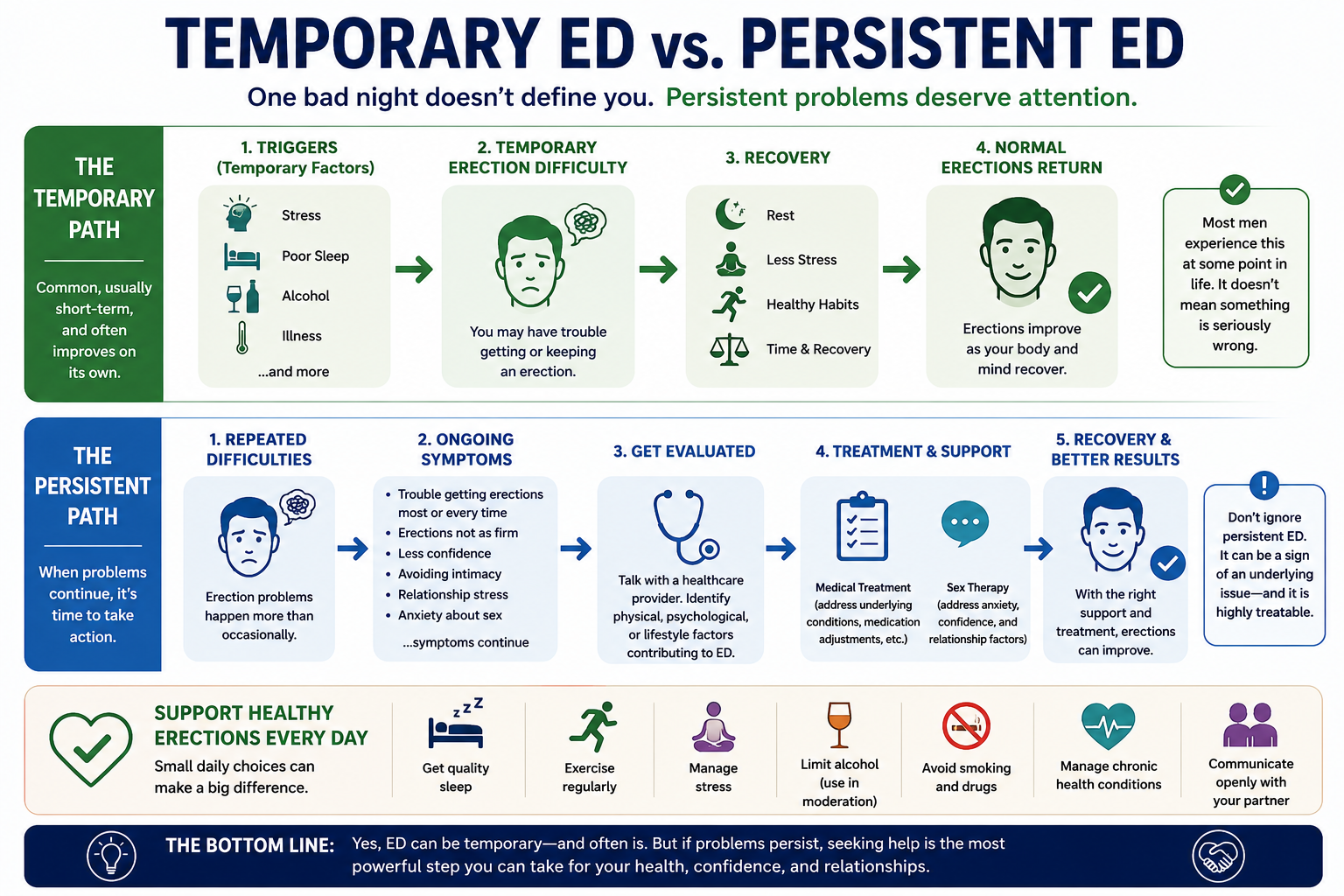
Can Erectile Dysfunction Be Temporary?
Yes. In many cases, erectile dysfunction (ED) is temporary.
An occasional erection problem is a normal part of life and doesn't necessarily mean you have a long-term medical condition. Many men experience temporary ED at some point, especially during times of increased stress, illness, fatigue, or major life changes.
The key is recognizing the difference between a temporary setback and a problem that continues over time.
Common Causes of Temporary Erectile Dysfunction
Many everyday situations can temporarily affect your ability to get or maintain an erection.
These include:
High levels of stress
Performance anxiety
Poor sleep
Fatigue
Drinking too much alcohol
Recreational drug use
Illness or infection
Relationship conflict
Major life changes
Certain short-term medications
Once these factors improve, erections often return to normal.
For example, someone who has had a stressful week at work, slept only a few hours each night, and drank heavily over the weekend may notice difficulty getting an erection. After getting adequate rest, reducing stress, and allowing the body to recover, erections may improve without any medical treatment.
Temporary Doesn't Mean "It's All in Your Head"
One of the biggest misconceptions about temporary ED is that it isn't "real."
Temporary erectile dysfunction is absolutely real.
Stress hormones, alcohol, sleep deprivation, illness, and anxiety all create physical changes in the body that can affect blood flow, nerve signaling, hormone levels, and sexual arousal.
Even when the cause is psychological, the erection difficulty is a genuine physical response—not something you're imagining.
When Temporary ED Becomes Performance Anxiety
Sometimes the erection problem itself isn't what lasts.
The worry about it does.
Imagine you lose an erection one night because you were exhausted.
The next time you're intimate, you remember what happened.
You begin wondering:
"What if it happens again?"
Instead of enjoying the moment, you start monitoring your erection.
That anxiety activates your body's stress response, making another erection problem more likely.
Now you're no longer dealing only with fatigue—you've entered the performance anxiety cycle.
For many men, this is how occasional ED becomes an ongoing concern.
When ED May Not Be Temporary
While temporary ED is common, persistent erection difficulties deserve medical attention.
You should consider talking with a healthcare provider if:
You've been experiencing erection difficulties for several weeks or longer.
The problem happens most or every time you have sex.
Your erections have become noticeably less firm over time.
You also have diabetes, high blood pressure, heart disease, or another chronic medical condition.
You recently started a medication that may affect sexual function.
Your symptoms are affecting your confidence, relationship, or quality of life.
Persistent ED doesn't necessarily mean something serious is wrong, but it is worth evaluating.
Can Temporary ED Be Prevented?
Not every episode can be prevented, but healthy habits can reduce your risk.
Some of the best ways to support healthy erections include:
Getting enough sleep each night.
Exercising regularly.
Managing stress.
Limiting excessive alcohol use.
Avoiding smoking and recreational drugs.
Managing chronic health conditions.
Staying physically active.
Talking openly with your partner instead of putting pressure on yourself to "perform."
Remember, erections are influenced by your overall health. Taking care of your body often means taking care of your sexual health as well.
The Bottom Line
Yes, erectile dysfunction can absolutely be temporary.
For many men, an isolated erection problem is simply the result of stress, fatigue, alcohol, illness, or another temporary factor. As those circumstances improve, erections often return to normal.
However, if erection difficulties continue, happen frequently, or begin affecting your confidence or relationships, don't ignore them. Erectile dysfunction is highly treatable, and early evaluation can help identify whether the cause is physical, psychological, or a combination of both.
Part 2: Why Erectile Dysfunction Happens
The Most Common Causes of Erectile Dysfunction
If you've been experiencing erectile dysfunction (ED), one of your first questions is probably:
"Why is this happening?"
The answer isn't always simple.
Erectile dysfunction is rarely caused by just one thing. Instead, it's usually the result of several physical, psychological, relationship, or lifestyle factors working together. Because an erection depends on healthy blood flow, nerves, hormones, brain function, and emotional well-being, changes in any of these areas can affect your ability to get or maintain an erection.
For some men, the cause is primarily medical. For others, it's anxiety, stress, or relationship challenges. Many experience a combination of both.
The good news is that identifying the cause is the first step toward finding the right treatment.
The Four Main Categories of Erectile Dysfunction
Most causes of erectile dysfunction fall into four broad categories:
1. Physical (Medical) Causes
Medical conditions are one of the most common causes of persistent erectile dysfunction.
Conditions that affect blood flow, nerves, hormones, or overall health can interfere with the body's ability to produce or maintain an erection.
Common examples include:
Heart disease
High blood pressure
Diabetes
High cholesterol
Low testosterone
Obesity
Sleep apnea
Neurological disorders
Pelvic injuries or surgery
Sometimes erectile dysfunction is the first noticeable sign that something else is affecting your health.
2. Psychological Causes
Your brain is one of your most important sexual organs.
Stress, anxiety, depression, past trauma, and negative beliefs about sex can all interfere with sexual arousal and make erections less reliable.
Psychological causes are especially common in younger men, although they can affect anyone at any age.
Some of the most common psychological contributors include:
Performance anxiety
Chronic stress
Generalized anxiety
Depression
Shame or guilt surrounding sex
Low self-confidence
Even when the cause is psychological, the erection difficulty is completely real.
3. Relationship Factors
Healthy relationships don't guarantee healthy erections.
Relationship stress can affect emotional safety, desire, communication, and sexual confidence.
Common relationship factors include:
Frequent conflict
Poor communication
Loss of emotional intimacy
Fear of disappointing your partner
Mismatched sexual desire
Trust concerns
Infidelity recovery
Pressure to perform
When emotional connection suffers, sexual confidence often suffers too.
4. Lifestyle Factors
Everyday habits have a significant impact on sexual health.
Lifestyle choices influence blood flow, hormone production, energy levels, mood, and cardiovascular health—all of which affect erections.
Lifestyle factors that can contribute to ED include:
Smoking
Excessive alcohol use
Recreational drug use
Poor sleep
Lack of physical activity
Chronic stress
Poor nutrition
Obesity
The encouraging news is that many lifestyle-related causes can improve with healthy changes over time.
Why Many Men Have More Than One Cause
One of the biggest misconceptions about erectile dysfunction is that there must be a single explanation.
In reality, ED is often caused by several factors happening at once.
For example:
A man with high blood pressure may experience mild changes in blood flow. After losing an erection once, he becomes worried it will happen again. That anxiety increases his stress response during sex, making erections even more difficult.
Now both a physical condition and performance anxiety are contributing to the problem.
Or imagine someone working long hours, sleeping poorly, drinking more alcohol than usual, and feeling disconnected from their partner. None of these factors alone may cause ED, but together they can significantly affect sexual function.
This is why a thorough evaluation is so important. Looking at the whole picture often leads to better treatment outcomes.
Remember: Erectile Dysfunction Is Usually Treatable
No matter what's contributing to your erectile dysfunction, there is reason to be hopeful.
Medical treatments, lifestyle changes, counseling, sex therapy, relationship work, or a combination of these approaches can help many men regain satisfying sexual function.
The most effective treatment starts with understanding the underlying cause—not just treating the symptoms.

Medical Causes of Erectile Dysfunction
Many people assume erectile dysfunction (ED) is simply a normal part of getting older. While age can increase the likelihood of experiencing ED, aging itself does not cause erectile dysfunction.
More often, ED is related to an underlying medical condition that affects blood flow, nerve function, hormone levels, or overall health.
Because an erection depends on several body systems working together, problems in any one of those systems can make erections less reliable.
In some cases, erectile dysfunction may even be one of the first warning signs that something else is happening in your body.
Heart Disease and Blood Vessel Problems
Healthy blood flow is essential for an erection.
When you're sexually aroused, blood vessels relax and allow blood to rapidly fill the penis. If blood flow is reduced, getting or maintaining an erection becomes more difficult.
Conditions that affect blood vessels are some of the most common medical causes of ED, including:
Heart disease
High blood pressure
High cholesterol
Atherosclerosis (hardening of the arteries)
Because the blood vessels in the penis are much smaller than those in the heart, changes in circulation may show up as erection problems years before someone develops chest pain or other symptoms of heart disease.
For this reason, healthcare providers often consider persistent erectile dysfunction a reason to evaluate a person's cardiovascular health.
Diabetes
Diabetes is one of the leading medical causes of erectile dysfunction.
Over time, high blood sugar can damage both blood vessels and nerves, making it more difficult for the brain and body to communicate during sexual arousal.
Men with diabetes may notice:
Difficulty getting an erection.
Erections that aren't as firm.
Difficulty maintaining an erection.
Changes in sexual sensation.
Keeping blood sugar well controlled can reduce the risk of these complications and support better sexual health.
Low Testosterone
Testosterone plays an important role in sexual desire, energy, mood, and overall sexual function.
However, low testosterone is often misunderstood.
While low testosterone can contribute to erectile dysfunction, it is not the cause of every erection problem. Many men with normal testosterone levels experience ED, and many men with lower testosterone levels continue to have normal erections.
Symptoms of low testosterone may include:
Lower sex drive
Fatigue
Reduced muscle mass
Mood changes
Fewer spontaneous morning erections
If low testosterone is suspected, your healthcare provider can order blood tests to determine whether hormone levels are contributing to your symptoms.
Neurological Conditions
An erection depends on healthy communication between your brain, spinal cord, and the nerves in your penis.
Conditions that affect the nervous system may interfere with these signals.
Examples include:
Multiple sclerosis
Parkinson's disease
Stroke
Spinal cord injuries
Peripheral neuropathy
Nerve damage related to diabetes
Depending on the cause, treatments may include medication, rehabilitation, assistive devices, or specialized sexual health care.
Pelvic Surgery and Cancer Treatment
Certain surgeries or cancer treatments can affect the nerves and blood vessels involved in erections.
Examples include:
Prostate cancer surgery
Bladder surgery
Colorectal surgery
Pelvic radiation therapy
Many men experience temporary or long-term changes in erectile function after these treatments.
The good news is that penile rehabilitation, ED medications, vacuum erection devices, injections, and sex therapy can often improve recovery and help people regain satisfying intimacy.
Sleep Apnea
Sleep is essential for healthy hormone production and sexual function.
Untreated sleep apnea can lower oxygen levels during sleep, increase the risk of cardiovascular disease, reduce testosterone production, and contribute to fatigue—all of which may affect erections.
If you snore loudly, wake up gasping for air, or feel exhausted despite getting enough sleep, it's worth discussing these symptoms with your healthcare provider.
Treating sleep apnea often improves overall health and may improve erectile function as well.
Obesity and Metabolic Health
Obesity is associated with several conditions that increase the risk of erectile dysfunction, including diabetes, high blood pressure, heart disease, and lower testosterone levels.
Carrying excess weight can also increase inflammation throughout the body and reduce healthy blood vessel function.
Even modest improvements in physical activity, nutrition, and weight management can have positive effects on both cardiovascular health and sexual function.
Chronic Illness
Many chronic medical conditions can affect erections, including:
Kidney disease
Liver disease
Thyroid disorders
Chronic pain conditions
Autoimmune diseases
Sometimes it's the condition itself that contributes to ED. Other times, medications used to treat these illnesses may play a role.
When Should You See a Medical Provider?
You should schedule an appointment with a healthcare provider if:
Erectile dysfunction happens regularly.
Your symptoms have lasted several weeks or longer.
You have diabetes, high blood pressure, high cholesterol, or heart disease.
You notice a sudden change in your erections without an obvious explanation.
You have other symptoms, such as fatigue, low libido, chest pain, or changes in urination.
ED is affecting your confidence, relationship, or quality of life.
A healthcare provider can evaluate potential medical causes, recommend appropriate testing, and discuss treatment options.
The Bottom Line
Erectile dysfunction is often a signal that your body needs attention—not a sign of weakness or a normal part of aging.
Many medical conditions that affect erections are highly treatable, especially when identified early.
If you're experiencing ongoing ED, don't ignore it or assume it's something you simply have to live with. Getting evaluated can improve not only your sexual health but also your overall health and well-being.

Mental Health and Erectile Dysfunction
When people hear that mental health can affect erections, they sometimes think it means the problem isn't "real."
Nothing could be further from the truth.
Your brain is your most important sexual organ. Every erection begins there. Your thoughts, emotions, stress level, and sense of safety all influence the physical processes that allow an erection to happen.
Mental health conditions don't create "imaginary" erectile dysfunction—they create real physical changes in the body that can make getting or maintaining an erection more difficult.
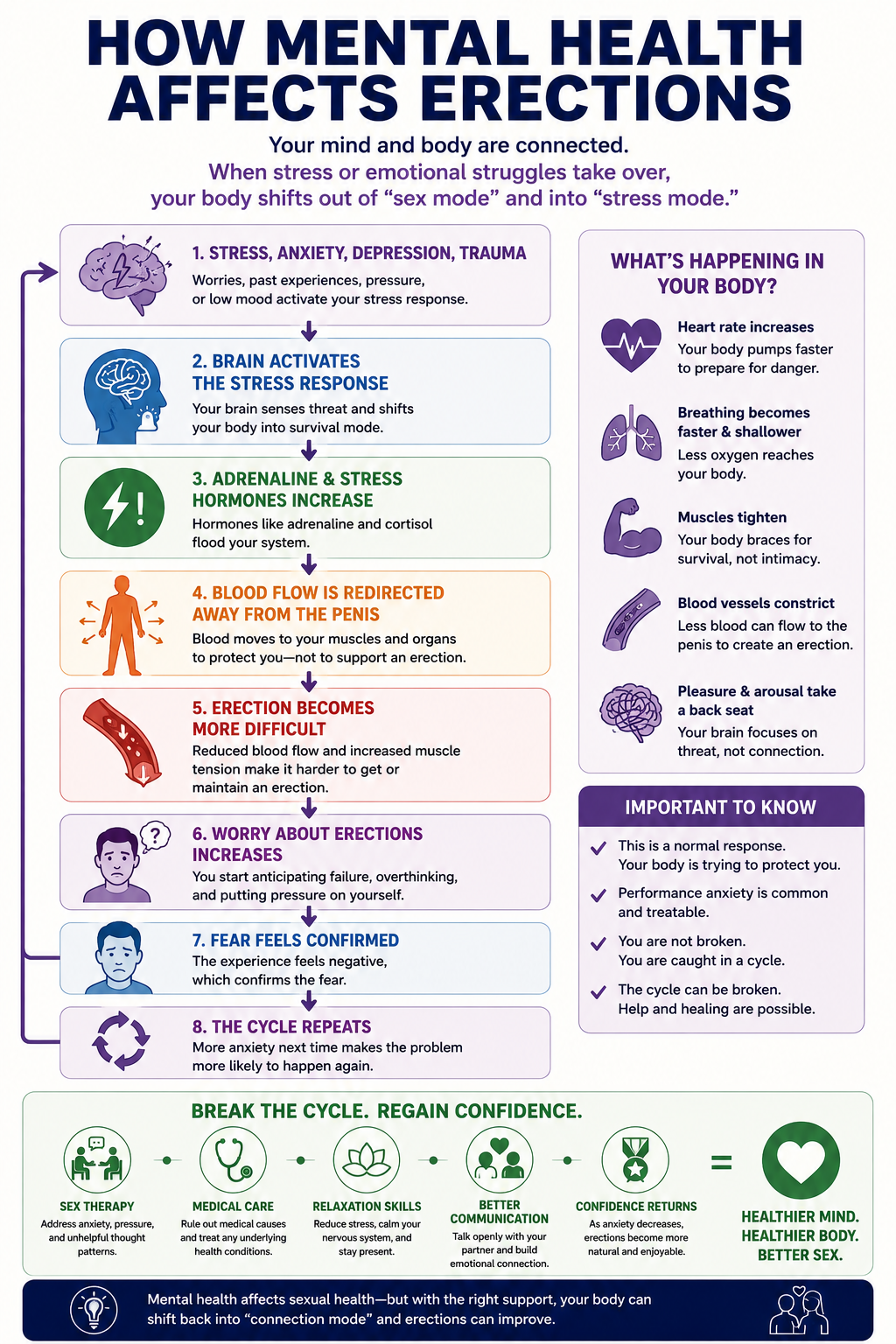
The Mind-Body Connection
An erection requires your body to feel safe enough to shift into a state of relaxation and arousal.
When you're calm and sexually engaged, your brain sends signals that allow blood vessels in the penis to relax and fill with blood.
When you're anxious, overwhelmed, or emotionally distressed, your body responds differently.
It activates your stress response.
Stress hormones like adrenaline increase your heart rate, tighten your muscles, and redirect blood flow away from the penis toward the large muscles needed for survival.
This response is incredibly helpful if you're escaping danger.
It's not very helpful if you're trying to have sex.
Stress
Everyone experiences stress.
Work deadlines, financial concerns, parenting responsibilities, caregiving, health problems, and major life changes can all affect sexual function.
When stress becomes chronic, your brain remains focused on solving problems rather than enjoying intimacy.
You may notice:
Less interest in sex.
Difficulty becoming aroused.
Trouble getting or maintaining an erection.
Feeling mentally distracted during intimacy.
Reducing stress doesn't just improve your mental health—it can improve your sexual health as well.
Anxiety
Anxiety is one of the most common psychological contributors to erectile dysfunction.
When you're anxious, your body stays on high alert.
Instead of relaxing into the experience, your brain scans for problems and potential threats.
This can make it difficult to:
Become sexually aroused.
Stay present during intimacy.
Maintain an erection.
Enjoy sex without worrying about what might happen next.
General anxiety can affect erections even when the anxiety has nothing to do with sex.
Performance Anxiety
Performance anxiety is a specific type of anxiety centered around sexual performance.
Rather than focusing on pleasure or connection, your attention shifts toward questions like:
"Am I hard enough?"
"What if I lose my erection?"
"What if I disappoint my partner?"
"What if this keeps happening?"
The more you monitor your erection, the more difficult it often becomes to maintain one.
This creates a frustrating cycle:
A difficult sexual experience leads to worry.
Worry leads to anxiety.
Anxiety affects the erection.
The erection problem confirms the fear.
The next sexual experience feels even more stressful.
The good news is that this cycle can be broken with the right treatment and support.
Depression
Depression can affect sexual health in several different ways.
Many people notice:
Lower sexual desire.
Reduced energy.
Less enjoyment during sex.
Difficulty becoming aroused.
Erectile dysfunction.
Depression may also reduce motivation, increase negative thoughts, and make emotional connection more difficult.
In addition, some antidepressant medications can contribute to erectile dysfunction or changes in sexual desire. If you notice changes after starting a medication, don't stop taking it on your own. Instead, talk with your healthcare provider about your options.
Trauma
Past experiences can continue to affect the body long after the event is over.
Sexual trauma, relationship trauma, childhood adversity, military trauma, medical trauma, or other overwhelming experiences may increase anxiety, make it harder to feel emotionally safe, or activate the body's stress response during intimacy.
For some people, their body reacts before they consciously realize they're feeling anxious.
Trauma responses are not a sign of weakness—they are your nervous system trying to protect you.
Trauma-informed therapy can help many people rebuild a sense of safety, confidence, and connection in intimate relationships.
Shame and Negative Beliefs About Sex
The messages we learn about sex growing up can stay with us for years.
Some people were taught that sex is shameful, selfish, sinful, or something that should never be discussed.
Others have experienced criticism, embarrassment, or negative sexual experiences that shaped how they see themselves.
These beliefs can increase anxiety, self-consciousness, and pressure during intimacy.
When sex becomes something to "get right" instead of something to enjoy, erections often become less reliable.
Mental Health Doesn't Mean the Cause Is "Only Psychological"
Many men worry that if stress or anxiety contributes to their ED, people will think they're imagining the problem.
That's not how erections work.
Mental health changes your body's physiology.
Stress hormones affect blood flow.
Anxiety changes nerve signaling.
Depression affects energy, motivation, and sexual desire.
These are real biological changes—not imagined ones.
It's also common for mental health concerns to exist alongside medical conditions.
For example, someone with diabetes may develop mild erectile dysfunction because of changes in blood flow. After several frustrating experiences, they become anxious before every sexual encounter.
Now both the medical condition and the anxiety are contributing to the problem.
The Bottom Line
Mental health and sexual health are deeply connected.
Stress, anxiety, depression, trauma, and shame can all affect the body's ability to achieve and maintain an erection. That doesn't mean the problem is "all in your head." It means your brain and body are working exactly as they're designed to under stress.
The encouraging news is that mental health concerns are treatable. Whether through stress management, counseling, sex therapy, trauma therapy, medication adjustments, or a combination of approaches, addressing your mental health can improve both your overall well-being and your sexual confidence.
Performance Anxiety: Why Your Mind Can Affect Your Erection
For many men, erectile dysfunction isn't caused by a medical condition—it's caused, or made worse, by performance anxiety.
Performance anxiety is one of the most common psychological causes of erectile dysfunction, especially in younger men and in those whose erection difficulties began suddenly.
The good news is that performance anxiety is highly treatable.
Understanding why it happens is the first step toward breaking the cycle.
What Is Performance Anxiety?
Performance anxiety is the fear or worry that you won't "perform well" during sexual activity.
Instead of focusing on pleasure, connection, or intimacy, your mind becomes consumed with questions like:
"What if I lose my erection?"
"What if I'm not hard enough?"
"What if I disappoint my partner?"
"What if they think I'm not attracted to them?"
"What if this keeps happening?"
When these thoughts take over, your body responds as if you're facing a threat.
Unfortunately, anxiety and erections don't work well together.
Your Brain Controls Your Erection
Many people think erections are controlled only by the penis.
They're not.
Every erection begins in the brain.
When you feel emotionally safe, relaxed, and sexually aroused, your brain sends signals through your nervous system that tell the blood vessels in your penis to relax and fill with blood.
This process happens automatically—you don't have to force it.
In fact, the less you try to control it, the more naturally it tends to happen.
Anxiety Activates Your Stress Response
When your brain detects fear or pressure, it shifts your body into survival mode.
Your body releases stress hormones such as adrenaline.
This causes several physical changes:
Your heart rate increases.
Your muscles become tense.
Your breathing becomes faster and shallower.
Blood flow is redirected toward the large muscles used for survival.
Blood vessels supplying the penis become less able to support an erection.
In other words, your body begins preparing to protect you—not to have sex.
This response is completely normal.
It's just happening at the wrong time.
The Harder You Try, the Harder It Gets
One of the most frustrating parts of performance anxiety is that trying harder often makes erections more difficult.
After one episode of erectile dysfunction, many men become hyperaware of every sexual experience.
Instead of enjoying intimacy, they begin monitoring themselves.
They may wonder:
"Am I getting hard yet?"
"Am I staying hard?"
"Can my partner tell?"
"Is something wrong with me?"
Psychologists sometimes call this spectatoring—watching and evaluating yourself instead of experiencing the moment.
The more attention you give to monitoring your erection, the less attention your brain gives to pleasure, connection, and arousal.
As anxiety increases, erections often become less reliable.
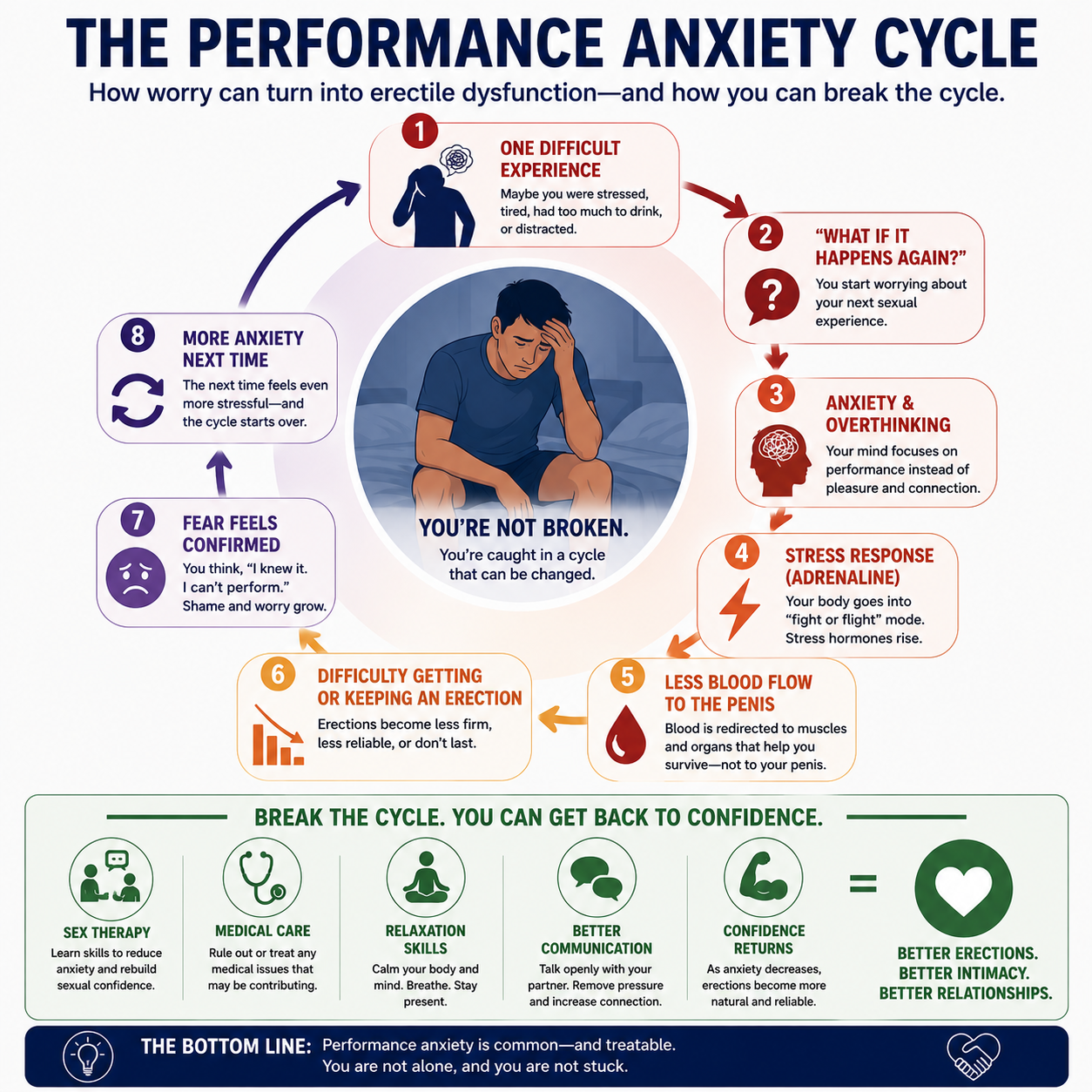
The Performance Anxiety Cycle
Performance anxiety often follows a predictable pattern.
It may begin with a single difficult experience caused by something completely temporary, such as stress, fatigue, alcohol, illness, or distraction.
Then the cycle begins:
You experience one episode of erection difficulty.
You begin worrying it will happen again.
You become anxious before or during sex.
Anxiety activates your stress response.
Your erection becomes more difficult to achieve or maintain.
Your fears feel confirmed.
The next sexual experience feels even more stressful.
Over time, the fear of erectile dysfunction can become more powerful than the original cause.
The encouraging news is that this cycle can be interrupted.
Signs Performance Anxiety May Be Affecting You
Performance anxiety may be contributing to your erection difficulties if:
You can usually get an erection during masturbation but struggle with a partner.
You wake up with morning erections.
Your erections are stronger in some situations than others.
The problem started suddenly after one difficult sexual experience.
You become nervous before intimacy.
You spend a lot of time checking whether you're getting or staying hard.
Your erections change depending on your stress level.
The problem is worse with a new partner than with someone you feel comfortable with.
These signs don't automatically rule out a medical cause, but they suggest anxiety may be playing an important role.
Performance Anxiety Is More Common Than You Think
Almost every sexually active person experiences moments of self-consciousness.
Whether it's worrying about erections, orgasm, body image, pleasing a partner, or sexual experience, concerns about performance are incredibly common.
One episode of erection difficulty can happen to anyone.
What keeps the problem going is often the fear that it will happen again.
Knowing this can help remove some of the shame that many men carry.
Can Performance Anxiety Be Treated?
Absolutely.
Performance anxiety responds well to evidence-based treatment.
Depending on your situation, treatment may include:
Cognitive behavioral therapy (CBT)
Mindfulness and relaxation techniques
Communication with your partner
Addressing underlying anxiety or depression
Treating any medical conditions that may also be contributing
For many men, treatment involves improving both physical and emotional health.
The Bottom Line
Performance anxiety is one of the most common—and most treatable—causes of erectile dysfunction.
Your mind and body are constantly working together during sexual activity. When anxiety activates your stress response, it creates real physical changes that make erections more difficult.
The good news is that this cycle isn't permanent. With the right support, it's possible to reduce anxiety, rebuild confidence, and enjoy sex without constantly worrying about your erection.
Relationship Factors That Affect Erections
When people think about erectile dysfunction (ED), they often focus on medical conditions or hormones.
But relationships matter, too.
The quality of your relationship can have a significant impact on your sexual confidence, emotional connection, and ability to become aroused. While relationship problems don't cause every case of erectile dysfunction, they can contribute to ED or make an existing problem feel even more difficult.
Healthy relationships don't guarantee perfect erections, just as relationship struggles don't automatically mean you'll experience ED. However, feeling emotionally connected, supported, and safe can make it easier to relax into intimacy.
Emotional Safety Matters
An erection is not simply a physical response—it's also influenced by your emotional state.
When you feel accepted, emotionally connected, and free from judgment, your body is more likely to relax and respond naturally to sexual arousal.
On the other hand, if you're worried about criticism, rejection, conflict, or disappointing your partner, your brain may activate its stress response instead.
That shift from feeling safe to feeling threatened can make erections much more difficult.
Communication Problems
Many couples avoid talking about sex because they feel embarrassed or don't want to hurt each other's feelings.
Unfortunately, avoiding the conversation often makes things worse.
Without communication, partners may begin making assumptions.
Someone experiencing ED may think:
"My partner probably thinks I'm not attracted to them."
Meanwhile, their partner may wonder:
"Maybe they don't find me attractive anymore."
Neither assumption may be true.
Open, honest conversations help reduce misunderstandings and remind both partners that erectile dysfunction is something you can work through together.
Fear of Disappointing Your Partner
Many men place enormous pressure on themselves to satisfy their partner every time they have sex.
While wanting to please your partner is natural, believing you must perform perfectly can create intense anxiety.
Thoughts like:
"I can't let them down."
"I have to stay hard the entire time."
"Sex has to end with intercourse."
"If I lose my erection, I've failed."
...can quickly shift your attention away from pleasure and connection.
The more pressure you feel, the more difficult it often becomes to maintain an erection.
Relationship Conflict
Frequent arguments, resentment, unresolved hurt, or ongoing tension can affect sexual intimacy.
When emotional closeness decreases, many couples notice changes in their sexual relationship as well.
Conflict may reduce:
Emotional connection
Desire
Trust
Affection
Sexual confidence
Addressing relationship concerns doesn't guarantee erections will immediately improve, but it often creates a stronger foundation for intimacy.
Mismatched Sexual Desire
It's common for partners to have different levels of sexual desire.
Problems arise when those differences create pressure.
For example, if one partner frequently initiates sex while the other worries about disappointing them, sex can begin to feel like a performance instead of a shared experience.
Over time, this pressure may increase anxiety and contribute to erectile difficulties.
Learning to communicate openly about desire, expectations, and different ways of being intimate can reduce this stress.
Trust and Emotional Connection
Trust plays a powerful role in sexual intimacy.
When trust has been damaged—whether because of infidelity, dishonesty, repeated conflict, or emotional distance—many people notice changes in their sexual response.
Some individuals become anxious.
Others become emotionally withdrawn.
Still others find it difficult to relax enough to become fully aroused.
Rebuilding trust often takes time, but emotional healing can also support sexual healing.
Pressure to Perform
One of the biggest relationship challenges couples face is unintentionally placing pressure on erections.
Sometimes the pressure comes from within.
Sometimes it comes from a partner.
Questions like:
"Are you okay?"
"Why did you lose your erection?"
"Is it because of me?"
"Do you still find me attractive?"
...are understandable, but in the middle of intimacy they can increase anxiety and make it even harder for an erection to return.
A more helpful approach is to shift the focus away from the erection and back toward connection, affection, and shared pleasure.
Erectile Dysfunction Doesn't Mean You're No Longer Attracted to Your Partner
This is one of the biggest misconceptions about erectile dysfunction.
Many partners assume:
"If they loved me or wanted me, they would be able to get an erection."
In reality, attraction and erections are not the same thing.
A person can deeply love their partner, find them incredibly attractive, and still experience erectile dysfunction because of stress, anxiety, fatigue, medical conditions, medication side effects, or performance anxiety.
Separating erections from attraction can help reduce blame, shame, and unnecessary conflict.
Working Together as a Team
The healthiest couples approach erectile dysfunction as a shared challenge rather than an individual failure.
Instead of asking:
"Whose fault is this?"
Try asking:
"How can we support each other?"
This shift changes the conversation from blame to collaboration.
Many couples discover that improving communication, expanding their definition of intimacy, and reducing performance pressure strengthens their relationship—even before erections fully improve.
The Bottom Line
Relationships don't cause every case of erectile dysfunction, but they can influence how often it happens, how stressful it feels, and how quickly couples recover from it.
Emotional safety, communication, trust, and reducing pressure all play an important role in healthy sexual relationships.
When couples work together instead of against each other, erectile dysfunction often becomes much more manageable—and intimacy becomes more connected, satisfying, and resilient.

How Stress, Burnout, and Life Changes Affect Sexual Performance
Life doesn't stop when you want to have sex.
Work deadlines, parenting, financial concerns, caring for loved ones, moving, health problems, grief, and major life transitions all place demands on your mind and body. While these experiences are a normal part of life, they can also affect your ability to get or maintain an erection.
For many men, erectile dysfunction doesn't begin because something is "wrong." It begins because their body is overwhelmed.
The encouraging news is that stress-related erection difficulties are common, understandable, and often improve when the underlying stress is addressed.
Stress Changes Your Body
Stress affects much more than your mood.
When your brain perceives stress, it activates your body's natural stress response. Hormones like adrenaline and cortisol increase, your heart rate rises, your muscles become tense, and blood flow is redirected toward the parts of your body that help you respond to danger.
This response is incredibly helpful if you're facing a real threat.
It's much less helpful when you're trying to relax and enjoy intimacy.
Because erections depend on relaxation, healthy blood flow, and feeling mentally present, chronic stress can interfere with every stage of sexual arousal.
Burnout Doesn't Stay at Work
Burnout is more than simply feeling tired.
It's a state of ongoing emotional, physical, and mental exhaustion caused by prolonged stress.
Whether burnout comes from your career, parenting, caregiving, school, or another responsibility, it often leaves you with very little energy for intimacy.
You may notice:
Less interest in sex.
Difficulty becoming aroused.
Trouble getting or maintaining an erection.
Feeling emotionally disconnected.
Wanting rest more than intimacy.
Burnout doesn't mean you love your partner any less. It often means your mind and body are asking for recovery.
Major Life Changes Can Affect Erections
Even positive life events can create stress.
Major transitions often require your brain to adapt, which can temporarily affect sexual desire and performance.
Examples include:
Starting a new job.
Losing a job.
Getting married.
Becoming a parent.
Moving to a new home.
Caring for aging parents.
Pregnancy and the postpartum period.
Divorce or separation.
Retirement.
Grief after the loss of a loved one.
During times of change, it's common for your sexual response to fluctuate.
For many people, erections improve once life becomes more predictable and stress levels decrease.
Mental Distraction Makes Arousal More Difficult
Sexual arousal requires attention.
If your mind is replaying tomorrow's meeting, worrying about paying bills, thinking about the kids, or planning your next task, it's difficult to fully engage in intimacy.
Many men describe feeling like they're physically present but mentally somewhere else.
This isn't a lack of attraction—it's a sign that your brain is still focused on solving problems instead of experiencing pleasure.
Sleep Plays a Bigger Role Than You Think
Stress and burnout often interfere with sleep.
Unfortunately, poor sleep can also affect erections.
Not getting enough quality sleep can:
Increase stress hormones.
Reduce testosterone production.
Lower energy levels.
Decrease sexual desire.
Make erections less reliable.
Healthy sleep is one of the simplest—and most overlooked—ways to support sexual health.
When Stress Turns Into Performance Anxiety
For some men, stress leads to one episode of erectile dysfunction.
Then a new source of stress develops.
They begin worrying about whether it will happen again.
Now they're dealing with two challenges:
The original life stress.
Anxiety about future sexual performance.
Over time, this creates a cycle where stress outside the bedroom combines with anxiety inside the bedroom.
Addressing both sources of stress often leads to the best outcomes.
Supporting Your Sexual Health During Stressful Times
You can't eliminate every source of stress, but you can reduce its impact on your sexual health.
Helpful strategies include:
Prioritizing consistent, quality sleep.
Exercising regularly.
Making time for relaxation and recovery.
Talking openly with your partner about stress.
Setting realistic expectations for intimacy.
Reducing pressure to have "perfect" sex.
Practicing mindfulness to stay present during intimacy.
Seeking professional support if stress or burnout becomes overwhelming.
Remember, intimacy doesn't have to disappear during stressful seasons. Sometimes slowing down, communicating openly, and focusing on connection rather than performance can help couples stay close while life feels demanding.
The Bottom Line
Stress, burnout, and major life changes can all affect sexual performance.
That doesn't mean your body is broken or that your relationship is failing. It means your nervous system is responding to the demands being placed on it.
As stress decreases and your mind and body have a chance to recover, sexual function often improves. If erection difficulties continue even after the stressful period has passed, it's worth talking with a healthcare provider or a sex therapist to explore other contributing factors.
Your sexual health is closely connected to your overall well-being. Taking care of yourself isn't just good for your mental health—it's good for your sex life, too.

Medications That Can Cause Erectile Dysfunction
If you've recently started a new medication and noticed changes in your erections, you're not imagining it.
Many prescription medications can affect sexual function. In some cases, they may make it more difficult to get or maintain an erection. Others may reduce sexual desire, delay orgasm, or affect ejaculation.
This doesn't mean you should stop taking your medication. In many situations, the benefits of treatment outweigh the side effects, and there may be ways to reduce or manage sexual symptoms.
The most important step is talking with your healthcare provider before making any changes.
How Medications Can Affect Erections
An erection depends on healthy blood flow, nerve function, hormone balance, and communication between your brain and body.
Some medications may interfere with one or more of these systems by:
Reducing blood flow to the penis.
Affecting nerve signals involved in arousal.
Changing hormone levels.
Lowering sexual desire.
Increasing fatigue or drowsiness.
Affecting mood or emotional responsiveness.
Not everyone experiences these side effects, and reactions can vary from person to person.
Antidepressants
Some antidepressants are well known for causing sexual side effects.
Selective serotonin reuptake inhibitors (SSRIs) and serotonin-norepinephrine reuptake inhibitors (SNRIs) may contribute to:
Difficulty getting or maintaining an erection.
Lower sexual desire.
Delayed orgasm.
Difficulty reaching orgasm.
These medications can be life-changing for depression and anxiety, so it's important not to stop taking them without medical guidance.
If sexual side effects are affecting your quality of life, your healthcare provider may recommend adjusting the dose, switching medications, or adding another treatment.
Blood Pressure Medications
High blood pressure itself can contribute to erectile dysfunction, but some medications used to treat it may also affect erections.
Examples include certain:
Diuretics ("water pills")
Beta blockers
Many newer blood pressure medications have a lower risk of sexual side effects.
If you've noticed changes after starting blood pressure medication, discuss your concerns with your healthcare provider rather than stopping the medication on your own.
Medications for Enlarged Prostate
Some medications used to treat benign prostatic hyperplasia (BPH), or an enlarged prostate, may affect sexual function.
Depending on the medication, side effects can include:
Difficulty getting an erection.
Lower sexual desire.
Changes in ejaculation.
Fortunately, not everyone experiences these effects, and alternative treatments may be available.
Hormonal Medications
Medications that lower testosterone or change hormone levels can affect sexual desire and erectile function.
Examples include some treatments used for:
Prostate cancer
Gender-affirming hormone therapy
Certain endocrine conditions
If hormone changes are contributing to ED, your healthcare provider can help determine the safest and most appropriate treatment options.
Opioid Pain Medications
Long-term opioid use may lower testosterone levels and reduce sexual function.
People taking opioids for chronic pain sometimes notice:
Difficulty getting or maintaining an erection.
Fatigue.
Reduced energy.
Never stop opioid medications suddenly without medical supervision.
Finasteride and Similar Medications
Some medications used to treat hair loss or an enlarged prostate, such as finasteride, have been associated with sexual side effects in some people.
Potential side effects include:
Erectile dysfunction.
Reduced libido.
Changes in ejaculation.
Many people take these medications without experiencing problems, but if symptoms develop, it's worth discussing them with your prescribing clinician.
Other Medications That May Affect Erections
A variety of other medications have also been associated with erectile dysfunction in some individuals, including certain:
Anti-anxiety medications.
Antipsychotic medications.
Anti-seizure medications.
Chemotherapy drugs.
Some medications used to treat stomach ulcers.
Certain heart rhythm medications.
This doesn't mean these medications always cause ED. It simply means sexual side effects are possible.
Never Stop a Medication on Your Own
It can be tempting to stop taking a medication if you think it's affecting your sex life.
However, doing so may worsen the medical condition the medication is treating and could even be dangerous.
Instead:
Talk with your healthcare provider.
Explain what changes you've noticed.
Ask whether your medication could be contributing.
Discuss whether another medication or dose adjustment might be appropriate.
Many people are surprised to learn they have options.
Medication Side Effects Aren't Always the Whole Story
Sometimes a medication contributes to erectile dysfunction—but it isn't the only cause.
For example, someone with high blood pressure may already have reduced blood flow affecting erections. After starting medication, they notice even more difficulty.
Or someone taking an antidepressant may also be experiencing anxiety, depression, relationship stress, or poor sleep.
Often, several factors are working together.
Looking at the whole picture helps healthcare providers recommend the most effective treatment.
The Bottom Line
Many medications can affect sexual function, but that doesn't mean you have to choose between your health and your sex life.
If you've noticed changes in your erections after starting a medication, talk with your healthcare provider. In many cases, adjustments can be made that support both your overall health and your sexual well-being.
Never stop or change a prescribed medication without first speaking with the healthcare professional who prescribed it.

Hormones and Erectile Dysfunction
Hormones play an important role in sexual health, but they're often misunderstood.
Many people assume that erectile dysfunction (ED) automatically means they have low testosterone. While hormones can contribute to erection difficulties, they are only one part of a much larger picture.
An erection depends on healthy blood flow, nerve function, brain activity, emotional well-being, and hormones all working together. If one or more of these systems isn't functioning properly, erections may become less reliable.
For some men, hormone changes contribute to ED. For others, hormones have little or nothing to do with the problem.
What Are Hormones?
Hormones are chemical messengers that help different parts of your body communicate with one another.
They regulate many important functions, including:
Sexual desire (libido)
Energy levels
Mood
Muscle mass
Bone health
Fertility
Sleep
Sexual function
Several hormones influence sexual health, but testosterone is the one most commonly associated with erectile dysfunction.
Testosterone and Erectile Dysfunction
Testosterone is the primary male sex hormone.
It plays an important role in:
Sexual desire
Morning erections
Energy
Mood
Sperm production
Muscle strength
However, testosterone is not the same thing as an erection.
Many men with normal testosterone levels experience erectile dysfunction.
Likewise, some men with lower testosterone levels continue to have normal erections.
Low testosterone is more likely to reduce sexual desire than to directly prevent an erection.
This is why measuring testosterone levels is only one part of evaluating ED.
Signs of Low Testosterone
Low testosterone may cause symptoms such as:
Lower sex drive
Fatigue
Reduced energy
Mood changes or irritability
Difficulty building muscle
Increased body fat
Fewer spontaneous morning erections
Reduced body hair in some cases
These symptoms can also have many other causes, so blood testing is necessary to determine whether testosterone levels are actually low.
Other Hormones That Can Affect Erections
While testosterone gets the most attention, several other hormones can also influence sexual function.
Thyroid Hormones
Both an underactive thyroid (hypothyroidism) and an overactive thyroid (hyperthyroidism) can affect sexual desire, energy, mood, and erectile function.
Treating thyroid conditions often improves overall well-being and may improve sexual function.
Prolactin
Prolactin is a hormone produced by the pituitary gland.
When prolactin levels become unusually high, it can reduce testosterone production, lower sexual desire, and contribute to erectile dysfunction.
Although this is less common, your healthcare provider may recommend testing prolactin levels if your symptoms suggest a hormonal cause.
Cortisol
Cortisol is often called the body's primary stress hormone.
During periods of chronic stress, cortisol levels may remain elevated.
Over time, this can affect:
Sexual desire
Sleep
Mood
Energy
Hormone balance
This is one reason why long-term stress can affect both libido and erectile function.
When Should Hormones Be Tested?
Hormone testing isn't necessary for every person with erectile dysfunction.
However, your healthcare provider may recommend blood tests if you have:
Low sexual desire
Fatigue
Fewer morning erections
Difficulty building muscle
Symptoms of low testosterone
Erectile dysfunction that doesn't improve with initial treatment
A medical history that increases the likelihood of hormonal problems
Blood tests are usually performed in the morning, when testosterone levels are naturally at their highest.
Can Testosterone Therapy Help?
For men who have confirmed low testosterone and symptoms related to testosterone deficiency, testosterone replacement therapy may improve:
Sexual desire
Energy
Mood
Overall sense of well-being
Some men also notice improvements in erectile function.
However, testosterone therapy is not a treatment for everyone with ED.
If your testosterone level is normal, taking extra testosterone is unlikely to improve erections and may expose you to unnecessary risks.
That's why it's important to have a proper medical evaluation before considering hormone treatment.
Hormones Are Only One Piece of the Puzzle
Many men search for a quick solution and assume testosterone is the missing piece.
In reality, erections depend on much more than hormones.
Blood flow, nerve function, cardiovascular health, medications, mental health, relationship dynamics, sleep, stress, and lifestyle all play important roles.
The most effective treatment begins with identifying the actual cause—not assuming every erection problem is hormonal.
The Bottom Line
Hormones are an important part of sexual health, but they are only one factor that influences erections.
Low testosterone and other hormonal conditions can contribute to erectile dysfunction, especially when accompanied by symptoms like low libido, fatigue, and reduced morning erections.
If you think your hormones may be affecting your sexual health, talk with your healthcare provider. A simple blood test can help determine whether hormone changes are contributing to your symptoms and guide the most appropriate treatment.
Remember, the goal isn't simply to raise hormone levels—it's to understand what's causing your symptoms so you can receive the care that's right for you.

How Trauma Can Affect Erections
Trauma can affect every part of a person's life—including their sexual health.
Many people are surprised to learn that past traumatic experiences can contribute to erectile dysfunction (ED), even years after the event occurred. This isn't because someone is weak or "can't get over it." It's because trauma can change how the brain and nervous system respond to stress, safety, and intimacy.
Understanding this connection can be the first step toward healing.
Trauma Doesn't Stay in the Past
Trauma is not defined only by what happened.
It's also about how your brain and body learned to respond afterward.
After a traumatic experience, your nervous system may become more sensitive to situations that feel emotionally or physically vulnerable.
For some people, intimacy can activate the same survival system that once helped protect them from danger.
This response happens automatically. It isn't a choice, and it isn't a sign that something is wrong with you.
Your Nervous System Prioritizes Safety
Healthy sexual arousal depends on feeling safe.
When your brain senses safety, it allows your body to relax, become emotionally present, and respond to sexual stimulation.
After trauma, your nervous system may become more likely to interpret certain situations as threatening—even when you're with a safe, loving partner.
When that happens, your body shifts into survival mode.
Instead of supporting sexual arousal, your brain focuses on protection.
This can make erections more difficult to achieve or maintain.
Trauma Can Affect Erections in Different Ways
Trauma affects everyone differently.
Some men experience:
Difficulty getting or maintaining an erection.
Lower sexual desire.
Anxiety before or during sex.
Feeling emotionally disconnected during intimacy.
Avoiding sexual situations altogether.
Difficulty staying present during sex.
Increased self-consciousness or fear of vulnerability.
Others may not notice changes until years after the traumatic event, especially during periods of increased stress.
Types of Trauma That May Affect Sexual Function
Many different experiences can influence sexual health.
These may include:
Childhood abuse or neglect.
Military or combat trauma.
Medical trauma or painful medical procedures.
Serious accidents.
Domestic violence.
Emotional abuse.
Relationship betrayal or infidelity.
Witnessing violence or other frightening events.
Not everyone who experiences trauma develops erectile dysfunction, and not everyone with ED has a history of trauma.
However, trauma can be one important piece of the puzzle.
Trauma Isn't Always About Sex
One common misconception is that only sexual trauma affects erections.
In reality, any experience that leaves your nervous system feeling chronically unsafe can influence sexual function.
For example, someone who experienced a serious car accident, combat, childhood neglect, or prolonged emotional abuse may notice anxiety, hypervigilance, or difficulty relaxing during intimacy.
The brain doesn't separate emotional safety from sexual safety as much as we often think.
Shame Can Make the Problem Worse
Many survivors of trauma carry feelings of shame, guilt, or self-blame.
When erection difficulties occur, these feelings can become even stronger.
Some men begin wondering:
"What's wrong with me?"
"Why can't I just relax?"
"Am I broken?"
"Will this ever get better?"
These thoughts are understandable—but they are not accurate.
Trauma responses are normal adaptations to abnormal experiences.
Your nervous system learned to protect you.
With the right support, it can also learn that intimacy can be safe again.
Healing Is Possible
One of the most encouraging things about trauma recovery is that the brain remains capable of change throughout life.
Trauma-informed treatment can help reduce the nervous system's stress response, increase emotional safety, and rebuild confidence during intimacy.
Depending on your needs, treatment may include:
Trauma-focused therapy.
Cognitive behavioral therapy (CBT).
Mindfulness and nervous system regulation skills.
Healing doesn't always happen overnight, but many people notice meaningful improvements in both their emotional well-being and their sexual relationships over time.
You Don't Have to Face This Alone
Trauma can feel incredibly isolating.
Many people avoid talking about it because they fear being judged, misunderstood, or dismissed.
You deserve compassionate care.
Whether your trauma happened recently or decades ago, support is available. Seeking help is not a sign of weakness—it's an investment in your health, your relationships, and your future.
The Bottom Line
Trauma can affect erections because it changes how the brain and nervous system respond to intimacy, stress, and safety.
These reactions are real, common, and treatable.
If you believe past trauma may be affecting your sexual health, know that healing is possible. With the right support, many people regain not only healthier sexual functioning but also a greater sense of safety, confidence, and connection with themselves and their partners.
Your past may help explain what you're experiencing—but it does not determine your future.
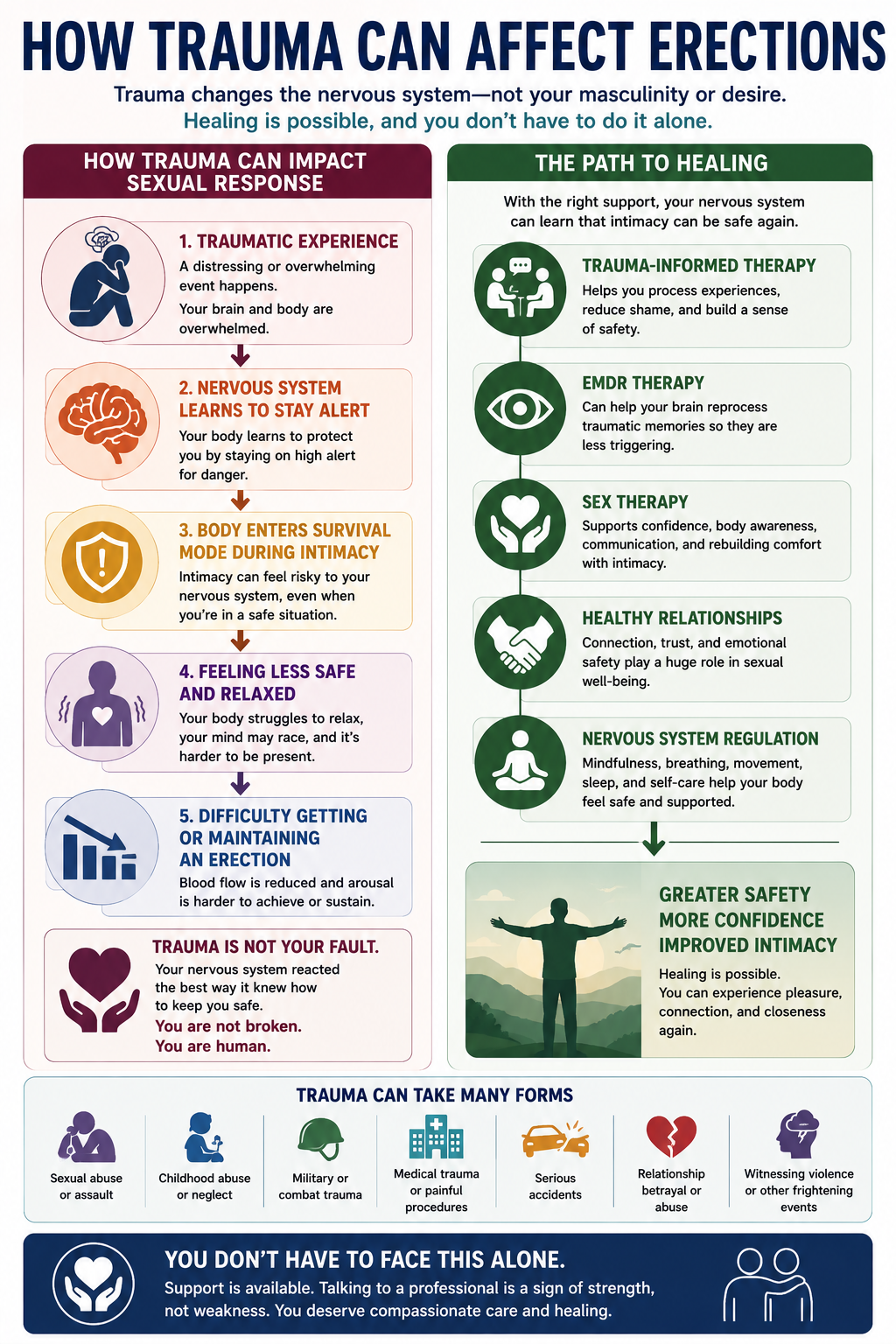
Lifestyle Factors That Influence Erectile Function
Your everyday habits play a bigger role in your sexual health than you might realize.
Because erections depend on healthy blood flow, hormone balance, nerve function, energy, and emotional well-being, the choices you make each day can influence how reliably your body responds during sexual activity.
Lifestyle factors aren't the cause of every case of erectile dysfunction (ED), but they often contribute. The encouraging news is that many of these factors can be improved over time, benefiting not only your erections but also your overall health.
Physical Activity
Regular exercise is one of the best things you can do for your sexual health.
Physical activity supports:
Healthy blood flow.
Heart health.
Testosterone production.
Energy levels.
Stress reduction.
Mood.
Weight management.
You don't have to become a marathon runner to see benefits.
Walking, cycling, swimming, strength training, and other forms of regular movement can all improve cardiovascular health, which is essential for healthy erections.
Smoking
Smoking damages blood vessels throughout the body, including those that supply the penis.
Over time, smoking can:
Reduce blood flow.
Damage blood vessel function.
Increase the risk of heart disease.
Increase the likelihood of erectile dysfunction.
Quitting smoking is one of the most important steps you can take to improve both your cardiovascular health and your sexual health.
Alcohol
Many people believe alcohol improves sex because it helps them relax.
While small amounts of alcohol may reduce inhibitions for some people, larger amounts can make it much more difficult to get or maintain an erection.
Heavy alcohol use may:
Reduce sexual arousal.
Delay orgasm.
Make erections less reliable.
Lower testosterone over time.
Affect nerve function with long-term use.
If you notice that erection problems happen mostly after drinking, alcohol may be playing a role.
Recreational Drugs
Many recreational drugs can interfere with sexual function.
Depending on the substance, they may affect:
Blood flow.
Nerve signaling.
Hormone levels.
Mood.
Sexual desire.
Erections.
While some substances may temporarily increase confidence or reduce anxiety, they often make erections less reliable and can contribute to long-term sexual health problems.
Sleep
Sleep is one of the most overlooked parts of sexual health.
During sleep, your body restores itself, regulates hormones, and supports healthy testosterone production.
Poor sleep may lead to:
Lower energy.
Increased stress.
Reduced libido.
Lower testosterone levels.
Difficulty getting or maintaining an erection.
Aim for seven to nine hours of quality sleep most nights whenever possible.
Nutrition
A healthy diet supports healthy blood vessels, heart health, and stable energy levels.
Eating a variety of fruits, vegetables, whole grains, lean proteins, healthy fats, and fiber helps support the cardiovascular system that erections depend on.
Rather than looking for a single "miracle food," focus on consistent eating habits that support your overall health.
What's good for your heart is often good for your erections.
Weight and Metabolic Health
Carrying excess weight increases the risk of several conditions linked to erectile dysfunction, including:
Diabetes.
High blood pressure.
High cholesterol.
Sleep apnea.
Lower testosterone levels.
Even modest improvements in weight, physical activity, and nutrition can support better overall health and may improve erectile function.
Progress—not perfection—is the goal.
Chronic Stress
Stress isn't only a mental health concern—it also affects your body.
Long-term stress increases adrenaline and cortisol, making it more difficult to relax into sexual arousal.
Managing stress through exercise, hobbies, mindfulness, social connection, or counseling can improve both mental well-being and sexual function.
Taking Care of Your Whole Health
Healthy erections are often a reflection of healthy body systems working together.
The same habits that lower your risk of heart disease, diabetes, and other chronic illnesses also support better sexual health.
Instead of focusing on erections alone, think about improving your overall well-being.
Small, consistent changes often have a greater impact than trying to change everything at once.
Lifestyle Changes Are Part of the Treatment Plan
Lifestyle changes don't replace medical care when it's needed.
If your ED is related to diabetes, heart disease, low testosterone, medication side effects, or another medical condition, those concerns still deserve appropriate treatment.
However, combining healthy lifestyle habits with medical care and, when appropriate, sex therapy often leads to the best outcomes.
The Bottom Line
Your daily habits have a powerful influence on your sexual health.
Regular exercise, quality sleep, limiting alcohol, avoiding smoking, eating a balanced diet, managing stress, and caring for your overall health all support healthy erectile function.
You don't have to make every change overnight.
Each positive step you take supports not only your erections but also your heart, your brain, your energy, your relationships, and your long-term health.
Remember, healthy erections aren't created by one habit alone. They're the result of a healthy body, a healthy mind, and a lifestyle that supports both.

Part 3: Erectile Dysfunction Across Different Populations
Erectile Dysfunction in Younger Men
Many people think erectile dysfunction (ED) only affects older men.
That's simply not true.
Although ED becomes more common with age, younger men can also experience difficulty getting or maintaining an erection. In fact, healthcare providers are seeing more young men seek treatment for erectile dysfunction than ever before.
If you're in your 20s, 30s, or early 40s, experiencing ED does not mean you're "too young," "less of a man," or permanently broken.
In many cases, erectile dysfunction in younger men is highly treatable.
Is ED Common in Younger Men?
Occasional erection difficulties are common at every age.
You might have trouble getting or maintaining an erection if you're:
Extremely stressed.
Anxious.
Sleep deprived.
Sick.
Drinking alcohol.
Using recreational drugs.
Nervous with a new partner.
Distracted by work or life responsibilities.
Having one or two episodes of erectile dysfunction does not necessarily mean you have a long-term problem.
However, if erection difficulties become frequent or continue for several weeks or months, it's important to talk with a healthcare provider.
Common Causes of ED in Younger Men
Unlike older adults, younger men are less likely to have age-related changes in blood vessels.
Instead, erectile dysfunction is often related to a combination of psychological, lifestyle, and medical factors.
Some of the most common causes include:
Performance anxiety.
Chronic stress.
Anxiety disorders.
Depression.
Poor sleep.
Heavy alcohol use.
Recreational drug use.
Smoking or vaping.
Relationship challenges.
Sexual trauma.
Side effects from certain medications.
Diabetes, hormonal conditions, or other medical concerns.
For many men, more than one factor is involved.
Performance Anxiety Is Especially Common
Performance anxiety is one of the leading contributors to erectile dysfunction in younger men.
Often, it begins with one temporary erection problem.
Maybe you were:
Tired.
Stressed.
Distracted.
Drinking alcohol.
Nervous with a new partner.
The next time you're intimate, you begin worrying:
"What if it happens again?"
That worry activates your body's stress response.
Instead of relaxing into the experience, you start monitoring your erection.
Ironically, the more pressure you put on yourself to stay hard, the more difficult it often becomes.
Fortunately, this cycle can be treated.
Don't Assume It's "Just Anxiety"
Because psychological causes are common in younger men, many people assume ED is always caused by stress or anxiety.
That's not always the case.
Even young adults can develop medical conditions that affect erections, including:
Diabetes.
High blood pressure.
High cholesterol.
Thyroid disorders.
Low testosterone.
Neurological conditions.
Side effects from medications.
A medical evaluation helps rule out underlying health concerns and ensures you're treating the actual cause rather than making assumptions.
Pornography and Unrealistic Expectations
Many younger men grow up with unrealistic messages about sex.
Pornography, social media, movies, and cultural expectations often create the impression that:
Erections should happen instantly.
Erections should never change during sex.
Sex should always end with intercourse.
Men should always be ready for sex.
Losing an erection means you've failed.
Real life is different.
Healthy sexual experiences include variation, communication, laughter, pauses, and occasional erection changes.
Comparing yourself to unrealistic expectations can increase anxiety and make erections less reliable.
Lifestyle Matters More Than You Think
The habits you build in your 20s and 30s affect your sexual health now and later in life.
Healthy habits that support erections include:
Regular exercise.
Quality sleep.
Managing stress.
Limiting excessive alcohol.
Avoiding smoking and recreational drugs.
Eating a balanced diet.
Staying physically active.
These habits support healthy blood flow, hormone balance, and cardiovascular health—all of which are essential for healthy erections.
Don't Wait to Ask for Help
Many younger men delay seeking treatment because they feel embarrassed or assume the problem will go away on its own.
While occasional erection difficulties often improve naturally, persistent ED deserves attention.
The sooner you seek help, the sooner you can:
Identify any underlying medical conditions.
Reduce performance anxiety.
Improve confidence.
Strengthen your relationship.
Prevent the cycle of anxiety and avoidance from becoming more established.
Asking for help is a sign that you're taking your health seriously.
The Bottom Line
Erectile dysfunction can happen at any age.
For younger men, ED is often related to stress, anxiety, lifestyle factors, relationship concerns, or temporary life circumstances, but medical conditions can also play a role.
The good news is that erectile dysfunction in younger men is highly treatable. Whether the cause is physical, psychological, or a combination of both, effective treatments are available.
If you're experiencing ongoing erection difficulties, don't ignore them and don't assume you have to figure it out alone. Talking with a healthcare provider or a qualified sex therapist can help you understand what's causing your symptoms and find a treatment plan that works for you.
Erectile Dysfunction in Midlife
Many men notice changes in their sexual response during their 40s and 50s.
These changes can be surprising, especially if sex used to feel effortless. You may find that erections take longer to develop, require more direct stimulation, or are less predictable than they were in your 20s.
These changes are common—and they don't necessarily mean you have erectile dysfunction.
Understanding what changes are normal and what deserves medical attention can help reduce unnecessary worry and improve your sexual confidence.
Sexual Response Naturally Changes With Age
As men get older, their sexual response often becomes more responsive rather than spontaneous.
When you were younger, sexual desire may have seemed to appear out of nowhere. An attractive thought, a brief touch, or simply waking up in the morning might have been enough to trigger an erection.
During midlife, many men find that arousal develops differently.
Instead of feeling instantly ready for sex, your body may need more time, more physical stimulation, and a greater sense of emotional connection before an erection develops.
This shift is a normal part of aging for many men.
It doesn't mean you've lost your sexuality or that something is wrong with your relationship. It simply means your body responds differently than it did years ago.
Outside Stressors Have a Bigger Impact
One of the biggest changes many men notice in midlife is that everyday stress has a greater effect on their sex life.
By this stage of life, you may be balancing:
A demanding career.
Financial responsibilities.
Raising children or teenagers.
Caring for aging parents.
Health concerns.
Relationship responsibilities.
Less time for rest and recovery.
When your mind is focused on deadlines, bills, family responsibilities, or tomorrow's schedule, it's much harder to stay present during intimacy.
Sexual arousal depends on attention.
If your brain is busy solving problems, it has less capacity to focus on pleasure and connection.
Presence Is an Important Part of Arousal
Many men assume erections are automatic.
In reality, healthy erections require your brain to be engaged in the experience.
If you're mentally replaying a stressful conversation, thinking about work, or worrying about everything waiting for you tomorrow, your body may struggle to fully shift into a state of sexual arousal.
This doesn't mean you're no longer attracted to your partner.
It means your nervous system is occupied elsewhere.
Learning to slow down, reduce distractions, and become mentally present can make a meaningful difference in your sexual experiences.
Changes in Erections Are Often Normal
During midlife, you may notice that:
Erections take longer to develop.
More direct touch is needed.
Erections are less firm if you're tired or stressed.
It takes longer to become fully aroused.
You may lose an erection if your attention shifts away from intimacy.
These changes are common and do not automatically mean you have erectile dysfunction.
However, if erection difficulties become frequent, persist for several weeks or months, or begin affecting your quality of life, it's important to seek a medical evaluation.
Midlife Is Also a Time to Prioritize Your Health
While some changes in sexual response are expected, midlife is also when medical conditions associated with erectile dysfunction become more common.
These include:
High blood pressure.
High cholesterol.
Diabetes.
Sleep apnea.
Cardiovascular disease.
Hormonal changes.
Side effects from medications.
Because erectile dysfunction can sometimes be an early warning sign of these conditions, don't assume that every change is "just getting older."
Talking with your healthcare provider can help identify whether there's an underlying medical cause that needs attention.
Managing Stress Supports Sexual Health
You can't eliminate every source of stress, but you can reduce its impact on your sex life.
Helpful strategies include:
Prioritizing quality sleep.
Exercising regularly.
Setting boundaries around work when possible.
Practicing mindfulness or relaxation techniques.
Spending intentional, distraction-free time with your partner.
Allowing enough time for arousal instead of rushing into sex.
Talking openly about changing sexual needs and expectations.
Many couples discover that slowing down actually leads to more satisfying intimacy.
Removing pressure and focusing on connection often allows responsive desire to develop naturally.
A Different Sexual Response Doesn't Mean a Worse One
Many men compare their current sexual response to what they experienced in their 20s.
This comparison can create unnecessary frustration.
Instead of expecting your body to respond exactly as it once did, consider learning how it responds now.
Midlife sexuality often becomes less about instant arousal and more about connection, communication, and taking time to enjoy the experience.
For many couples, this shift leads to deeper intimacy and more satisfying sex—not less.
The Bottom Line
Midlife brings normal changes to sexual response.
Many men notice that desire becomes more responsive than spontaneous, erections require more time and stimulation, and outside stress has a greater impact on their ability to stay present during intimacy.
These changes are common and do not necessarily mean you have erectile dysfunction.
At the same time, persistent erection difficulties should never be ignored. Midlife is an excellent time to prioritize your physical health, manage stress, and have open conversations with your partner and healthcare provider.
Your sex life may look different than it did 20 years ago—but different doesn't mean worse. With realistic expectations, healthy habits, and the right support when needed, many men continue to enjoy deeply satisfying sexual relationships throughout midlife.
Erectile Dysfunction and Aging
One of the biggest myths about erectile dysfunction (ED) is that it's simply a normal part of getting older.
The truth is more complicated.
While erectile dysfunction becomes more common with age, aging itself does not cause ED. Instead, getting older increases the likelihood of developing medical conditions, taking medications, and experiencing lifestyle changes that can affect erectile function.
Many men continue to enjoy healthy, satisfying sex lives well into their 60s, 70s, and beyond.
Growing older doesn't mean the end of your sex life—it often means learning how your body responds differently.
Erectile Dysfunction and Aging
One of the biggest myths about erectile dysfunction (ED) is that it's simply a normal part of getting older.
The truth is more complicated.
While erectile dysfunction becomes more common with age, aging itself does not cause ED. Instead, getting older increases the likelihood of developing medical conditions, taking medications, and experiencing lifestyle changes that can affect erectile function.
Many men continue to enjoy healthy, satisfying sex lives well into their 60s, 70s, and beyond.
Growing older doesn't mean the end of your sex life—it often means learning how your body responds differently.
How Sexual Response Changes with Age
As men age, it's normal for sexual response to become slower and less automatic than it was in early adulthood.
You may notice that:
Erections take longer to develop.
More physical stimulation is needed.
Erections may not feel as firm as they once did.
It may take longer to recover between erections.
Morning erections become less frequent.
Orgasms may feel different.
Ejaculation may involve less semen.
These changes are a normal part of aging for many men and do not necessarily mean you have erectile dysfunction.
Desire Often Becomes More Responsive
Many older men notice that sexual desire changes over time.
When you were younger, desire may have seemed spontaneous—you could become aroused quickly with very little stimulation.
As you age, desire often becomes more responsive.
This means your body may need:
More time.
More physical touch.
More emotional connection.
More mental presence.
Less pressure to perform.
Rather than feeling ready for sex immediately, arousal often builds gradually throughout an intimate experience.
This is a healthy and common change—not a sign that something is wrong.
Health Conditions Become More Common
Although aging itself doesn't cause ED, certain medical conditions become more common with age.
These include:
Heart disease.
High blood pressure.
High cholesterol.
Diabetes.
Sleep apnea.
Low testosterone.
Neurological disorders.
Enlarged prostate.
Side effects from medications.
Because these conditions can affect blood flow, nerves, or hormones, they may contribute to erectile dysfunction.
Treating the underlying condition often improves overall health and may improve sexual function as well.
Medications Can Play a Role
As people get older, they're also more likely to take medications for chronic health conditions.
Some medications used to treat:
High blood pressure.
Depression.
Anxiety.
Enlarged prostate.
Chronic pain.
Heart conditions.
...may contribute to erectile dysfunction in some individuals.
Never stop taking a prescribed medication without talking with your healthcare provider. In many cases, adjustments or alternative treatments are available.
Staying Healthy Supports Sexual Health
The same habits that support healthy aging also support healthy erections.
These include:
Regular physical activity.
A heart-healthy diet.
Quality sleep.
Managing chronic medical conditions.
Avoiding smoking.
Limiting excessive alcohol.
Managing stress.
Staying socially and emotionally connected.
Your heart, blood vessels, brain, and hormones all work together to support sexual function.
Taking care of your overall health is one of the best investments you can make in your sexual health.
Intimacy Can Continue to Grow
Many couples discover that while sex changes with age, intimacy often deepens.
As concerns about pregnancy, careers, or raising young children become less central, some couples find they have more time to focus on connection, communication, and pleasure.
Older adulthood can be an opportunity to redefine sex beyond performance.
Taking more time, exploring different forms of intimacy, communicating openly, and focusing on pleasure rather than perfection often leads to deeply satisfying sexual experiences.
When Should You Seek Help?
Although some changes are expected with aging, persistent erectile dysfunction should never be dismissed as "just getting older."
Talk with your healthcare provider if:
You frequently have difficulty getting or maintaining an erection.
Your erections have changed significantly over time.
ED is affecting your confidence or relationship.
You have other symptoms such as chest pain, fatigue, low libido, or changes in urination.
Your symptoms have lasted for several weeks or longer.
Many effective treatments are available regardless of your age.
You're Never Too Old to Improve Your Sex Life
One of the most harmful myths about aging is that older adults stop wanting or enjoying sex.
Research and clinical experience tell a very different story.
Many people remain sexually active throughout later life and report that emotional closeness, affection, and intimacy become even more meaningful with age.
Sex may look different than it did decades earlier—but different does not mean worse.
With realistic expectations, good communication, healthy lifestyle habits, and appropriate medical care, many older adults continue to enjoy fulfilling and satisfying sexual relationships.
The Bottom Line
Getting older changes how your body responds sexually, but it does not automatically cause erectile dysfunction.
Aging often brings slower arousal, a greater need for stimulation, and a shift from spontaneous desire to responsive desire. These are normal changes for many men.
Persistent erectile dysfunction, however, deserves evaluation because it may be related to treatable medical conditions, medications, or other health concerns.
Healthy aging includes caring for your sexual health. No matter your age, it's never too late to seek help, improve your health, and enjoy meaningful intimacy.

Erectile Dysfunction After Prostate Cancer or Pelvic Surgery
For many men, recovering from prostate cancer or pelvic surgery means adjusting to unexpected changes in their sexual health.
One of the most common concerns after these procedures is erectile dysfunction (ED).
If you're experiencing erection difficulties after surgery, you're not alone. Erectile dysfunction is a common side effect of many pelvic surgeries, particularly those involving the prostate, bladder, rectum, or surrounding nerves.
While recovery takes time, many men experience improvement with appropriate treatment and rehabilitation.
Why Does Surgery Affect Erections?
An erection depends on healthy blood flow, nerves, and communication between your brain and your body.
During surgery in the pelvis, especially around the prostate, these delicate nerves and blood vessels may be stretched, irritated, or damaged.
Even when surgeons successfully perform nerve-sparing procedures, the nerves often need time to heal.
As a result, erections may not return immediately after surgery.
Procedures That May Affect Erectile Function
Several surgeries and treatments can increase the risk of erectile dysfunction, including:
Radical prostatectomy (prostate removal)
Bladder surgery
Colorectal surgery
Surgery for rectal or anal cancer
Pelvic trauma surgery
Pelvic radiation therapy
Not everyone experiences erectile dysfunction after these treatments, but temporary or long-term changes in sexual function are common.
How Long Does Recovery Take?
Every person's recovery is different.
Some men notice gradual improvement within several months.
For others, recovery may take one to two years or longer, particularly if nerves were significantly affected.
Several factors influence recovery, including:
Your age.
Erectile function before surgery.
Your overall health.
Whether nerves could be spared during surgery.
The type of surgery or cancer treatment you received.
Other medical conditions, such as diabetes or cardiovascular disease.
Recovery is often gradual rather than immediate.
Small improvements over time are common.
What Is Penile Rehabilitation?
After surgery, healthcare providers may recommend penile rehabilitation.
Penile rehabilitation is a treatment approach designed to support healthy blood flow and help preserve erectile tissue while the nerves recover.
Depending on your situation, this may include:
Oral ED medications.
Vacuum erection devices (penis pumps).
Penile injections.
Pelvic floor physical therapy.
Lifestyle changes that support cardiovascular health.
Not every treatment is appropriate for every person, so it's important to discuss options with your healthcare team.
The Emotional Side of Recovery
Erectile dysfunction after cancer treatment affects more than the body.
Many men experience:
Grief.
Frustration.
Anxiety.
Changes in self-confidence.
Concerns about masculinity.
Fear of disappointing their partner.
Worry that intimacy will never feel the same.
These feelings are understandable.
Recovering from cancer or major surgery is about much more than healing physically. Emotional recovery deserves attention, too.
Intimacy Can Continue During Recovery
Many couples assume intimacy has to stop until erections return.
It doesn't.
Recovery is an opportunity to broaden your definition of intimacy.
Couples often benefit from focusing on:
Affection.
Kissing.
Touch.
Massage.
Oral sex, if desired.
Mutual pleasure.
Emotional closeness.
Open communication.
Removing the pressure to achieve an erection every time can reduce anxiety and help couples stay connected while recovery continues.
How Sex Therapy Can Help
Sex therapy can be an important part of recovery after prostate cancer or pelvic surgery.
A qualified sex therapist can help individuals and couples:
Adjust to changes in sexual function.
Reduce performance anxiety.
Improve communication.
Explore new ways of being intimate.
Address grief, shame, or changes in body image.
Rebuild sexual confidence.
Many people find that emotional support is just as important as medical treatment during recovery.
A Team Approach Often Works Best
Recovery is often most successful when multiple healthcare professionals work together.
Your treatment team may include:
A urologist.
An oncologist.
Your primary care provider.
A pelvic floor physical therapist.
A sex therapist.
A mental health professional.
Each member of the team addresses a different part of recovery, helping you improve both your physical and emotional well-being.
There Is Hope
Perhaps the most important thing to remember is this:
Experiencing erectile dysfunction after prostate cancer treatment or pelvic surgery does not mean your sex life is over.
Recovery takes patience, and progress often happens gradually.
Many men regain satisfying sexual function through a combination of medical treatment, rehabilitation, healthy lifestyle habits, and emotional support.
Even when erections don't return exactly as they were before surgery, couples often discover new ways to experience pleasure, intimacy, and connection.
The Bottom Line
Erectile dysfunction is a common side effect of prostate cancer treatment and many pelvic surgeries, but it is not something you have to face alone.
Understanding why ED occurs, beginning rehabilitation early when appropriate, and working closely with your healthcare team can make a meaningful difference in recovery.
Healing involves more than erections. It includes rebuilding confidence, strengthening relationships, and learning that intimacy can continue in many different forms.
With time, support, and the right treatment plan, many men are able to reclaim a fulfilling and satisfying sexual life after surgery.
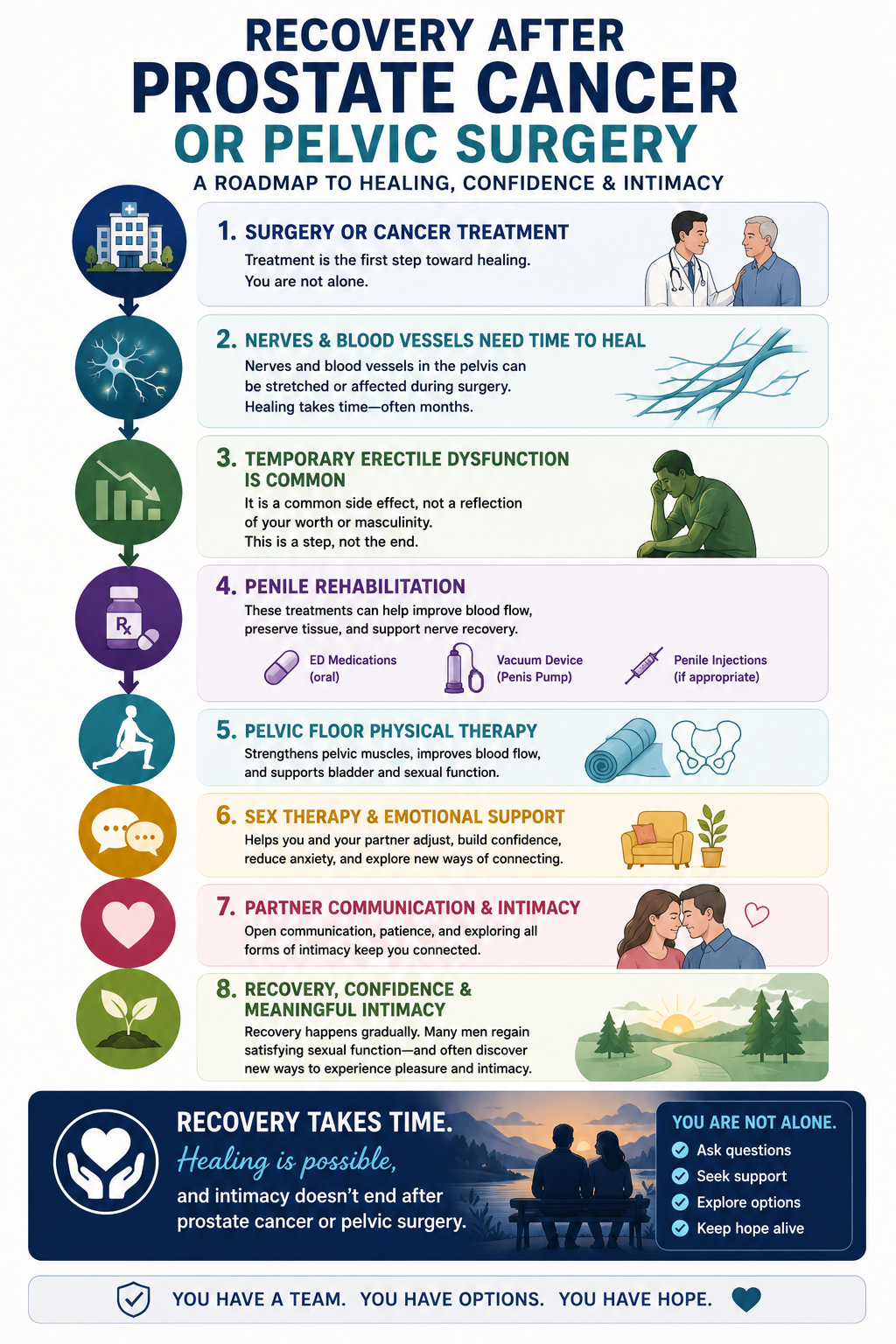
Erectile Dysfunction in LGBTQ+ Relationships
Erectile dysfunction (ED) can affect anyone with a penis, regardless of sexual orientation or gender identity.
Whether you're gay, bisexual, queer, transgender, nonbinary, or in another LGBTQ+ relationship, erection difficulties can influence confidence, intimacy, communication, and emotional well-being.
Although the physical causes of ED are often the same for everyone, LGBTQ+ individuals may also face unique experiences and stressors that deserve recognition and compassionate care.
Erectile Dysfunction Doesn't Look the Same in Every Relationship
There is no "right" way to have sex.
For some couples, erections play a central role in intimacy.
For others, they are only one part of a much broader sexual experience.
Because every relationship is different, erectile dysfunction may affect people in different ways.
Some people worry about:
Feeling less confident during sex.
Letting their partner down.
Changes in their preferred sexual activities.
Fear of rejection.
Changes in body image.
Anxiety about future sexual experiences.
These concerns are common and understandable.
Minority Stress Can Affect Sexual Health
Many LGBTQ+ people experience ongoing stress related to discrimination, stigma, rejection, or feeling unsafe expressing their identity.
Researchers often refer to this as minority stress.
Living with chronic stress can affect:
Mental health.
Sleep.
Hormone balance.
Anxiety levels.
Sexual desire.
Erectile function.
This doesn't mean LGBTQ+ identity causes erectile dysfunction.
Rather, the chronic stress associated with discrimination and stigma can affect the same mind-body systems involved in healthy sexual functioning.
Performance Pressure Exists in Every Community
Performance anxiety is not limited to heterosexual relationships.
Many LGBTQ+ individuals experience worries such as:
"Will I be able to stay hard?"
"Will my partner think I'm unattractive?"
"Will they compare me to previous partners?"
"What if I can't do what I planned?"
These thoughts can activate the body's stress response, making erections more difficult to achieve or maintain.
The cycle is the same regardless of sexual orientation.
Communication Is One of the Best Treatments
Open communication helps reduce misunderstanding and unnecessary self-blame.
Rather than making assumptions, talk openly with your partner about:
What you're experiencing.
What feels supportive.
What creates pressure.
Other ways to experience intimacy and pleasure.
Your expectations and concerns.
Many couples find that honest conversations strengthen their relationship and reduce anxiety around erections.
Erectile Dysfunction Doesn't Define Your Sex Life
An erection is only one part of sexuality.
Pleasure, intimacy, affection, touch, emotional connection, oral sex, mutual stimulation, toys, and many other forms of intimacy can all be fulfilling parts of a healthy sexual relationship.
Expanding your definition of sex often reduces performance pressure and creates more opportunities for satisfying intimacy.
Transgender and Gender-Diverse Individuals
For transgender and gender-diverse people, erectile function may be influenced by additional factors such as:
Gender-affirming hormone therapy.
Gender dysphoria.
Gender-affirming surgeries.
Medications.
Mental health.
Minority stress.
Sexual health is highly individual.
Working with healthcare providers who are knowledgeable about both sexual medicine and gender-affirming care can help ensure that treatment recommendations are personalized and respectful of your goals.
Finding Affirming Healthcare
Everyone deserves healthcare that feels safe, respectful, and free from judgment.
If you're seeking help for erectile dysfunction, look for providers who:
Use inclusive language.
Respect your identity and relationships.
Ask about your sexual goals instead of making assumptions.
Consider both physical and emotional factors affecting your sexual health.
Create a space where you feel comfortable asking questions.
Feeling understood can make it easier to discuss concerns that may otherwise feel difficult to bring up.
The Bottom Line
Erectile dysfunction can affect people of every sexual orientation and gender identity.
While the physical causes of ED are often similar across populations, LGBTQ+ individuals may also experience unique stressors that influence sexual health.
The encouraging news is that effective treatment is available.
Whether your erection difficulties are related to medical conditions, stress, hormones, medications, relationship concerns, or a combination of factors, you deserve affirming, evidence-based care that respects your identity and your relationship.
Healthy sexuality isn't defined by one body part or one sexual activity. It's built on connection, communication, pleasure, and feeling safe enough to be yourself.

Erectile Dysfunction in New Relationships vs. Long-Term Relationships
Erectile dysfunction (ED) can happen in any relationship, whether you've been dating for a few weeks or have been married for decades.
However, the reasons behind erection difficulties often look different depending on the stage of the relationship.
Understanding these differences can reduce unnecessary worry, improve communication, and help you identify the factors that may be contributing to your symptoms.
Erectile Dysfunction in New Relationships
Starting a new relationship can be exciting—but it can also be stressful.
Even when you're deeply attracted to your partner, the desire to make a good impression can create pressure.
Many people experience thoughts like:
"I really want this to go well."
"What if I lose my erection?"
"What if they think something is wrong with me?"
"What if they don't want to see me again?"
These worries can activate the body's stress response, making it harder to get or maintain an erection.
Ironically, caring deeply about a new partner can sometimes increase performance anxiety rather than decrease it.
The Pressure to Impress
In a new relationship, you may not yet know:
What your partner enjoys.
How they communicate about sex.
How they'll respond if something unexpected happens.
Whether they'll be understanding or judgmental.
This uncertainty can make you more self-conscious.
Many people begin monitoring their erections instead of enjoying the moment, increasing anxiety and making erections less reliable.
Why ED Happens in Long-Term Relationships
Long-term relationships bring different challenges.
Over time, couples may experience:
Busy schedules.
Parenting responsibilities.
Financial stress.
Caring for aging parents.
Health concerns.
Less time for intimacy.
Changes in sexual routines.
These stressors don't necessarily reduce attraction, but they can make it more difficult to feel mentally present during sex.
Familiarity Can Be Helpful
One advantage of long-term relationships is emotional safety.
Partners who know each other well are often better able to:
Communicate openly.
Reduce pressure.
Laugh when something unexpected happens.
Focus on intimacy instead of performance.
Support one another through challenges.
Feeling emotionally safe allows many people to relax, making erections more likely to occur naturally.
Familiarity Can Also Create Challenges
For some couples, years together can lead to routines that feel predictable.
Sex may begin to feel scheduled, rushed, or focused on accomplishing a goal rather than enjoying the experience.
Couples may also stop talking openly about their sexual needs because they assume they already know each other.
Over time, this can contribute to:
Less novelty.
Reduced emotional connection.
Mismatched desire.
Increased pressure when sex does happen.
These issues don't mean the relationship is unhealthy—they simply mean the relationship may benefit from renewed communication and intentional connection.
Attraction Isn't the Whole Story
One of the most common misunderstandings about erectile dysfunction is believing it reflects attraction.
In reality, you can be incredibly attracted to your partner and still experience ED.
Likewise, someone can have reliable erections in a new relationship while struggling in a long-term one—or the opposite.
Erections are influenced by many factors, including:
Stress.
Sleep.
Physical health.
Mental health.
Medications.
Hormones.
Emotional safety.
Relationship dynamics.
Attraction is only one piece of the puzzle.
Talking About It Helps
Whether you're in a new relationship or have been together for years, honest communication is one of the most effective ways to reduce anxiety.
Instead of avoiding the topic, try talking about:
What you're experiencing.
What helps you feel relaxed.
What creates pressure.
Ways to stay connected even if an erection doesn't happen.
These conversations often reduce shame and strengthen emotional intimacy.
Every Relationship Can Adapt
Healthy couples understand that sexuality changes throughout life.
Rather than measuring success by whether an erection occurs every time, many couples find greater satisfaction by focusing on:
Pleasure.
Curiosity.
Emotional closeness.
Affection.
Flexibility.
Teamwork.
When the pressure to perform decreases, erections often become more reliable.
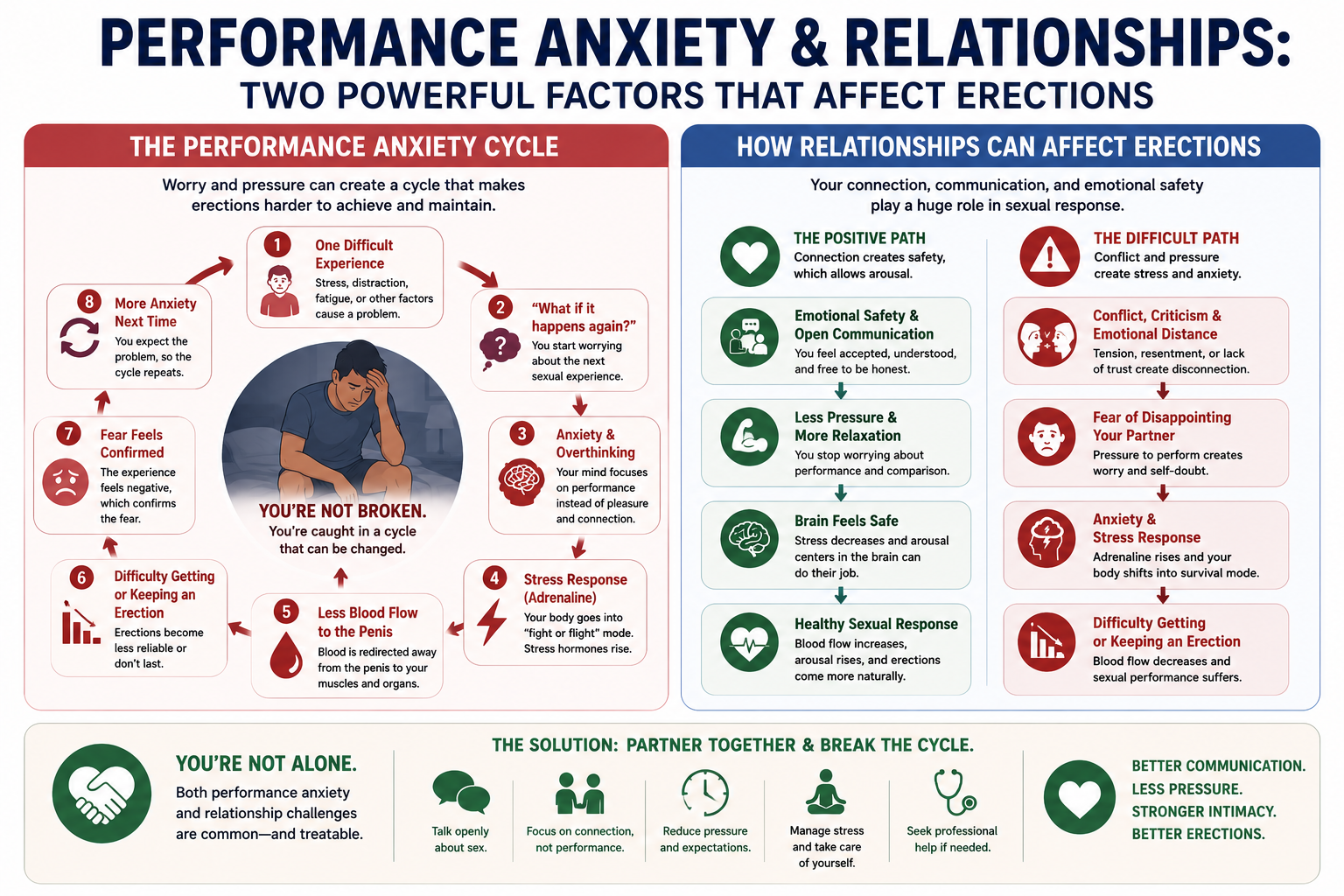
The Bottom Line
Erectile dysfunction can happen in both new and long-term relationships, but the contributing factors are often different.
New relationships may bring excitement, uncertainty, and performance anxiety. Long-term relationships may involve stress, routine, changing health, or life responsibilities that affect sexual function.
Neither situation means your relationship is failing or that attraction has disappeared.
Open communication, realistic expectations, and approaching ED as a shared challenge—not a personal failure—can help couples build stronger relationships and more satisfying intimacy at every stage of life.
How Erectile Dysfunction Is Diagnosed
If you've been experiencing erectile dysfunction (ED), you may be wondering what happens when you talk to a healthcare provider.
The good news is that diagnosing erectile dysfunction is usually straightforward.
In many cases, the diagnosis begins with a conversation about your symptoms, medical history, and overall health. The goal isn't simply to confirm that you have ED—it's to understand why it's happening so you can receive the most effective treatment.
Remember, erectile dysfunction is a symptom, not a diagnosis.
Step 1: Talking About Your Symptoms
Your healthcare provider will begin by asking questions about your erections and your overall health.
They may ask:
When did the problem begin?
Did it start suddenly or gradually?
Does it happen every time you have sex or only occasionally?
Can you get an erection but not maintain one?
Do you wake up with morning erections?
Are you able to get an erection during masturbation?
Have you noticed changes in your sexual desire?
Is the problem affecting your relationship or confidence?
These questions help your provider understand whether the cause may be physical, psychological, or a combination of both.
Step 2: Reviewing Your Medical History
Many health conditions can contribute to erectile dysfunction.
Your provider will likely ask about:
Heart disease.
High blood pressure.
Diabetes.
High cholesterol.
Sleep apnea.
Hormonal conditions.
Neurological disorders.
Previous surgeries or cancer treatments.
Pelvic injuries.
You'll also be asked about any medications, vitamins, or supplements you take, since some medications can affect erectile function.
Step 3: Discussing Lifestyle Factors
Your everyday habits are an important part of the evaluation.
Your provider may ask about:
Smoking or vaping.
Alcohol use.
Recreational drug use.
Exercise habits.
Sleep quality.
Nutrition.
Stress levels.
These factors provide valuable clues and may identify opportunities to improve your overall health as well as your sexual health.
Step 4: Talking About Mental Health and Relationships
Because the brain plays such an important role in erections, your provider may ask about:
Stress.
Anxiety.
Depression.
Performance anxiety.
Past trauma.
Major life changes.
These conversations aren't meant to suggest that your ED is "all in your head."
Instead, they're an important part of understanding how your mind and body work together during sexual arousal.
Step 5: A Physical Examination
Depending on your symptoms, your healthcare provider may perform a physical exam.
This may include checking:
Blood pressure.
Heart rate.
Weight and body mass index (BMI).
The penis and testicles.
Signs of hormonal changes.
Pulses in your legs to evaluate circulation.
The examination is typically brief and helps identify possible medical causes of erectile dysfunction.
Step 6: Blood Tests
Not everyone needs laboratory testing, but blood work is often recommended when symptoms suggest an underlying medical condition.
Your provider may order tests such as:
Blood sugar (to screen for diabetes).
Cholesterol levels.
Testosterone.
Thyroid function.
Kidney function.
Liver function.
Complete blood count (CBC).
These tests help identify conditions that may contribute to erectile dysfunction.
Step 7: Additional Testing (When Needed)
Most people do not need specialized testing.
However, if the cause of ED remains unclear or treatment isn't working, your healthcare provider may recommend additional evaluation.
This could include:
An ultrasound to assess blood flow to the penis.
Nocturnal penile tumescence (NPT) testing to evaluate erections during sleep.
Specialized hormone testing.
Referral to a urologist or another specialist.
These tests are usually reserved for more complex situations.
Is It Physical, Psychological, or Both?
One of the most important goals of the evaluation is determining what factors are contributing to your symptoms.
For some people, the cause is primarily physical.
For others, it's largely related to stress, anxiety, or performance anxiety.
Many people have a combination of both.
Understanding the full picture allows your healthcare provider to recommend the treatment most likely to help.
Be Honest—It Helps Your Provider Help You
Talking about erections can feel uncomfortable.
Some people worry they'll be judged or embarrassed.
Healthcare providers discuss sexual health every day.
The more honest you are about your symptoms, lifestyle, and concerns, the easier it is to identify the underlying cause and recommend effective treatment.
There is no benefit to minimizing or hiding what's been happening.
The Bottom Line
Diagnosing erectile dysfunction is about understanding your health—not judging your sexual performance.
A thorough evaluation includes discussing your symptoms, medical history, mental health, relationships, lifestyle habits, medications, and, when appropriate, a physical exam and blood tests.
The goal is simple: identify the underlying cause so you can receive the treatment that's right for you.
The encouraging news is that most cases of erectile dysfunction are treatable, and the first step toward recovery is getting an accurate diagnosis.
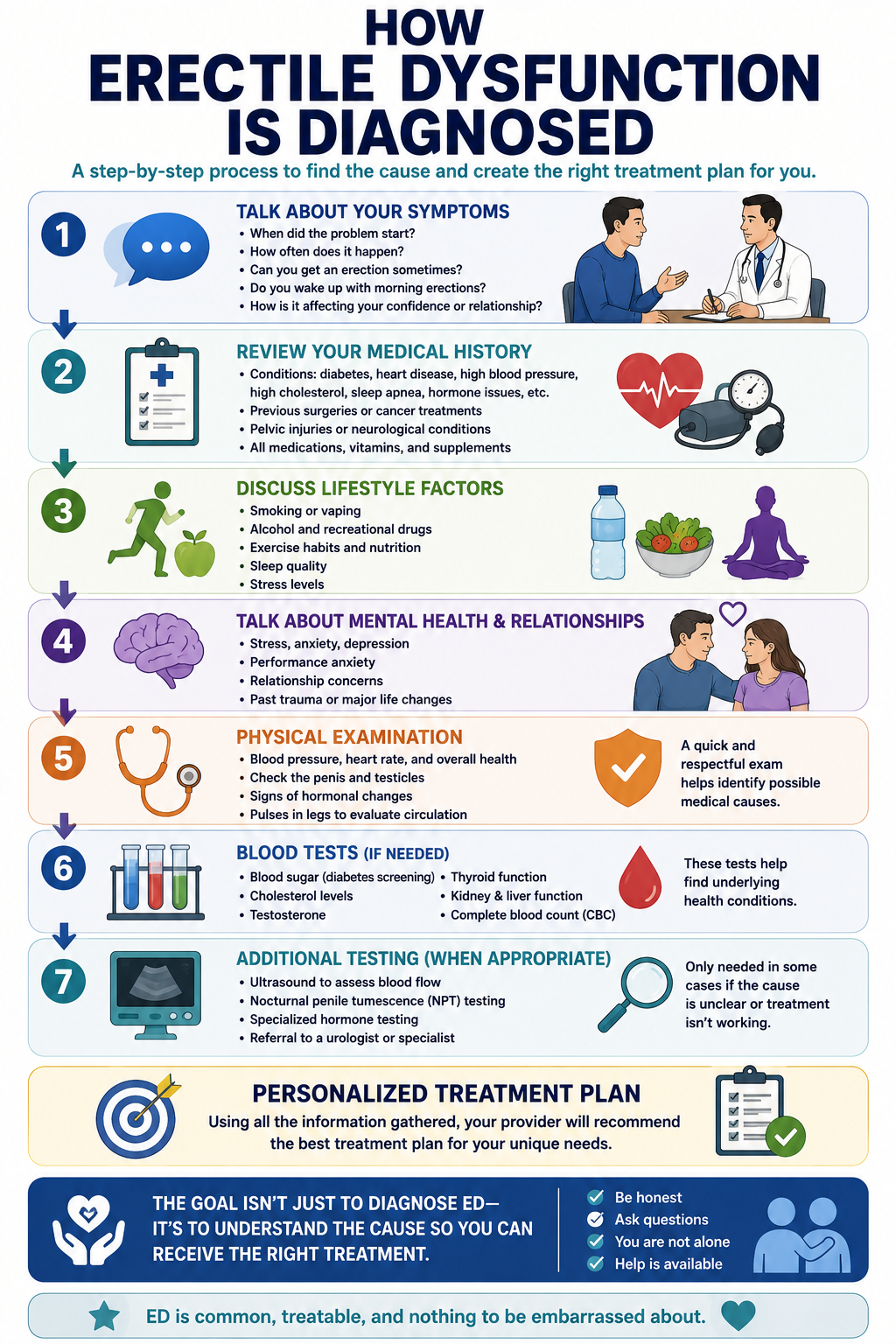
Is Your ED Physical, Psychological, or Both?
One of the first questions many people ask after experiencing erectile dysfunction (ED) is:
"Is this physical, or is it all in my head?"
The answer is often more complicated than either option.
For some people, ED is primarily caused by a medical condition affecting blood flow, nerves, or hormones.
For others, stress, anxiety, depression, or performance anxiety plays the biggest role.
Many people experience a combination of both.
Understanding the difference can help you seek the right treatment—and avoid making assumptions that may delay your recovery.
Signs Your ED May Be More Physical
Physical erectile dysfunction often develops gradually over time.
You may notice:
Erections becoming less firm over several months or years.
Difficulty getting or maintaining an erection in most situations.
Fewer or no morning erections.
Difficulty during both partnered sex and masturbation.
A history of diabetes, high blood pressure, heart disease, or high cholesterol.
A recent pelvic surgery or radiation treatment.
Symptoms beginning after starting a new medication.
Physical ED doesn't always happen overnight. For many men, the changes are subtle at first and become more noticeable over time.
Signs Your ED May Be More Psychological
Psychological erectile dysfunction often has a different pattern.
You may notice:
Symptoms that began suddenly.
Erections are normal during masturbation but difficult with a partner.
You still wake up with morning erections.
Erections are stronger in some situations than others.
The problem is worse with a new partner.
Symptoms increase during stressful periods.
You find yourself worrying about your erections before sex even begins.
These patterns may suggest that stress, anxiety, or performance anxiety is playing a significant role.
However, psychological symptoms do not mean the problem is "imagined." They reflect real physical changes in the body's stress response.
Many Men Experience Both
One of the biggest misconceptions about erectile dysfunction is believing there has to be one single cause.
In reality, many men experience a combination of physical and psychological factors.
For example:
A man develops mild erectile dysfunction because of high blood pressure.
After several frustrating experiences, he starts worrying before every sexual encounter.
Now he has reduced blood flow and performance anxiety.
Or imagine someone recovering from prostate cancer surgery.
Their nerves are healing, but they also become anxious about whether erections will return.
Both the physical recovery and the emotional response affect sexual function.
This combination is incredibly common.
A Simple Comparison
While only a healthcare provider can diagnose the cause of erectile dysfunction, these general patterns can be helpful.
More Likely PhysicalMore Likely PsychologicalGradual onsetSudden onsetOccurs in most situationsChanges depending on the situationMorning erections become less frequentMorning erections are often still presentOccurs during both partnered sex and masturbationMore common during partnered sexOften associated with medical conditions or medicationsOften associated with stress, anxiety, or performance pressure
Remember, these are general patterns—not rules.
Many people fit into both columns.
Why You Shouldn't Diagnose Yourself
It's tempting to search the internet and decide what the cause must be.
Unfortunately, erectile dysfunction is rarely that simple.
Someone with diabetes may also have performance anxiety.
Someone with anxiety may also have low testosterone.
Someone taking blood pressure medication may also be under tremendous stress at work.
A thorough evaluation looks at your whole health—not just one symptom.
What If You're Not Sure?
Most people aren't.
That's completely normal.
Instead of trying to determine the exact cause on your own, ask yourself:
Have my erections changed recently?
Do I notice any patterns?
Have I been under unusual stress?
Have I started any new medications?
Do I have any medical conditions that affect blood flow or hormones?
Is this affecting my confidence, relationship, or quality of life?
These observations can help you have a more productive conversation with your healthcare provider.
Why Identifying the Cause Matters
Different causes require different treatments.
For example:
Physical causes may benefit from treating underlying medical conditions, medications for ED, lifestyle changes, or other medical therapies.
Psychological causes may respond well to sex therapy, cognitive behavioral therapy (CBT), stress management, or treatment for anxiety or depression.
Mixed causes often improve most when both the physical and emotional aspects are addressed together.
Treating only one part of the problem may leave another important factor unaddressed.
The Bottom Line
Erectile dysfunction is rarely as simple as "physical" or "psychological."
For some people, the cause is primarily medical.
For others, stress, anxiety, or performance anxiety plays a larger role.
For many, both physical and emotional factors are working together.
The most effective treatment begins with understanding the whole picture. A healthcare provider can help identify the underlying causes and create a treatment plan that supports both your physical health and your emotional well-being.
Remember, the goal isn't to place blame on your body or your mind. The goal is to understand what's happening so you can move forward with confidence and receive the care that's right for you.
Is Your ED Physical, Psychological, or Both?
One of the first questions many people ask after experiencing erectile dysfunction (ED) is:
"Is this physical, or is it all in my head?"
The answer is often more complicated than either option.
For some people, ED is primarily caused by a medical condition affecting blood flow, nerves, or hormones.
For others, stress, anxiety, depression, or performance anxiety plays the biggest role.
Many people experience a combination of both.
Understanding the difference can help you seek the right treatment—and avoid making assumptions that may delay your recovery.
Signs Your ED May Be More Physical
Physical erectile dysfunction often develops gradually over time.
You may notice:
Erections becoming less firm over several months or years.
Difficulty getting or maintaining an erection in most situations.
Fewer or no morning erections.
Difficulty during both partnered sex and masturbation.
A history of diabetes, high blood pressure, heart disease, or high cholesterol.
A recent pelvic surgery or radiation treatment.
Symptoms beginning after starting a new medication.
Physical ED doesn't always happen overnight. For many men, the changes are subtle at first and become more noticeable over time.
Signs Your ED May Be More Psychological
Psychological erectile dysfunction often has a different pattern.
You may notice:
Symptoms that began suddenly.
Erections are normal during masturbation but difficult with a partner.
You still wake up with morning erections.
Erections are stronger in some situations than others.
The problem is worse with a new partner.
Symptoms increase during stressful periods.
You find yourself worrying about your erections before sex even begins.
These patterns may suggest that stress, anxiety, or performance anxiety is playing a significant role.
However, psychological symptoms do not mean the problem is "imagined." They reflect real physical changes in the body's stress response.
Many Men Experience Both
One of the biggest misconceptions about erectile dysfunction is believing there has to be one single cause.
In reality, many men experience a combination of physical and psychological factors.
For example:
A man develops mild erectile dysfunction because of high blood pressure.
After several frustrating experiences, he starts worrying before every sexual encounter.
Now he has reduced blood flow and performance anxiety.
Or imagine someone recovering from prostate cancer surgery.
Their nerves are healing, but they also become anxious about whether erections will return.
Both the physical recovery and the emotional response affect sexual function.
This combination is incredibly common.
Why You Shouldn't Diagnose Yourself
It's tempting to search the internet and decide what the cause must be.
Unfortunately, erectile dysfunction is rarely that simple.
Someone with diabetes may also have performance anxiety.
Someone with anxiety may also have low testosterone.
Someone taking blood pressure medication may also be under tremendous stress at work.
A thorough evaluation looks at your whole health—not just one symptom.
What If You're Not Sure?
Most people aren't.
That's completely normal.
Instead of trying to determine the exact cause on your own, ask yourself:
Have my erections changed recently?
Do I notice any patterns?
Have I been under unusual stress?
Have I started any new medications?
Do I have any medical conditions that affect blood flow or hormones?
Is this affecting my confidence, relationship, or quality of life?
These observations can help you have a more productive conversation with your healthcare provider.
Why Identifying the Cause Matters
Different causes require different treatments.
For example:
Physical causes may benefit from treating underlying medical conditions, medications for ED, lifestyle changes, or other medical therapies.
Psychological causes may respond well to sex therapy, cognitive behavioral therapy (CBT), stress management, or treatment for anxiety or depression.
Mixed causes often improve most when both the physical and emotional aspects are addressed together.
Treating only one part of the problem may leave another important factor unaddressed.
The Bottom Line
Erectile dysfunction is rarely as simple as "physical" or "psychological."
For some people, the cause is primarily medical.
For others, stress, anxiety, or performance anxiety plays a larger role.
For many, both physical and emotional factors are working together.
The most effective treatment begins with understanding the whole picture. A healthcare provider can help identify the underlying causes and create a treatment plan that supports both your physical health and your emotional well-being.
Remember, the goal isn't to place blame on your body or your mind. The goal is to understand what's happening so you can move forward with confidence and receive the care that's right for you.
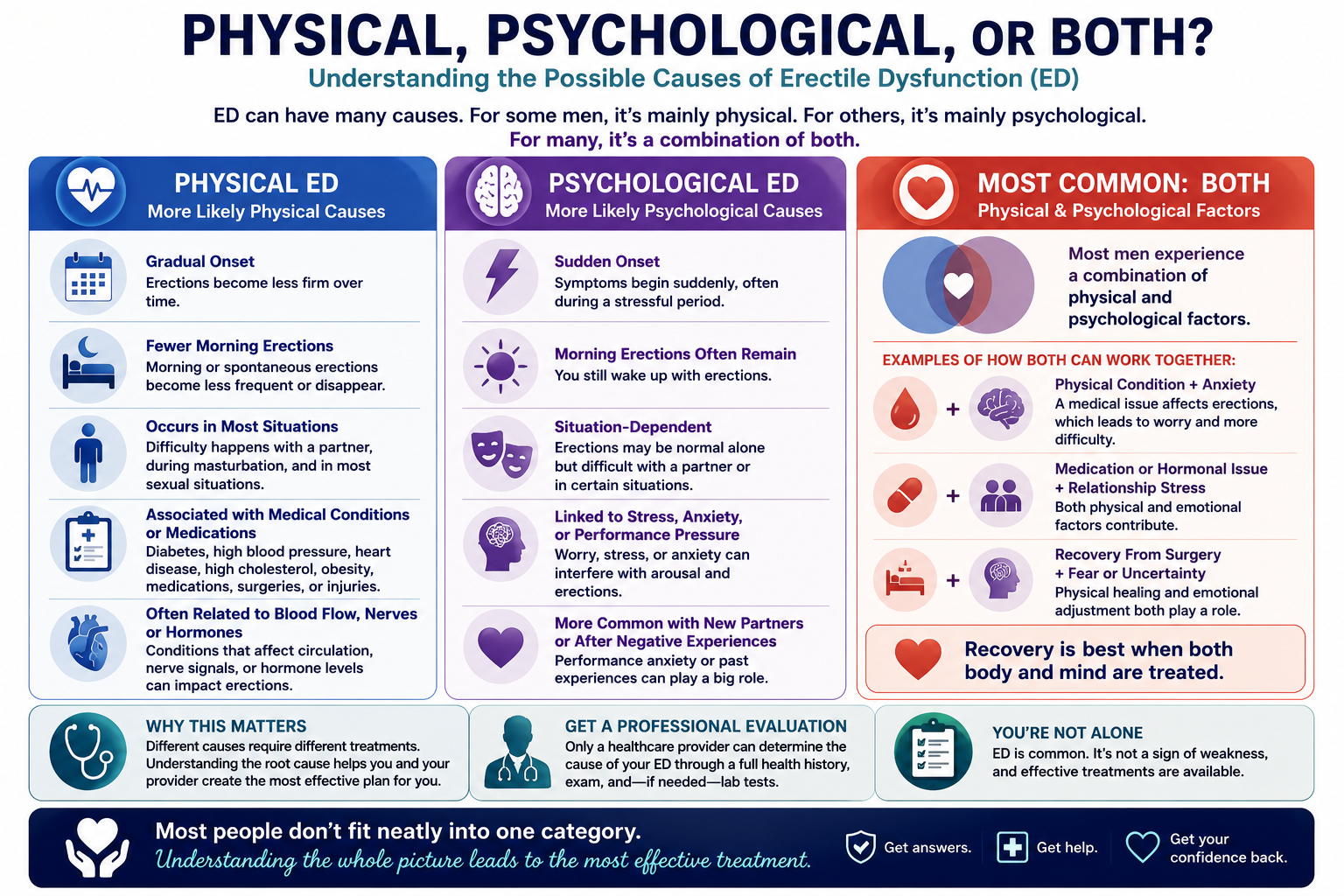
When Should You See a Medical Provider?
Many men wonder whether erectile dysfunction is something they should simply "wait out" or whether it's time to schedule an appointment.
The answer depends on how often it's happening, how long it's been going on, and whether other health concerns may be contributing.
An occasional erection problem is common and usually isn't a cause for concern. Stress, fatigue, alcohol, illness, or a difficult day can temporarily affect sexual performance.
However, if erectile dysfunction becomes frequent or persistent, it's important to seek medical care.
ED is highly treatable, and in some cases, it can be an early warning sign of an underlying health condition that deserves attention.
You Should See a Medical Provider If...
Consider scheduling an appointment if:
You've been experiencing erection difficulties for several weeks or longer.
ED happens most or every time you try to have sex.
Your erections have gradually become less firm over time.
You can no longer maintain an erection long enough for satisfying sexual activity.
You've noticed a significant change in your sexual function.
ED is causing stress, anxiety, or affecting your confidence.
Erectile dysfunction is creating tension in your relationship.
You don't have to wait until the problem becomes severe before asking for help.
Seek Medical Care Sooner If You Have Certain Health Conditions
Because erectile dysfunction is closely connected to cardiovascular health, it's especially important to seek evaluation if you have:
Diabetes.
High blood pressure.
High cholesterol.
Heart disease.
Obesity.
Sleep apnea.
Kidney disease.
Neurological conditions.
These conditions can affect blood flow, nerves, and hormone function—all of which are important for healthy erections.
If ED Starts After Beginning a New Medication
Some medications can contribute to erectile dysfunction.
If your symptoms began after starting a new prescription medication, don't stop taking it on your own.
Instead, schedule an appointment with the healthcare provider who prescribed it.
Many medication-related sexual side effects can be managed by adjusting the dose, switching medications, or exploring other treatment options.
Don't Ignore Sudden Changes
A sudden change in erectile function without an obvious explanation deserves medical attention.
Although stress and anxiety can cause sudden ED, unexpected changes may also be related to:
Hormonal changes.
Medication side effects.
Blood vessel problems.
Neurological conditions.
Other medical concerns.
Your healthcare provider can help determine the cause.
Erectile Dysfunction Can Be an Early Warning Sign
One of the most important reasons to seek medical care is that erectile dysfunction sometimes appears before other symptoms of cardiovascular disease.
The blood vessels supplying the penis are smaller than those supplying the heart.
Because of this, reduced blood flow may affect erections before it causes chest pain or other noticeable symptoms.
For some men, ED is the first sign that it's time to evaluate heart health.
Seeking medical care early doesn't just improve your sexual health—it may also protect your overall health.
What Kind of Healthcare Provider Should You See?
A good place to start is your:
Primary care provider.
Family medicine physician.
Internal medicine physician.
Urologist.
Depending on your symptoms, you may also benefit from seeing:
An endocrinologist for hormone concerns.
A cardiologist if cardiovascular disease is suspected.
A mental health professional or sex therapist if stress, anxiety, trauma, or relationship concerns are contributing.
Many people benefit from a team approach that addresses both physical and emotional factors.
What If It Feels Embarrassing?
Many men delay seeking help because they feel embarrassed.
It's important to remember that healthcare providers discuss erectile dysfunction every day.
ED is one of the most common concerns they evaluate.
Your provider's goal isn't to judge you.
Their job is to understand what's happening and help you find effective treatment.
The more honest you are about your symptoms, the easier it is to identify the cause.
Don't Wait Until It Affects Your Relationship
Some men wait until erectile dysfunction begins causing significant stress in their relationship before asking for help.
You don't have to reach that point.
Early treatment often:
Improves treatment outcomes.
Reduces performance anxiety.
Protects self-confidence.
Prevents unnecessary relationship conflict.
Identifies medical conditions sooner.
Seeking help early is often much easier than trying to manage months or years of frustration on your own.
The Bottom Line
Occasional erectile dysfunction is common and happens to nearly every man at some point.
Persistent erectile dysfunction is different.
If ED has been happening regularly, affecting your confidence, impacting your relationship, or lasting for several weeks or longer, it's time to talk with a healthcare provider.
Remember, erectile dysfunction is not simply a normal part of aging or something you have to accept.
It is a common medical condition with many effective treatment options.
The earlier you seek care, the sooner you can understand what's causing your symptoms and begin working toward better sexual health and overall well-being.

What Medical Tests Might Be Recommended?
If you've been diagnosed with erectile dysfunction (ED), you may wonder whether you'll need a long list of medical tests.
For most people, the answer is no.
Many cases of erectile dysfunction can be evaluated through a detailed conversation, a physical examination, and a few basic laboratory tests.
Additional testing is usually recommended only when the cause of ED is unclear, symptoms are unusual, or initial treatments haven't been effective.
The goal of testing is simple: identify the underlying cause so you can receive the most appropriate treatment.
Blood Tests
Blood tests are one of the most common parts of an ED evaluation.
Depending on your symptoms and medical history, your healthcare provider may recommend testing:
Blood Sugar (Glucose or Hemoglobin A1c)
Diabetes is one of the most common medical causes of erectile dysfunction.
Testing your blood sugar helps determine whether diabetes or prediabetes may be affecting blood flow and nerve function.
Cholesterol Levels
High cholesterol can damage blood vessels and reduce blood flow throughout the body, including the penis.
A cholesterol test helps evaluate your cardiovascular health.
Testosterone
If you have symptoms such as:
Low sex drive.
Fatigue.
Reduced energy.
Fewer morning erections.
Difficulty building muscle.
...your healthcare provider may recommend measuring your testosterone level.
Because testosterone levels naturally fluctuate throughout the day, this test is usually performed in the morning.
Thyroid Function Tests
An overactive or underactive thyroid can affect:
Energy.
Mood.
Sexual desire.
Erectile function.
Testing thyroid hormone levels can help identify treatable hormonal conditions.
Other Blood Tests
Depending on your health history, your provider may also recommend tests that evaluate:
Kidney function.
Liver function.
Complete blood count (CBC).
Additional hormone levels, such as prolactin, if indicated.
Not everyone needs all of these tests.
Blood Pressure Measurement
Healthy blood flow is essential for healthy erections.
Checking your blood pressure is a simple but important part of evaluating erectile dysfunction.
Both high blood pressure and some medications used to treat it can contribute to ED.
Cardiovascular Evaluation
Because erectile dysfunction can sometimes be an early sign of cardiovascular disease, your healthcare provider may evaluate your overall heart health.
Depending on your age, symptoms, and risk factors, this may include:
Reviewing your personal and family medical history.
Assessing your risk for heart disease.
Recommending additional cardiac testing if appropriate.
For some men, an ED evaluation becomes an opportunity to identify heart disease before more serious symptoms develop.
Penile Doppler Ultrasound
Most men never need this test.
However, if your healthcare provider needs more information about blood flow, they may recommend a penile Doppler ultrasound.
During this test:
Medication is injected into the side of the penis to create an erection.
An ultrasound is used to evaluate blood flow into and out of the penis.
The test helps identify blood vessel problems that may be contributing to ED.
Although the idea of this test can sound intimidating, it is generally well tolerated and performed by trained healthcare professionals.
Nocturnal Penile Tumescence (NPT) Testing
Healthy men usually experience several erections during sleep.
Nocturnal penile tumescence testing measures whether these nighttime erections are occurring.
This test may occasionally help healthcare providers distinguish between physical and psychological contributors to erectile dysfunction.
Today, it is used much less frequently than in the past because other evaluation methods are often sufficient.
Specialized Hormone Testing
If initial blood work suggests a hormonal condition, additional testing may be recommended.
This may include evaluating:
Prolactin.
Luteinizing hormone (LH).
Follicle-stimulating hormone (FSH).
Other endocrine hormones.
These tests help identify less common hormonal causes of erectile dysfunction.
Do Most People Need All These Tests?
No.
Most men do not need every test listed in this chapter.
Your healthcare provider will recommend testing based on:
Your age.
Your symptoms.
Your medical history.
Your physical examination.
Your risk factors.
Your response to initial treatment.
The evaluation is individualized.
Why Testing Matters
Medical testing isn't about proving that erectile dysfunction exists.
You already know something has changed.
The purpose of testing is to answer important questions, such as:
Is blood flow affected?
Could diabetes or heart disease be contributing?
Are hormone levels normal?
Is a medication playing a role?
Is another medical condition affecting sexual function?
Finding these answers helps guide the most effective treatment plan.
The Bottom Line
Most people with erectile dysfunction need only a focused medical evaluation and a few basic laboratory tests.
More specialized testing is recommended only when additional information is needed or when the cause of ED remains unclear.
Medical testing isn't something to fear.
Instead, it's an opportunity to better understand your health, identify treatable conditions, and create a personalized plan that supports both your sexual health and your overall well-being.
Remember, the goal isn't simply to restore erections—it's to improve your health as a whole.
What Medical Tests Might Be Recommended?
If you've been diagnosed with erectile dysfunction (ED), you may wonder whether you'll need a long list of medical tests.
For most people, the answer is no.
Many cases of erectile dysfunction can be evaluated through a detailed conversation, a physical examination, and a few basic laboratory tests.
Additional testing is usually recommended only when the cause of ED is unclear, symptoms are unusual, or initial treatments haven't been effective.
The goal of testing is simple: identify the underlying cause so you can receive the most appropriate treatment.
Blood Tests
Blood tests are one of the most common parts of an ED evaluation.
Depending on your symptoms and medical history, your healthcare provider may recommend testing:
Blood Sugar (Glucose or Hemoglobin A1c)
Diabetes is one of the most common medical causes of erectile dysfunction.
Testing your blood sugar helps determine whether diabetes or prediabetes may be affecting blood flow and nerve function.
Cholesterol Levels
High cholesterol can damage blood vessels and reduce blood flow throughout the body, including the penis.
A cholesterol test helps evaluate your cardiovascular health.
Testosterone
If you have symptoms such as:
Low sex drive.
Fatigue.
Reduced energy.
Fewer morning erections.
Difficulty building muscle.
...your healthcare provider may recommend measuring your testosterone level.
Because testosterone levels naturally fluctuate throughout the day, this test is usually performed in the morning.
Thyroid Function Tests
An overactive or underactive thyroid can affect:
Energy.
Mood.
Sexual desire.
Erectile function.
Testing thyroid hormone levels can help identify treatable hormonal conditions.
Other Blood Tests
Depending on your health history, your provider may also recommend tests that evaluate:
Kidney function.
Liver function.
Complete blood count (CBC).
Additional hormone levels, such as prolactin, if indicated.
Not everyone needs all of these tests.
Blood Pressure Measurement
Healthy blood flow is essential for healthy erections.
Checking your blood pressure is a simple but important part of evaluating erectile dysfunction.
Both high blood pressure and some medications used to treat it can contribute to ED.
Cardiovascular Evaluation
Because erectile dysfunction can sometimes be an early sign of cardiovascular disease, your healthcare provider may evaluate your overall heart health.
Depending on your age, symptoms, and risk factors, this may include:
Reviewing your personal and family medical history.
Assessing your risk for heart disease.
Recommending additional cardiac testing if appropriate.
For some men, an ED evaluation becomes an opportunity to identify heart disease before more serious symptoms develop.
Penile Doppler Ultrasound
Most men never need this test.
However, if your healthcare provider needs more information about blood flow, they may recommend a penile Doppler ultrasound.
During this test:
Medication is injected into the side of the penis to create an erection.
An ultrasound is used to evaluate blood flow into and out of the penis.
The test helps identify blood vessel problems that may be contributing to ED.
Although the idea of this test can sound intimidating, it is generally well tolerated and performed by trained healthcare professionals.
Nocturnal Penile Tumescence (NPT) Testing
Healthy men usually experience several erections during sleep.
Nocturnal penile tumescence testing measures whether these nighttime erections are occurring.
This test may occasionally help healthcare providers distinguish between physical and psychological contributors to erectile dysfunction.
Today, it is used much less frequently than in the past because other evaluation methods are often sufficient.
Specialized Hormone Testing
If initial blood work suggests a hormonal condition, additional testing may be recommended.
This may include evaluating:
Prolactin.
Luteinizing hormone (LH).
Follicle-stimulating hormone (FSH).
Other endocrine hormones.
These tests help identify less common hormonal causes of erectile dysfunction.
Do Most People Need All These Tests?
No.
Most men do not need every test listed in this chapter.
Your healthcare provider will recommend testing based on:
Your age.
Your symptoms.
Your medical history.
Your physical examination.
Your risk factors.
Your response to initial treatment.
The evaluation is individualized.
Why Testing Matters
Medical testing isn't about proving that erectile dysfunction exists.
You already know something has changed.
The purpose of testing is to answer important questions, such as:
Is blood flow affected?
Could diabetes or heart disease be contributing?
Are hormone levels normal?
Is a medication playing a role?
Is another medical condition affecting sexual function?
Finding these answers helps guide the most effective treatment plan.
The Bottom Line
Most people with erectile dysfunction need only a focused medical evaluation and a few basic laboratory tests.
More specialized testing is recommended only when additional information is needed or when the cause of ED remains unclear.
Medical testing isn't something to fear.
Instead, it's an opportunity to better understand your health, identify treatable conditions, and create a personalized plan that supports both your sexual health and your overall well-being.
Remember, the goal isn't simply to restore erections—it's to improve your health as a whole.

When Should You See a Urologist?
Many men wonder whether they should see their primary care provider or go directly to a urologist for erectile dysfunction (ED).
The answer depends on your symptoms, medical history, and how long you've been experiencing erection difficulties.
For many people, a primary care provider is an excellent place to start. They can evaluate common causes of ED, order basic laboratory tests, review your medications, and begin treatment.
However, there are times when seeing a urologist is especially helpful.
What Is a Urologist?
A urologist is a physician who specializes in conditions affecting the:
Urinary system.
Male reproductive system.
Penis.
Testicles.
Prostate.
Bladder.
Kidneys.
Because erectile dysfunction often involves blood flow, nerves, hormones, and the reproductive system, urologists have specialized training in diagnosing and treating many causes of ED.
You Should Consider Seeing a Urologist If...
A referral to a urologist may be appropriate if:
Erectile dysfunction has continued despite initial treatment.
Oral ED medications aren't working or cause bothersome side effects.
You're interested in learning about additional treatment options.
You've had prostate cancer treatment or pelvic surgery.
You have penile pain or significant curvature of the penis.
You have concerns about low testosterone or other reproductive health issues.
Your healthcare provider suspects a more complex medical cause.
A urologist can provide additional testing and discuss treatments that may not be available in a primary care setting.
If You Have Peyronie's Disease
If your penis has developed a noticeable curve, bends during erections, or erections have become painful, it's important to see a urologist.
These symptoms may be caused by Peyronie's disease, a condition in which scar tissue develops inside the penis.
Early evaluation can help determine the most appropriate treatment and may improve outcomes.
After Prostate Cancer or Pelvic Surgery
Many men are referred to a urologist after:
Radical prostatectomy.
Pelvic surgery.
Bladder surgery.
Cancer treatment affecting the pelvis.
A urologist can discuss recovery, penile rehabilitation, medications, vacuum erection devices, injections, and other options that may support sexual function during healing.
If ED Medications Aren't Working
Some men assume that if medications such as sildenafil or tadalafil don't work, nothing else can help.
Fortunately, that's not true.
A urologist can help determine why medications aren't working and discuss additional treatment options, including:
Adjusting medication dosage or timing.
Trying a different medication.
Vacuum erection devices.
Penile injections.
Intraurethral medications.
Penile implants for appropriate candidates.
There are often more options than people realize.
A Urologist Looks Beyond the Erection
Although urologists specialize in erectile dysfunction, they also evaluate overall urologic health.
Depending on your symptoms, they may assess for:
Prostate conditions.
Urinary symptoms.
Low testosterone.
Fertility concerns.
Peyronie's disease.
Blood flow problems.
Nerve-related conditions.
Their goal is to identify and treat the underlying cause—not simply prescribe medication.
You May Still Benefit From Other Specialists
Erectile dysfunction isn't always caused by a urologic problem.
Depending on your situation, your care may also involve:
A primary care provider.
A cardiologist.
An endocrinologist.
A pelvic floor physical therapist.
A sex therapist.
A mental health professional.
Each provider brings a different area of expertise.
Working together often leads to the best long-term outcomes.
Don't Wait Until the Problem Gets Worse
Many men wait months or even years before seeing a specialist because they hope the problem will resolve on its own.
While occasional ED is common, persistent erectile dysfunction deserves evaluation.
Seeking care early can:
Identify underlying medical conditions.
Expand your treatment options.
Reduce performance anxiety.
Improve sexual confidence.
Protect your long-term sexual health.
The sooner you understand what's causing your symptoms, the sooner you can begin treating them.
The Bottom Line
A urologist is a specialist in male reproductive and urinary health who can evaluate and treat many causes of erectile dysfunction.
If your symptoms continue despite initial treatment, you've had prostate cancer or pelvic surgery, medications aren't helping, or you have concerns such as penile curvature or pain, a urology evaluation may be an important next step.
Remember, seeing a urologist doesn't mean your situation is hopeless. It means you're working with someone who has advanced training in diagnosing erectile dysfunction and helping you find the treatment that's right for you.
Most importantly, you don't have to navigate this alone. Effective treatments are available, and many men experience significant improvement with the right care.

When Should You See a Sex Therapist?
Many people assume that erectile dysfunction (ED) is only a medical problem.
While medical conditions certainly play an important role, erections are also influenced by your brain, emotions, relationships, and nervous system.
That's why many people benefit from working with a sex therapist.
A sex therapist is a licensed mental health professional with specialized training in human sexuality who helps individuals and couples address the emotional, psychological, behavioral, and relationship factors that affect sexual functioning.
Seeing a sex therapist doesn't mean your ED is "all in your head."
It means you're taking a comprehensive approach to improving your sexual health.
What Does a Sex Therapist Do?
A sex therapist helps people understand and treat the factors that may be interfering with healthy sexual functioning.
Depending on your situation, therapy may focus on:
Stress and burnout.
Depression or anxiety.
Trauma and past experiences.
Communication about sex.
Body image concerns.
Fear of losing an erection.
Rebuilding confidence after repeated episodes of ED.
Sex therapy is not physical or hands-on.
Sessions involve conversation, education, practical exercises, and evidence-based therapeutic techniques that you can apply outside of therapy.
You Should Consider Seeing a Sex Therapist If...
Sex therapy may be especially helpful if:
Your healthcare provider believes stress or anxiety is contributing to your ED.
You worry about losing your erection before sex begins.
ED started after one difficult sexual experience.
You avoid intimacy because you're afraid it will happen again.
Your relationship has become strained because of ED.
You feel embarrassed, ashamed, or less confident because of your erections.
You have a history of sexual trauma or other traumatic experiences.
Medical treatment alone hasn't fully resolved the problem.
Many people seek therapy because they want to enjoy sex again—not simply achieve an erection.
Performance Anxiety Is One of the Most Common Reasons
Performance anxiety is one of the leading psychological contributors to erectile dysfunction.
After one episode of erection difficulty, many men begin thinking:
"What if it happens again?"
"What if I disappoint my partner?"
"What if they think I'm not attracted to them?"
"What if something is wrong with me?"
These thoughts activate the body's stress response, making erections more difficult.
Sex therapy helps interrupt this cycle by reducing anxiety, building confidence, and shifting the focus away from performance and back toward pleasure and connection.
Sex Therapy Can Help Couples, Too
Erectile dysfunction affects more than one person.
Partners often experience:
Confusion.
Self-doubt.
Frustration.
Fear of saying the wrong thing.
Worry that attraction has changed.
Couples therapy or sex therapy can help partners:
Communicate openly.
Reduce blame and misunderstanding.
Learn how to support one another.
Expand intimacy beyond erections.
Work together as a team.
Many couples find that their relationship becomes stronger through the recovery process.
What Happens During Sex Therapy?
Every therapist works differently, but treatment often includes:
Learning how erections work.
Understanding the connection between the brain and the body.
Identifying factors contributing to ED.
Reducing performance pressure.
Improving communication.
Addressing unhelpful beliefs about masculinity or sex.
Practicing evidence-based strategies to reduce anxiety.
Creating gradual exercises that help rebuild confidence and intimacy.
Treatment is individualized based on your goals and experiences.
Can Sex Therapy Be Combined With Medical Treatment?
Absolutely.
In fact, many people benefit from combining:
Medical evaluation.
ED medications when appropriate.
Lifestyle changes.
Treatment for underlying medical conditions.
Sex therapy.
Addressing both the physical and emotional aspects of erectile dysfunction often leads to the best long-term results.
Does Seeing a Sex Therapist Mean You'll Be in Therapy Forever?
No.
Many people attend therapy for a specific concern and stop once they have met their goals.
The length of treatment depends on factors such as:
The cause of your ED.
How long symptoms have been present.
Whether trauma or relationship concerns are involved.
Your personal goals.
Some people notice meaningful improvements in a relatively short period, while others benefit from longer-term support.
Finding the Right Sex Therapist
When looking for a sex therapist, consider someone who:
Is a licensed mental health professional.
Has specialized training in sexual health.
Uses evidence-based treatments.
Creates a safe, nonjudgmental environment.
Is comfortable working with individuals and couples.
Respects your values, identity, and relationship structure.
Finding someone you feel comfortable talking with is one of the most important parts of successful therapy.
The Bottom Line
Sex therapy is an evidence-based treatment that helps address the emotional, psychological, behavioral, and relationship factors that contribute to erectile dysfunction.
Whether your ED is caused by performance anxiety, stress, trauma, relationship challenges, or a combination of physical and emotional factors, therapy can help you understand what's happening and develop practical skills to improve your sexual confidence.
Remember, the goal of sex therapy isn't simply to help you have an erection.
It's to help you build a healthier relationship with your body, your partner, and your sexuality—so that intimacy becomes less about pressure and more about connection, pleasure, and confidence.
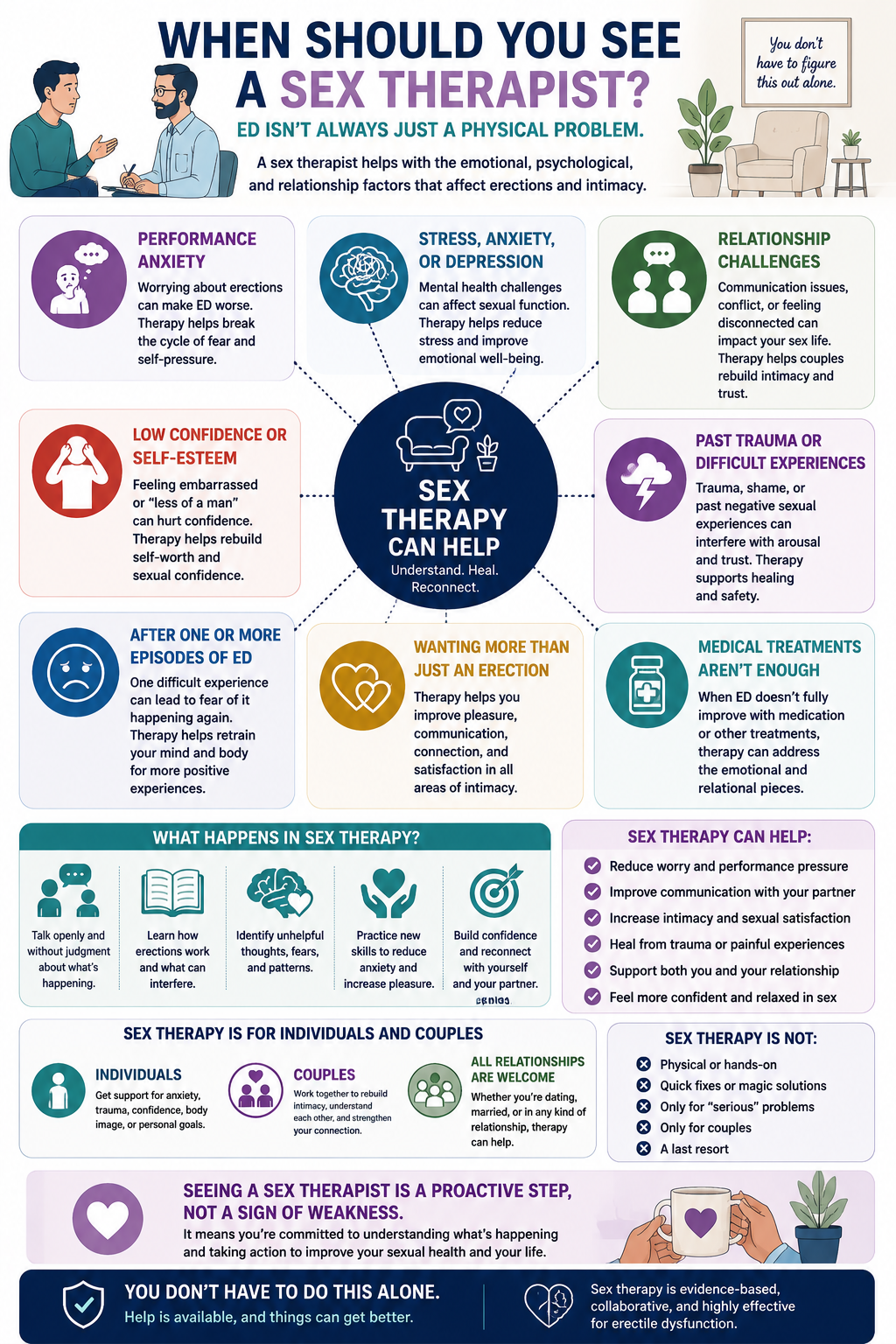
Evidence-Based Treatment Options for Erectile Dysfunction
The good news about erectile dysfunction (ED) is that it is highly treatable.
In fact, most men improve when the underlying cause is identified and treated appropriately.
There is no single "best" treatment for erectile dysfunction because ED can have many different causes. For some men, improving blood flow is the answer. For others, reducing anxiety, addressing relationship concerns, or treating an underlying medical condition leads to the greatest improvement.
Many people benefit from a combination of treatments rather than relying on just one approach.
The goal isn't simply to produce an erection—it's to improve your overall sexual health, confidence, intimacy, and quality of life.
Step 1: Treat the Underlying Cause
Before focusing on erections alone, it's important to identify what's contributing to the problem.
Treatment may involve:
Managing diabetes or high blood pressure.
Improving heart health.
Adjusting medications that affect erections.
Treating low testosterone when medically appropriate.
Addressing sleep apnea.
Managing depression or anxiety.
Reducing chronic stress.
When the underlying condition improves, erections often improve as well.
Oral Medications
For many men, medications known as PDE5 inhibitors are an effective first treatment.
These medications help increase blood flow to the penis during sexual arousal.
Common examples include:
Sildenafil (Viagra)
Tadalafil (Cialis)
Vardenafil (Levitra)
Avanafil (Stendra)
These medications do not automatically cause an erection.
Sexual stimulation is still necessary for them to work.
Your healthcare provider can help determine which medication is most appropriate based on your health history and other medications you take.
Lifestyle Changes
Healthy erections depend on a healthy body.
Research consistently shows that lifestyle changes can improve erectile function, particularly when ED is related to cardiovascular health.
Helpful lifestyle changes include:
Exercising regularly.
Quitting smoking.
Limiting alcohol.
Eating a heart-healthy diet.
Managing stress.
Improving sleep.
Maintaining a healthy weight.
These changes support healthy blood vessels, hormone balance, and overall well-being.
Sex Therapy
Sex therapy is one of the most effective treatments for erectile dysfunction when psychological, relationship, or mixed factors are involved.
A sex therapist helps individuals and couples:
Reduce performance anxiety.
Improve communication.
Rebuild sexual confidence.
Address shame or embarrassment.
Heal after difficult sexual experiences.
Expand intimacy beyond erections.
Sex therapy is especially effective when ED is related to stress, anxiety, trauma, or relationship challenges.
Sensate Focus Exercises
Sensate focus is one of the best-studied behavioral treatments for performance anxiety and erectile dysfunction.
Originally developed by sex researchers William Masters and Virginia Johnson, sensate focus helps couples shift attention away from performance and back toward connection.
The exercises involve gradually rebuilding intimacy through structured, non-demand touching experiences.
During the early stages, couples intentionally avoid intercourse and orgasm goals.
Instead, they focus on:
Physical touch.
Curiosity.
Relaxation.
Pleasure without pressure.
Removing the expectation that an erection "must" happen often reduces anxiety and allows erections to return naturally over time.
Mindfulness-Based Techniques
Many men with erectile dysfunction become trapped in their thoughts during sex.
Instead of experiencing intimacy, they monitor themselves:
"Am I getting hard?"
"Am I losing my erection?"
"Can my partner tell?"
Mindfulness helps shift attention away from self-monitoring and back to the present moment.
Mindfulness-based approaches may include:
Slow, diaphragmatic breathing.
Body awareness exercises.
Guided mindfulness meditation.
Grounding techniques.
Focusing on physical sensations instead of anxious thoughts.
Research suggests mindfulness can reduce performance anxiety and improve overall sexual satisfaction, particularly when anxiety is contributing to ED.
EMDR Therapy
For some men, erectile dysfunction is connected to unresolved trauma, distressing sexual experiences, medical trauma, or deeply rooted fears about intimacy and performance.
In these situations, Eye Movement Desensitization and Reprocessing (EMDR) may be an appropriate treatment.
EMDR is an evidence-based psychotherapy originally developed to treat trauma, but it is also used to address experiences that continue to trigger anxiety, shame, or fear.
For example, EMDR may help individuals process:
Childhood abuse or neglect.
Medical trauma.
Distressing sexual experiences.
Repeated experiences of erectile dysfunction that have led to intense performance anxiety.
By helping the brain reprocess these experiences, EMDR may reduce the emotional intensity associated with them and make it easier to approach intimacy with greater confidence and less fear.
When trauma or performance anxiety is a significant contributor to ED, EMDR is often combined with sex therapy and medical treatment as part of a comprehensive treatment plan.
Cognitive Behavioral Therapy (CBT)
CBT helps people recognize and change unhelpful thoughts that contribute to anxiety.
Examples include:
"I'm going to fail."
"My partner will leave me."
"I'm not a real man if I lose my erection."
Replacing these beliefs with more balanced, realistic thoughts often reduces anxiety and improves sexual confidence.
Pelvic Floor Physical Therapy
The muscles of the pelvic floor play an important role in erections, ejaculation, and bladder function.
Some men benefit from working with a pelvic floor physical therapist to:
Improve muscle coordination.
Strengthen weak muscles.
Relax muscles that are overly tense.
Improve pelvic blood flow.
Pelvic floor therapy is especially helpful after prostate surgery, pelvic pain conditions, or certain forms of pelvic floor dysfunction.
Vacuum Erection Devices
Vacuum erection devices (sometimes called penis pumps) create negative pressure that draws blood into the penis.
They may be recommended:
After prostate cancer treatment.
During penile rehabilitation.
When medications are ineffective or not appropriate.
Many men successfully use vacuum devices as part of a broader treatment plan.
Penile Injections and Other Medical Treatments
When oral medications aren't effective, additional treatments may include:
Penile injection therapy (trimix).
Intraurethral medications.
Hormone treatment for confirmed hormone deficiencies.
Penile implants for carefully selected candidates.
These treatments are typically managed by a urologist.
The Best Treatment Is Often a Combination
For many men, no single treatment solves the problem.
Instead, the greatest improvement comes from addressing multiple factors at the same time.
For example, treatment might include:
Managing diabetes.
Taking an ED medication.
Exercising regularly.
Reducing stress.
Working with a sex therapist.
Practicing sensate focus exercises.
Using mindfulness techniques.
Processing trauma with EMDR when appropriate.
Treating both the body and the mind often leads to the most lasting improvements.
There Is Hope
Experiencing erectile dysfunction can feel frustrating, discouraging, and isolating.
Fortunately, today's treatment options are more effective than ever.
Whether your ED is caused by a medical condition, stress, trauma, relationship concerns, or a combination of factors, there are evidence-based treatments that can help.
Recovery doesn't always happen overnight, but many men regain satisfying sexual function and renewed confidence with the right support.
The Bottom Line
Erectile dysfunction is highly treatable.
The most effective treatment depends on the underlying cause, which is why a thorough evaluation is so important.
Medical treatments, lifestyle changes, sex therapy, sensate focus, mindfulness, EMDR, cognitive behavioral therapy, pelvic floor physical therapy, and other evidence-based approaches all have an important role depending on your individual needs.
You don't have to choose between treating your body or your mind.
The strongest treatment plans recognize that healthy erections depend on both, and they support the whole person—not just the symptom.

Can Couples Therapy Help?
Absolutely.
Although erectile dysfunction (ED) affects one person's body, it often affects both partners emotionally.
Many couples experience confusion, frustration, hurt feelings, or anxiety after repeated episodes of erectile dysfunction. Over time, these reactions can lead to less communication, less physical affection, and less intimacy.
The good news is that couples therapy can help.
Rather than focusing only on erections, couples therapy helps partners understand what's happening, communicate more effectively, reduce pressure, and rebuild emotional and physical connection.
For many couples, treating the relationship is just as important as treating the erection.
Erectile Dysfunction Affects Both Partners
When ED occurs, both partners often begin making assumptions.
The person experiencing ED may think:
"I'm letting my partner down."
"I'm not good enough."
"They're going to leave me."
"I'm less of a man."
Meanwhile, their partner may wonder:
"Are they still attracted to me?"
"Did I do something wrong?"
"Do they not want me anymore?"
"Should I stop initiating sex?"
These assumptions are common—but they're often inaccurate.
Without open communication, couples can become caught in a cycle of misunderstanding and emotional distance.
Couples Therapy Helps You Become a Team
One of the goals of couples therapy is helping partners stop viewing ED as "your problem" or "my problem."
Instead, it becomes:
Our challenge to work through together.
When couples approach erectile dysfunction as a shared experience rather than a personal failure, blame decreases and teamwork increases.
This shift alone often reduces anxiety and improves intimacy.
Emotionally Focused Therapy (EFT)
One of the most effective approaches used in couples therapy is Emotionally Focused Therapy (EFT).
EFT helps couples recognize the emotional patterns that develop around erectile dysfunction.
For example:
One partner worries about disappointing the other.
They begin avoiding sex.
The other partner feels rejected and stops initiating intimacy.
Both partners become lonely, even though they still deeply care about each other.
EFT helps couples slow down these patterns and understand the emotions underneath them.
Instead of responding with blame, criticism, or withdrawal, partners learn to respond with empathy, reassurance, and emotional support.
Feeling emotionally safe is one of the strongest foundations for healthy sexual intimacy.
Sensate Focus Exercises
Sensate focus is one of the most well-researched couples-based treatments for erectile dysfunction.
Instead of trying to "fix" erections, sensate focus removes pressure and helps couples reconnect physically.
The exercises involve structured touch experiences where the goal is not intercourse, orgasm, or maintaining an erection.
Instead, couples focus on:
Physical touch.
Curiosity.
Relaxation.
Enjoyment.
Emotional connection.
By removing the expectation that an erection has to happen, many couples find that anxiety decreases and intimacy becomes enjoyable again.
Over time, erections often become more reliable because the pressure surrounding them has been reduced.
Expanding Your Sexual Menu
One of the biggest traps couples fall into is defining sex as:
Penetration = Successful Sex
When penetration becomes the only measure of success, every erection carries enormous pressure.
Healthy sexuality is much broader than intercourse alone.
Expanding your sexual menu means exploring the many ways couples can experience pleasure, intimacy, and connection.
This may include:
Kissing.
Extended foreplay.
Sensual massage.
Mutual touch.
Oral sex.
Manual stimulation.
Using sexual wellness products or toys, if desired.
Sharing fantasies.
Showering or bathing together.
Simply enjoying skin-to-skin contact.
When couples broaden their definition of sex, erections often become one enjoyable part of intimacy instead of the entire focus.
Communication Is a Powerful Treatment
Many couples avoid talking about erectile dysfunction because they don't want to embarrass each other.
Unfortunately, silence often increases anxiety.
Couples therapy teaches partners how to communicate about:
Their fears.
Their needs.
Their expectations.
Their disappointments.
Their hopes.
Their sexual goals.
These conversations help reduce misunderstanding and create greater emotional closeness.
Couples Therapy Doesn't Mean Your Relationship Is Failing
Some couples worry that seeking therapy means something is wrong with their relationship.
In reality, many healthy couples attend therapy because they want to strengthen their relationship and navigate a challenge together.
Seeking support early often prevents frustration, resentment, and avoidance from becoming long-term patterns.
Couples Therapy Works Best Alongside Other Treatments
Couples therapy is often most effective when combined with other evidence-based treatments, such as:
Medical evaluation.
ED medications, when appropriate.
Lifestyle changes.
Sex therapy.
Mindfulness-based techniques.
Treatment for underlying medical conditions.
Addressing both the physical and emotional aspects of erectile dysfunction often leads to the greatest improvement.
The Bottom Line
Erectile dysfunction is rarely just an individual experience—it often affects both partners.
Couples therapy helps partners communicate more openly, reduce blame, strengthen emotional connection, and work together as a team.
Approaches such as Emotionally Focused Therapy (EFT) help couples rebuild emotional safety, while sensate focus exercises reduce performance pressure and encourage pleasurable, pressure-free intimacy.
Perhaps most importantly, couples therapy helps expand the definition of sex beyond penetration alone. When intimacy becomes about connection, pleasure, curiosity, and teamwork rather than performance, many couples discover that their relationship becomes stronger than it was before ED began.
Healing isn't just about restoring erections—it's about creating a relationship where both partners feel emotionally safe, sexually connected, and supported.

Part 5: Overcoming Performance Anxiety and Improving Your Sex Life
Understanding the Performance Anxiety Cycle
Performance anxiety is one of the most common causes of erectile dysfunction (ED), especially in younger men and those without a significant medical condition.
What many people don't realize is that performance anxiety often begins with just one difficult sexual experience.
A temporary erection problem—caused by stress, fatigue, alcohol, illness, or simply having an off day—can quickly become something much bigger.
The erection itself isn't always the problem.
The fear of it happening again often becomes the problem.
Understanding this cycle is one of the first steps toward breaking it.
How the Cycle Begins
Imagine this scenario:
You've had a long week at work.
You're exhausted, you've had a few drinks, and when you try to have sex, you have difficulty getting or maintaining an erection.
This happens to almost every man at some point.
Your partner is understanding, and the evening moves on.
But later that night, a thought enters your mind:
"What if that happens again?"
That single thought can become the beginning of the performance anxiety cycle.
Anticipation Creates Anxiety
The next time you're intimate, instead of focusing on your partner or enjoying the experience, your attention shifts inward.
You may find yourself thinking:
"I hope I stay hard."
"Don't lose your erection."
"What if I disappoint them?"
"What if they think I'm not attracted to them?"
"I have to make this work."
Although these thoughts seem helpful, they actually increase anxiety.
Your brain begins treating sex like a test instead of an opportunity for connection.
Anxiety Activates the Stress Response
When your brain senses pressure or fear, it activates your body's stress response.
Stress hormones such as adrenaline prepare your body to deal with danger.
While this response is helpful if you're escaping a threat, it's not helpful during intimacy.
Instead of supporting sexual arousal, your body shifts its attention toward protection.
Blood flow is redirected, muscles become tense, and it becomes much harder to get or maintain an erection.
The more anxious you become, the more difficult erections often become.
Monitoring Instead of Experiencing
One of the hallmarks of performance anxiety is self-monitoring.
Instead of enjoying the moment, many men constantly check whether their erection is changing.
You may notice yourself thinking:
"Am I getting hard enough?"
"Am I losing it?"
"Can my partner tell?"
"I need to fix this."
This constant monitoring pulls your attention away from pleasure, touch, and emotional connection.
Ironically, the harder you try to control your erection, the more difficult it often becomes.
Avoidance Strengthens the Cycle
After several difficult experiences, many people begin avoiding situations that could lead to sex.
They may:
Avoid initiating intimacy.
Turn down sexual opportunities.
Stay busy to avoid vulnerability.
Withdraw emotionally.
Make excuses to avoid sex altogether.
While avoidance may reduce anxiety in the short term, it often strengthens the fear over time.
The less experience you have with positive, pressure-free intimacy, the more intimidating sex can begin to feel.
How to Break the Cycle
The encouraging news is that the performance anxiety cycle can be interrupted.
Helpful strategies include:
Understanding that occasional erection changes are normal.
Reducing pressure to "perform."
Focusing on pleasure instead of perfection.
Practicing slow breathing and relaxation techniques.
Using mindfulness to stay present.
Trying sensate focus exercises with your partner.
Talking openly about your fears.
Seeking support from a healthcare provider or sex therapist when needed.
The goal isn't to force an erection.
The goal is to create the conditions in which your body can respond naturally.
Your Partner Can Be Part of the Solution
Many partners assume an erection problem means they are no longer attractive.
Others become anxious themselves, unintentionally increasing pressure.
Open communication can help both partners understand that performance anxiety is a common, treatable experience.
When couples work together instead of blaming themselves or each other, the cycle often begins to lose its power.
Recovery Takes Practice
Breaking the performance anxiety cycle rarely happens after one successful sexual experience.
Like learning any new skill, it takes repetition.
Each positive, pressure-free experience teaches your brain and nervous system that intimacy is safe.
Over time, confidence grows and anxiety often decreases.
Progress may not always be linear, but each step forward helps weaken the cycle.
The Bottom Line
Performance anxiety often begins with one temporary erection difficulty but continues because of fear, self-monitoring, and avoidance.
The more pressure you place on yourself to perform, the more difficult erections can become.
Fortunately, this cycle can be broken.
With education, open communication, evidence-based strategies such as mindfulness and sensate focus, and support from healthcare providers or sex therapists when needed, many men regain both their confidence and their erections.
Remember, healthy sexuality isn't about passing a test. It's about feeling safe, connected, and present with yourself and your partner.

Practical Ways to Reduce Performance Anxiety
Performance anxiety is one of the most common contributors to erectile dysfunction (ED).
The encouraging news is that performance anxiety is also one of the most treatable causes of ED.
The goal isn't to "try harder" to get an erection.
In fact, trying harder usually makes erections more difficult.
Instead, the goal is to reduce pressure, calm your nervous system, and help your mind and body work together.
These evidence-based strategies can help.
Shift Your Goal from Performance to Connection
One of the biggest changes you can make is redefining what success looks like.
Instead of asking yourself:
"Will I stay hard?"
"Will I be able to have intercourse?"
"What if I disappoint my partner?"
Try asking:
"How can we enjoy being together?"
"How can I stay present?"
"How can I connect with my partner?"
When connection becomes the goal instead of performance, anxiety often begins to decrease.
Practice Slow, Deep Breathing
When you're anxious, your body naturally shifts into "fight, flight, or freeze" mode.
Slow, diaphragmatic breathing signals to your nervous system that you're safe.
Try this exercise:
Inhale slowly through your nose for four seconds.
Hold your breath for two seconds.
Exhale gently through your mouth for six seconds.
Repeat for several minutes before and during intimacy if needed.
This simple technique can reduce muscle tension, slow your heart rate, and help your body become more receptive to sexual arousal.
Stay in the Present Moment
Performance anxiety pulls your attention into the future.
You begin worrying about what might happen instead of experiencing what's happening.
Mindfulness helps bring your attention back to the present.
Notice:
Your partner's touch.
Their breathing.
The warmth of their skin.
Physical sensations in your own body.
The emotional connection you're sharing.
When your attention stays in the moment, your brain has fewer opportunities to fuel anxious thoughts.
Stop Monitoring Your Erection
One of the most common habits in performance anxiety is constantly checking whether your erection is changing.
You might catch yourself thinking:
"Am I hard enough?"
"Am I losing it?"
"Can they tell?"
This habit pulls your attention away from pleasure and increases pressure.
When you notice yourself monitoring, gently redirect your attention back to touch, closeness, and enjoyment.
Challenge Unhelpful Thoughts
Anxiety often grows from unrealistic beliefs.
Examples include:
"I have to stay hard the entire time."
"If I lose my erection, I've failed."
"My partner will leave me."
"Real men never have this problem."
Ask yourself:
Is this thought actually true?
Replacing harsh self-criticism with more realistic thinking can reduce anxiety and build confidence over time.
Slow Things Down
Many couples unintentionally rush into intercourse.
When you feel pressured to become erect immediately, anxiety often increases.
Give yourself permission to slow down.
Spend more time:
Kissing.
Touching.
Talking.
Laughing together.
Exploring each other's bodies.
Enjoying foreplay.
Arousal often develops more naturally when there isn't a rush to reach a specific goal.
Try Sensate Focus Exercises
Sensate focus is one of the most effective treatments for performance anxiety.
These structured exercises temporarily remove the expectation of intercourse and erections.
Instead, couples focus on:
Giving and receiving touch.
Curiosity.
Relaxation.
Physical pleasure.
Emotional connection.
By removing pressure, many people discover that erections return more naturally.
Talk Openly With Your Partner
Many people try to hide their anxiety.
Unfortunately, secrecy often makes the problem worse.
Talking openly about what you're experiencing can reduce misunderstandings and help your partner become part of the solution.
You might say:
"I've been feeling anxious about my erections lately, and I think the pressure is making it harder. I'd really like us to focus on enjoying each other instead of worrying about whether everything goes perfectly."
Most partners appreciate honesty far more than silence.
Take Care of Your Overall Health
Performance anxiety often becomes worse when you're already physically or emotionally depleted.
Supporting your overall health can improve both your confidence and your erections.
Focus on:
Regular exercise.
Quality sleep.
Managing stress.
Limiting alcohol.
Avoiding recreational drugs.
Eating a balanced diet.
A healthy body creates a stronger foundation for healthy sexual function.
Know When to Ask for Help
If performance anxiety continues despite your efforts, you're not failing.
Many people benefit from working with a sex therapist.
Therapy can help you:
Understand the performance anxiety cycle.
Reduce fear and self-monitoring.
Build confidence.
Improve communication.
Address past experiences that may still be affecting you.
Learn additional evidence-based techniques.
Asking for help is one of the most effective steps you can take.
Progress, Not Perfection
Recovery from performance anxiety rarely happens overnight.
Some experiences will feel easier than others.
That's completely normal.
Instead of measuring success by whether you had an erection every time, notice other signs of progress, such as:
Feeling less anxious.
Staying present longer.
Enjoying intimacy more.
Communicating more openly.
Feeling closer to your partner.
These are meaningful signs that your nervous system is learning that intimacy is safe again.
The Bottom Line
Performance anxiety is highly treatable.
By slowing down, practicing mindfulness, challenging anxious thoughts, communicating openly, using sensate focus exercises, and focusing on connection rather than performance, many people experience significant improvements in both their confidence and their erections.
Remember, your body doesn't respond well to pressure.
It responds best when it feels safe, relaxed, and connected.
Reducing performance anxiety isn't about becoming perfect—it's about creating the conditions where intimacy can feel enjoyable again.

How to Rebuild Sexual Confidence
One of the hardest parts of erectile dysfunction (ED) isn't always the erection itself.
It's what happens to your confidence.
After repeated experiences of losing an erection, many people begin questioning themselves.
You may wonder:
"What's wrong with me?"
"Will this happen every time?"
"Am I letting my partner down?"
"Will they stop wanting me?"
"Will I ever feel confident again?"
These thoughts are understandable.
But they don't have to define your future.
Sexual confidence can be rebuilt.
Like rebuilding strength after an injury, it takes time, patience, and the right approach.
Understand That Confidence Isn't the Starting Point
Many people believe they need to feel confident before they can enjoy sex again.
In reality, confidence usually comes after positive experiences—not before them.
Each time you have an intimate experience where you feel safe, connected, and less pressured, your brain gathers new evidence:
"Maybe I don't have to be afraid."
Confidence grows one experience at a time.
Stop Measuring Your Worth by Your Erection
One of the biggest obstacles to rebuilding confidence is believing that your value depends on your ability to get or maintain an erection.
It doesn't.
Your partner is likely drawn to much more than your erections.
They value your:
Kindness.
Sense of humor.
Affection.
Emotional connection.
Support.
Presence.
Love.
An erection is one part of sexuality—not the measure of your worth as a partner.
Redefine What Success Looks Like
If every sexual experience is judged by whether penetration happened or whether your erection lasted the entire time, confidence becomes fragile.
Instead, consider asking:
Did we feel connected?
Did we enjoy being together?
Did we communicate honestly?
Did we share pleasure?
Did I stay more present than last time?
These are signs of progress, too.
When success becomes about connection instead of performance, confidence often grows naturally.
Build Confidence Gradually
You don't have to jump back into intercourse right away.
Many couples rebuild confidence by taking smaller steps, such as:
Spending time cuddling.
Kissing without expectations.
Exploring sensual touch.
Trying sensate focus exercises.
Practicing mindfulness together.
Expanding intimacy beyond penetration.
Each positive experience teaches your brain that intimacy can be safe, enjoyable, and pressure-free.
Challenge Your Inner Critic
Many men speak to themselves in ways they would never speak to someone they love.
Thoughts like:
"I'm a failure."
"I'm broken."
"I'm not a real man."
...don't build confidence—they destroy it.
When you notice these thoughts, ask yourself:
Would I say this to a close friend experiencing the same thing?
Replacing harsh self-criticism with realistic, compassionate thinking creates space for confidence to grow.
Let Your Partner In
Confidence often grows faster when you stop carrying the burden alone.
Talk openly with your partner about what you're experiencing.
Many partners are relieved to understand that ED is not about attraction or lack of love.
Working together reduces isolation and reminds both of you that you're on the same team.
Celebrate Progress Instead of Perfection
Recovery isn't measured by having a perfect erection every time.
Notice other signs that you're moving forward:
Feeling less anxious.
Thinking less about your erection.
Staying present during intimacy.
Feeling more emotionally connected.
Initiating affection more often.
Enjoying sex without as much pressure.
These changes are signs that your confidence is returning.
How EMDR Can Help Rebuild Confidence
For some people, the biggest obstacle isn't the erection itself—it's the memory of past experiences.
After repeated episodes of erectile dysfunction, many men begin expecting failure before intimacy even begins.
The brain starts treating sex as something to fear instead of something to enjoy.
Similarly, people with a history of sexual trauma, medical trauma, relationship betrayal, or other distressing experiences may carry memories that continue to trigger anxiety and self-doubt.
Eye Movement Desensitization and Reprocessing (EMDR) is an evidence-based psychotherapy that helps the brain process distressing memories so they no longer carry the same emotional intensity.
In the context of erectile dysfunction, EMDR may help people process:
Repeated experiences of losing an erection.
Embarrassing or shame-filled sexual experiences.
Performance anxiety.
Sexual trauma.
Medical trauma, including prostate cancer treatment or pelvic surgery.
Negative beliefs such as:
"I'm broken."
"I'm not good enough."
"I'm going to fail."
As these experiences are processed, many people find that they approach intimacy with less fear, less self-monitoring, and greater confidence.
EMDR isn't about forgetting what happened.
It's about helping your brain recognize that those past experiences no longer have to control your present.
Healing Takes Time
There will likely be good days and difficult days.
That's true for almost every area of recovery.
Confidence doesn't return all at once.
It grows through repeated experiences of safety, connection, and self-compassion.
Every step forward matters.
The Bottom Line
Sexual confidence isn't something you're born with—and it isn't something you lose forever.
It can be rebuilt.
By reducing performance pressure, expanding your definition of intimacy, communicating openly, practicing evidence-based techniques such as mindfulness and sensate focus, and addressing distressing experiences through therapies like EMDR when appropriate, many people regain both their confidence and their enjoyment of sex.
Remember, confidence doesn't come from never experiencing difficulty.
It comes from learning that one difficult experience does not define you, your relationship, or your future.
Healing is possible, and with time, support, and patience, many people discover that they emerge from this experience with greater confidence, deeper intimacy, and a healthier relationship with their sexuality than they had before.
What Partners Should Know About Erectile Dysfunction (and Common Mistakes to Avoid)
Erectile dysfunction (ED) doesn't just affect the person experiencing it—it affects both partners.
It's normal for both people to have questions, worries, and strong emotions.
Many partners wonder:
"Are they still attracted to me?"
"Did I do something wrong?"
"Is our sex life over?"
"Should I stop initiating sex?"
Meanwhile, the person experiencing ED may be thinking:
"I'm letting my partner down."
"I'm embarrassed."
"They're going to leave me."
"I don't know how to fix this."
When neither partner talks about these fears, misunderstandings grow.
The good news is that erectile dysfunction is one of the most treatable sexual concerns, and couples who approach it as a team often become closer through the recovery process.
Remember: Erectile Dysfunction Is Usually Not About Attraction
In reality, erections are influenced by many factors, including:
Blood flow.
Hormones.
Stress.
Anxiety.
Sleep.
Medications.
Chronic health conditions.
A person can be deeply attracted to their partner and still experience erectile dysfunction.
Before assuming the worst, start with curiosity and conversation.
Don't Take It Personally
It's understandable to feel hurt or confused when your partner has difficulty getting or maintaining an erection.
However, interpreting ED as rejection often creates additional pressure.
Instead of thinking:
"They don't want me anymore."
Consider asking:
"I know this has probably been difficult for you. How are you feeling about it?"
Approaching the conversation with empathy instead of assumptions creates emotional safety.
Common Mistake #1: Avoiding the Conversation
Many couples never talk about erectile dysfunction because they're afraid of making things worse.
Unfortunately, silence often increases anxiety.
Talking openly helps both partners understand what's happening and reminds each other that they're facing the challenge together.
Common Mistake #2: Making It About Attraction
Comments like:
"You must not find me attractive."
"Is there someone else?"
"You don't want me anymore."
...are understandable fears, but they're often inaccurate.
Most people experiencing ED are already worried about disappointing their partner.
Adding guilt or blame usually increases anxiety rather than solving the problem.
Common Mistake #3: Focusing Only on the Erection
When every sexual experience becomes centered on whether an erection happens, intimacy begins to feel like a test.
Instead, focus on enjoying the time you're spending together.
Connection, affection, laughter, touch, and pleasure are all valuable parts of intimacy.
An erection doesn't have to determine whether the experience was meaningful.
Common Mistake #4: Stopping All Physical Affection
Some couples stop hugging, kissing, cuddling, or touching because they're afraid it might lead to sex.
Over time, this can create emotional distance.
Instead, continue to nurture non-sexual affection.
Holding hands, cuddling, kissing, and spending time physically close help maintain connection while reducing pressure.
Common Mistake #5: Expecting Every Sexual Experience to Be Perfect
Every couple has sexual experiences that don't go exactly as planned.
That's normal.
Recovery isn't about achieving perfect erections every time.
It's about reducing anxiety, improving communication, and creating positive experiences together.
Progress is far more important than perfection.
Common Mistake #6: Waiting Too Long to Seek Help
Many couples hope erectile dysfunction will simply disappear.
Sometimes it does.
But when ED continues for several weeks or months, it's time to seek professional guidance.
Early treatment can:
Identify underlying medical conditions.
Reduce performance anxiety.
Prevent relationship strain.
Improve treatment outcomes.
Asking for help is a sign of taking your health and your relationship seriously.
What Partners Can Do Instead
Partners play an important role in recovery.
Helpful ways to offer support include:
Listen without judgment.
Reassure your partner that you're on the same team.
Reduce pressure around sex.
Celebrate progress instead of perfection.
Expand intimacy beyond penetration.
Encourage medical evaluation when appropriate.
Be open to trying new ways of connecting.
Consider couples therapy or sex therapy if the problem continues.
Small acts of patience and understanding can make a big difference.
Remember That Intimacy Is Bigger Than Erections
One of the healthiest shifts couples can make is expanding their definition of sex.
Pleasure and intimacy can include:
Kissing.
Cuddling.
Massage.
Mutual touch.
Oral sex.
Shared fantasies.
Showering together.
Laughing and enjoying each other's company.
When couples stop measuring success by penetration alone, many discover a richer and more satisfying sexual relationship.
You're Stronger Together
Erectile dysfunction is not a reflection of your relationship's strength.
In fact, many couples say that learning to communicate openly about ED helped them become more emotionally connected than they had been before.
When partners replace blame with curiosity, silence with conversation, and pressure with teamwork, recovery becomes much easier.
The Bottom Line
Erectile dysfunction affects both partners, but it doesn't have to pull you apart.
The most common mistakes—staying silent, making assumptions, focusing only on erections, avoiding affection, and waiting too long to seek help—are understandable, but they can unintentionally keep the cycle going.
Instead, approach erectile dysfunction as a shared challenge.
Communicate openly, support one another with patience and compassion, and remember that intimacy is about far more than an erection.
When couples work together, many find that they not only improve their sexual relationship but also build greater trust, emotional closeness, and resilience along the way.

Expanding Intimacy Beyond Penetration
Many people grow up believing that sex follows one specific script:
Kissing leads to foreplay.
Foreplay leads to an erection.
An erection leads to penetration.
Penetration leads to orgasm.
The experience is considered successful only if every step happens exactly as expected.
While this script is common, it's also one of the biggest reasons erectile dysfunction (ED) creates so much pressure.
When penetration becomes the only definition of "real sex," every erection begins to feel like a test.
The good news is that intimacy is much bigger than penetration.
Many couples discover that expanding their sexual menu not only reduces pressure but also creates a richer, more satisfying sexual relationship.
What Is the Sexual Menu?
Think of your sexual relationship like a restaurant menu.
If a restaurant served only one meal, most people would eventually become bored.
Healthy sexuality is similar.
Your sexual menu includes all the different ways you can experience pleasure, closeness, affection, playfulness, and connection—not just intercourse.
The more options you have, the less pressure there is for any one activity to go perfectly.
Penetration Is Only One Form of Intimacy
Many couples are surprised to realize how many meaningful experiences don't require penetration.
Your sexual menu might include:
Kissing.
Extended foreplay.
Sensual massage.
Mutual touch.
Oral sex.
Manual stimulation.
Showering or bathing together.
Dancing together.
Sharing fantasies.
Exploring erotic literature or audio together.
Using sexual wellness products or toys, if desired.
Skin-to-skin cuddling.
Eye contact and affectionate touch.
Simply lying together and enjoying physical closeness.
Every couple's menu will look different.
The goal isn't to do everything—it's to discover what helps both partners feel connected and satisfied.
Why Expanding the Sexual Menu Helps ED
When intercourse becomes the only acceptable outcome, anxiety often increases.
Many people begin thinking:
"I have to stay hard."
"We can't have sex unless I have an erection."
"If penetration doesn't happen, I've failed."
These thoughts create pressure.
Expanding your definition of intimacy removes some of that pressure.
Ironically, when erections are no longer required for intimacy to feel successful, they often become easier to achieve and maintain.
Focus on Pleasure Instead of Performance
One of the most effective mindset shifts is asking a different question.
Instead of:
"Did I perform well?"
Try asking:
"Did we enjoy being together?"
"Did we feel connected?"
"Did we laugh?"
"Did we experience pleasure?"
"Did we feel emotionally close?"
Pleasure and connection are much healthier measures of intimacy than performance alone.
Be Curious Together
Long-term relationships often benefit from bringing curiosity back into the bedroom.
Consider exploring questions like:
What kinds of touch help you feel loved?
What helps you relax?
What makes you feel desired?
Is there something we've always wanted to try together?
How can we make intimacy feel less rushed?
Approaching intimacy with curiosity instead of expectations can reduce anxiety and strengthen emotional connection.
Slow Down
Many couples move quickly toward penetration without realizing it.
When penetration becomes the destination, everything beforehand can begin to feel like a checklist.
Instead, give yourselves permission to slow down.
Spend more time:
Kissing.
Touching.
Talking.
Laughing.
Exploring each other's bodies.
Enjoying the experience without watching the clock.
Slowing down often allows arousal to build more naturally.
Remember That Intimacy Doesn't End if an Erection Changes
One of the most important lessons couples can learn is this:
If an erection changes during intimacy, the experience doesn't have to end.
You can continue:
Touching.
Kissing.
Massaging.
Giving or receiving oral sex.
Holding each other.
Laughing together.
Exploring other forms of pleasure.
Removing the pressure to stop immediately often reduces embarrassment and helps both partners stay emotionally connected.
Talk About What You Enjoy
Expanding your sexual menu starts with conversation.
Ask each other:
What makes you feel closest to me?
What kinds of touch do you enjoy?
What would you like to explore together?
What helps you feel relaxed during intimacy?
These conversations create opportunities to discover new ways of connecting.
There Is No "Right" Way to Be Intimate
Healthy sexuality isn't about following someone else's script.
It's about discovering what works for the two of you.
Every couple is different.
The most satisfying sexual relationships are often the ones that allow flexibility, curiosity, playfulness, and open communication.
The Bottom Line
Erectile dysfunction can feel overwhelming when penetration is viewed as the only measure of successful sex.
Expanding your sexual menu reminds couples that intimacy includes far more than intercourse.
By exploring different forms of touch, affection, pleasure, and emotional connection, couples often reduce performance pressure, strengthen their relationship, and create more satisfying sexual experiences.
Remember, healthy intimacy isn't defined by one sexual activity.
It's built through connection, curiosity, communication, and shared pleasure.
Sometimes, letting go of the old script opens the door to a more fulfilling sex life than you ever expected.

Part 6: Frequently Asked Questions
Frequently Asked Questions About Erectile Dysfunction
Can anxiety cause erectile dysfunction?
Yes. Anxiety is one of the most common psychological causes of erectile dysfunction. When you're anxious, your body releases stress hormones like adrenaline, which can reduce blood flow to the penis and make it harder to get or maintain an erection. Performance anxiety, generalized anxiety, and chronic stress can all contribute to ED. The good news is that anxiety-related ED is highly treatable through approaches such as sex therapy, mindfulness, cognitive behavioral therapy (CBT), and, in some cases, medication.
Can stress cause erectile dysfunction?
Yes. Ongoing stress can interfere with sexual desire, arousal, and erections. Work stress, financial concerns, relationship conflict, parenting responsibilities, and other life pressures can activate your body's stress response, making it more difficult to become sexually aroused. Managing stress through healthy lifestyle habits, relaxation techniques, therapy, and improved communication can often improve erectile function.
Can depression cause ED?
Yes. Depression can reduce sexual desire, make it more difficult to become aroused, and contribute to erectile dysfunction. Some antidepressant medications can also affect sexual function. If you're experiencing symptoms of depression and ED, talk with your healthcare provider. Both conditions are treatable, and addressing depression often improves sexual health.
Can porn cause erectile dysfunction?
For most people, pornography does not directly cause erectile dysfunction. However, for some individuals, excessive or compulsive pornography use, unrealistic sexual expectations, or feelings of shame related to pornography may contribute to sexual difficulties. If pornography is affecting your relationship, sexual satisfaction, or ability to enjoy partnered intimacy, a healthcare provider or sex therapist can help you better understand what may be contributing.
Does masturbation cause erectile dysfunction?
No. Masturbation does not cause erectile dysfunction. In fact, masturbation is a normal sexual behavior for many people. If you can get and maintain an erection during masturbation but struggle during partnered sex, factors such as performance anxiety, relationship dynamics, or stress may be playing a role. If you're concerned about changes in your erections, it's worth discussing them with a healthcare provider.
Can low testosterone cause ED?
Yes, but it's not the most common cause. Low testosterone is more likely to reduce sexual desire (libido) than directly cause erectile dysfunction. However, some men with low testosterone also experience weaker erections. If you have symptoms such as low libido, fatigue, reduced energy, or difficulty building muscle, your healthcare provider may recommend checking your testosterone level with a morning blood test.
Does Viagra work if my ED is caused by anxiety?
Sometimes. Medications such as sildenafil (Viagra) or tadalafil (Cialis) can help some men with anxiety-related ED by improving blood flow to the penis. However, medication does not treat the underlying anxiety. Many people experience the best long-term results when medication is combined with approaches such as sex therapy, mindfulness, sensate focus exercises, or cognitive behavioral therapy to address the psychological factors contributing to ED.
Can therapy help erectile dysfunction?
Yes. Therapy can be very effective, especially when stress, anxiety, performance anxiety, trauma, or relationship concerns contribute to erectile dysfunction. Sex therapy, couples therapy, cognitive behavioral therapy (CBT), mindfulness-based approaches, and EMDR for trauma-related concerns are all evidence-based treatments that may help depending on the underlying cause.
Is erectile dysfunction reversible?
Often, yes. Many cases of erectile dysfunction improve once the underlying cause is identified and treated. Lifestyle changes, managing medical conditions, treating anxiety or depression, adjusting medications, improving communication, and using appropriate medical treatments can all improve erectile function. Recovery depends on the cause, but many men experience significant improvement with the right treatment plan.
Can young men have erectile dysfunction?
Yes. Although erectile dysfunction becomes more common with age, younger men can experience ED as well. In younger adults, psychological factors such as performance anxiety, stress, depression, relationship concerns, or trauma are common contributors, although medical causes are still possible. Persistent ED at any age deserves a medical evaluation.
Why can I get an erection alone but not with a partner?
This pattern often suggests that psychological factors, such as performance anxiety, stress, or relationship concerns, may be contributing. If you have normal erections during masturbation or while sleeping but struggle during partnered sex, it doesn't necessarily mean the problem is "all in your head." It simply means that emotional and situational factors may be affecting your body's sexual response. A healthcare provider or sex therapist can help determine the underlying cause.
Why do I lose my erection during sex?
Losing an erection during sex can happen for many reasons. Stress, anxiety, distractions, fatigue, alcohol, certain medications, medical conditions, or changes in arousal can all contribute. One isolated experience is common and usually isn't cause for concern. However, if it happens repeatedly or begins affecting your confidence or relationship, it's a good idea to seek professional evaluation.
Can erectile dysfunction be an early sign of heart disease?
Yes. In some men, erectile dysfunction is one of the earliest signs of cardiovascular disease. Because the blood vessels supplying the penis are smaller than those supplying the heart, reduced blood flow may affect erections before heart disease causes other symptoms. That's one reason persistent ED should never be ignored. A medical evaluation can help assess both your sexual health and your overall cardiovascular health.
When should I worry about erectile dysfunction?
Occasional erectile dysfunction is common and happens to nearly every man at some point. You should consider talking with a healthcare provider if ED has been happening regularly for several weeks or longer, is affecting your confidence or relationship, occurs along with other symptoms such as low libido or chest pain, or if you have medical conditions such as diabetes, high blood pressure, or heart disease. Early evaluation can identify treatable causes and help you receive the most effective care.
The Bottom Line
Erectile dysfunction is common, and most men have questions about why it's happening and what they can do about it.
The encouraging news is that most cases of ED are treatable. Whether the cause is physical, psychological, or a combination of both, effective treatments are available.
If your symptoms are persistent or causing distress, don't wait to seek help. The sooner you understand what's contributing to your erectile dysfunction, the sooner you can begin working toward a healthier, more confident, and more satisfying sex life.
Part 7: Key Takeaways
What to Remember About Erectile Dysfunction and Performance Anxiety
If you've made it this far, you've probably realized something important:
Erectile dysfunction is much more common—and much more treatable—than most people realize.
Whether your symptoms began suddenly or developed gradually, you're not alone. Millions of men experience erectile dysfunction at some point in their lives, and for most people, effective treatment is available.
Perhaps the most important thing to remember is this:
Erectile dysfunction is a symptom—not a reflection of your masculinity, your worth, or your relationship.
Erectile Dysfunction Is Often Caused by More Than One Thing
Very few cases of erectile dysfunction have a single cause.
Your erections are influenced by:
Blood flow.
Hormones.
Nerve function.
Medications.
Sleep.
Stress.
Anxiety.
Mental health.
Lifestyle habits.
For many people, both physical and psychological factors are working together.
That's why treating the whole person—not just the erection—often leads to the best outcomes.
Performance Anxiety Is Common—and Treatable
One difficult sexual experience does not mean you'll always struggle with erections.
Unfortunately, fear of it happening again can create a cycle of anxiety that makes erections more difficult.
The encouraging news is that this cycle can be broken.
Mindfulness, sensate focus, cognitive behavioral therapy (CBT), sex therapy, couples therapy, EMDR when trauma or distressing experiences are contributing, and reducing performance pressure can all help restore confidence and intimacy.
Healthy Erections Begin With Healthy Bodies
Your sexual health is closely connected to your overall health.
Taking care of your body supports your erections.
Simple habits such as:
Exercising regularly.
Getting enough sleep.
Managing stress.
Eating a heart-healthy diet.
Limiting smoking and excessive alcohol.
Managing chronic medical conditions.
...can improve both your sexual health and your long-term well-being.
Intimacy Is Bigger Than Penetration
One of the most powerful lessons in this guide is that intimacy is not defined by intercourse alone.
Couples who expand their definition of sex often discover:
Less pressure.
Better communication.
Greater emotional closeness.
More creativity.
More pleasure.
Stronger relationships.
When intimacy becomes about connection instead of performance, erections often become less stressful and more natural.
You Don't Have to Figure This Out Alone
Many men wait months—or even years—before asking for help.
Some hope the problem will disappear.
Others feel embarrassed or believe they should be able to solve it on their own.
The truth is that seeking help is one of the strongest decisions you can make.
Healthcare providers discuss erectile dysfunction every day.
There is no shame in asking questions or exploring your treatment options.
Recovery Looks Different for Everyone
Some people improve through lifestyle changes.
Others benefit from medication.
Some find that therapy helps them overcome performance anxiety.
Many experience the greatest improvement through a combination of medical care, psychological support, relationship work, and healthy habits.
There is no single "right" path to recovery.
The best treatment plan is the one that's personalized to your unique needs.
There Is Hope
Perhaps the most important message in this guide is this:
Most cases of erectile dysfunction are treatable.
Whether your symptoms are caused by a medical condition, stress, anxiety, trauma, relationship challenges, or a combination of factors, effective treatments are available.
Healing doesn't always happen overnight, but progress is possible.
Many men not only regain satisfying sexual function but also develop greater confidence, stronger relationships, and a healthier understanding of intimacy along the way.
Final Thoughts
Erectile dysfunction and performance anxiety can feel overwhelming, but they do not define your future.
They are challenges that deserve understanding, compassion, and evidence-based care—not shame.
You deserve answers.
You deserve support.
And you deserve a sex life that is based on connection, pleasure, and confidence rather than fear or pressure.
Remember:
Your value has never been measured by your erections.
Healthy sexuality is built on communication, emotional safety, physical health, curiosity, and connection.
With the right support, many people discover that overcoming erectile dysfunction doesn't just improve their sex life—it strengthens their relationship with themselves, their partner, and their overall health.
Healing is possible, and you don't have to take the journey alone.
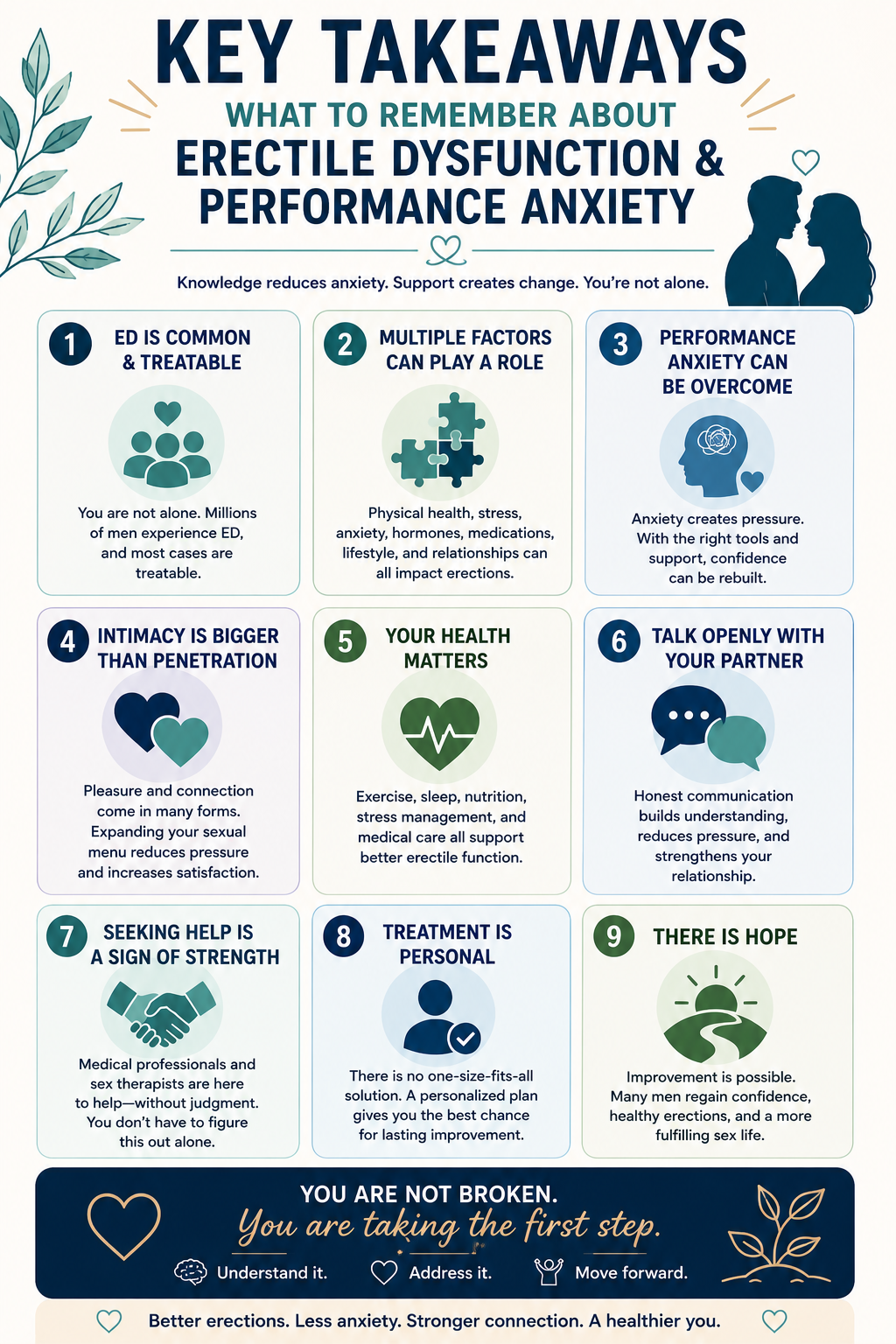
Next Steps If You're Ready for Help
If you've read this guide, chances are you've been looking for answers.
Maybe you've been struggling with erectile dysfunction for a few weeks.
Maybe performance anxiety has made intimacy feel stressful instead of enjoyable.
Or perhaps you've been carrying this concern for months—or even years—without telling anyone.
Wherever you are in your journey, know this:
You don't have to figure it out alone.
Erectile dysfunction is one of the most common sexual health concerns, and it is often highly treatable.
The first step isn't having all the answers.
The first step is asking for help.
Start With a Medical Evaluation
If your erectile dysfunction has been happening regularly or has lasted for several weeks or longer, schedule an appointment with a healthcare provider.
A medical evaluation can help identify:
Heart and blood vessel conditions.
Diabetes or prediabetes.
Hormone concerns.
Medication side effects.
Sleep disorders.
Neurological conditions.
Other medical factors that may be contributing.
Sometimes treating an underlying health condition leads to significant improvement in erectile function.
Don't Ignore the Emotional Side
Even when ED has a physical cause, the emotional impact is real.
Many people experience:
Performance anxiety.
Embarrassment.
Shame.
Loss of confidence.
Fear of intimacy.
Relationship stress.
These reactions are common, and they deserve attention.
Addressing the emotional side of ED is just as important as treating the physical symptoms.
Consider Working With a Sex Therapist
If anxiety, stress, trauma, or relationship concerns are contributing to your symptoms, working with a qualified sex therapist can make a meaningful difference.
Sex therapy can help you:
Understand what's contributing to your ED.
Reduce performance anxiety.
Rebuild sexual confidence.
Improve communication with your partner.
Expand intimacy beyond penetration.
Learn practical skills to enjoy sex with less pressure.
Therapy isn't about assigning blame.
It's about helping you build a healthier relationship with your body, your partner, and your sexuality.
Bring Your Partner Into the Process
If you're in a relationship, remember that erectile dysfunction is something you can navigate together.
Inviting your partner into the conversation can:
Reduce misunderstandings.
Strengthen emotional connection.
Lower performance pressure.
Create opportunities for teamwork.
Improve treatment outcomes.
You don't have to carry the burden alone.
Recovery Is Rarely About One Solution
There is no single treatment that works for everyone.
Many people experience the greatest improvement through a combination of approaches, such as:
Medical care.
Healthy lifestyle changes.
ED medication, when appropriate.
Sex therapy.
Couples therapy.
Mindfulness and relaxation techniques.
Sensate focus exercises.
EMDR when trauma or distressing experiences are contributing.
A personalized treatment plan is often the most effective approach.
Be Patient With Yourself
Healing takes time.
Some people notice improvements quickly.
For others, progress happens gradually.
Setbacks don't mean you're failing.
They simply mean you're learning, adjusting, and continuing forward.
Celebrate small victories, whether that's feeling less anxious, communicating more openly, or enjoying intimacy with less pressure.
Those moments are signs of real progress.
There Is Hope
One of the biggest myths about erectile dysfunction is that nothing can be done.
The truth is that most cases of ED can be improved with the right evaluation and treatment.
Whether your symptoms are related to a medical condition, performance anxiety, trauma, relationship challenges, or a combination of factors, there are evidence-based treatments that can help.
You deserve care that looks at the whole picture—not just the erection.
A Final Word
If there's one message to take away from this guide, let it be this:
You are not alone, and you are not broken.
Erectile dysfunction is a medical condition—not a personal failure.
Performance anxiety is a common human response—not a sign of weakness.
Asking for help is not giving up.
It's taking an important step toward better health, greater confidence, and more satisfying intimacy.
Whether your next step is scheduling an appointment with your healthcare provider, talking honestly with your partner, or reaching out to a sex therapist, every step forward matters.
Your sexual health is an important part of your overall well-being.
You deserve answers.
You deserve support.
And you deserve a relationship with your sexuality that is built on confidence, connection, and hope.
Thank you for taking the time to invest in your health by reading this guide.
I hope it has helped you better understand erectile dysfunction, performance anxiety, and the many effective treatments that are available.
Remember, healing is possible—and your next chapter can begin today.
If you are ready to start therapy book your first appointment here!
About the Author
Holly Nelson is a Licensed Professional Counselor (LPC) specializing in sex therapy, trauma recovery, and relationship health. She helps individuals and couples navigate concerns related to erectile dysfunction, performance anxiety, low libido, painful sex, orgasm difficulties, sexual trauma, intimacy, and relationship challenges.
Her approach combines evidence-based psychotherapy with compassionate, nonjudgmental care. Holly believes that sexual health is an essential part of overall well-being and that everyone deserves accurate information, effective treatment, and a safe place to discuss concerns that are often difficult to talk about.
Holly has advanced training in Eye Movement Desensitization and Reprocessing (EMDR), a psychotherapy approach used to treat trauma and other distressing experiences that may affect intimacy, confidence, and sexual functioning. She also incorporates evidence-based approaches including Cognitive Behavioral Therapy (CBT), Emotionally Focused Therapy (EFT), mindfulness-based interventions, sensate focus exercises, and trauma-informed care to help clients build healthier relationships with themselves and their partners.
Her clinical interests include:
Low libido and desire discrepancies
Men's sexual health
Women's sexual health
Orgasm difficulties
Relationship and couples therapy
LGBTQ+ affirming care
Sexual wellness across the lifespan
Holly is passionate about making sexual health education accessible, evidence-based, and free from shame. Through therapy, educational resources, podcasts, and social media, her goal is to help people better understand their bodies, strengthen their relationships, and experience greater confidence and connection.
Learn More
Website: https://www.theconnectionouch.com
Instagram: @sextherapywithholly
YouTube:@sextherapywithholly
This guide is intended for educational purposes only and should not replace individualized medical or mental health care. If you are experiencing persistent erectile dysfunction or other sexual health concerns, consult a qualified healthcare professional.
References
American Psychiatric Association. (2022). Diagnostic and Statistical Manual of Mental Disorders (5th ed., text rev.; DSM-5-TR). American Psychiatric Association.
American Urological Association. (2018). Erectile Dysfunction: AUA Guideline. (Current guideline with updates.)
Basson, R. (2001). Human sex-response cycles. Journal of Sex & Marital Therapy, 27(1), 33–43.
Brotto, L. A. (2013). Better Sex Through Mindfulness: How Women Can Cultivate Desire. Greystone Books.
Brotto, L. A., & Basson, R. (2014). Group mindfulness-based therapy significantly improves sexual desire in women. Behavior Research and Therapy, 57, 43–54. (Mindfulness principles applied broadly within sexual medicine.)
Burnett, A. L., Nehra, A., Breau, R. H., et al. (2018). Erectile Dysfunction: American Urological Association Guideline. The Journal of Urology, 200(3), 633–641.
Burnett, A. L., et al. (2024). Updates to the American Urological Association Guideline on Erectile Dysfunction. The Journal of Urology.
Centers for Disease Control and Prevention. (CDC). Sexual Health Resources. https://www.cdc.gov/sexual-health
Corona, G., Isidori, A. M., Aversa, A., et al. (2017). Endocrinologic control of men's sexual desire and arousal. Nature Reviews Urology.
Goldstein, I., Lue, T. F., Padma-Nathan, H., Rosen, R. C., Steers, W. D., & Wicker, P. A. (1998). Oral sildenafil in the treatment of erectile dysfunction. The New England Journal of Medicine, 338(20), 1397–1404.
Hackett, G. (2020). Guidelines for the management of erectile dysfunction. British Society for Sexual Medicine.
International Society for Sexual Medicine (ISSM). Clinical Practice Guidelines and Patient Resources.
Khera, M., Adaikan, G., Buvat, J., et al. (2016). Diagnosis and Treatment of Testosterone Deficiency. The Journal of Sexual Medicine.
Kloner, R. A. (2019). Erectile dysfunction and cardiovascular disease. International Journal of Impotence Research.
Levine, S. B. (2003). The nature of sexual desire. Journal of Sex & Marital Therapy.
Masters, W. H., & Johnson, V. E. (1970). Human Sexual Inadequacy. Little, Brown and Company.
McCabe, M. P., Sharlip, I. D., Atalla, E., et al. (2016). Definitions of Sexual Dysfunctions in Women and Men. The Journal of Sexual Medicine.
National Institutes of Health (NIH). National Institute of Diabetes and Digestive and Kidney Diseases (NIDDK). Erectile Dysfunction (Impotence). https://www.niddk.nih.gov
National Institutes of Health (NIH). National Heart, Lung, and Blood Institute. Heart Disease Risk Factors.
National Library of Medicine. MedlinePlus. Erectile Dysfunction.
Rosen, R. C., Cappelleri, J. C., Smith, M. D., Lipsky, J., & Peña, B. M. (1999). Development and evaluation of the International Index of Erectile Function (IIEF). Urology, 54(2), 346–351.
Shindel, A. W., & Parish, S. J. (2023). Management of erectile dysfunction. The Journal of Sexual Medicine.
Sipski, M. L., & Alexander, C. J. (1997). Sexual Function in People with Disability and Chronic Illness.
Society for Sex Therapy and Research (SSTAR). Clinical Resources.
Stanford University School of Medicine. Human Sexual Response Educational Resources.
World Association for Sexual Health (WAS). Declaration of Sexual Rights and educational resources.
World Health Organization. (WHO). Sexual Health Overview.
References for Trauma, Anxiety, and EMDR
American Psychological Association. Clinical Practice Guideline for the Treatment of PTSD.
Foa, E. B., Hembree, E., & Rothbaum, B. O. (2019). Prolonged Exposure Therapy for PTSD.
Shapiro, F. (2018). Eye Movement Desensitization and Reprocessing (EMDR) Therapy (3rd ed.). Guilford Press.
World Health Organization. (2013). Guidelines for the Management of Conditions Specifically Related to Stress.
References for Couples Therapy
Johnson, S. M. (2019). Attachment Theory in Practice.
Johnson, S. M. (2004). The Practice of Emotionally Focused Couple Therapy.
Wiebe, S. A., & Johnson, S. M. (2016). A review of the research in Emotionally Focused Therapy for couples. Family Process.